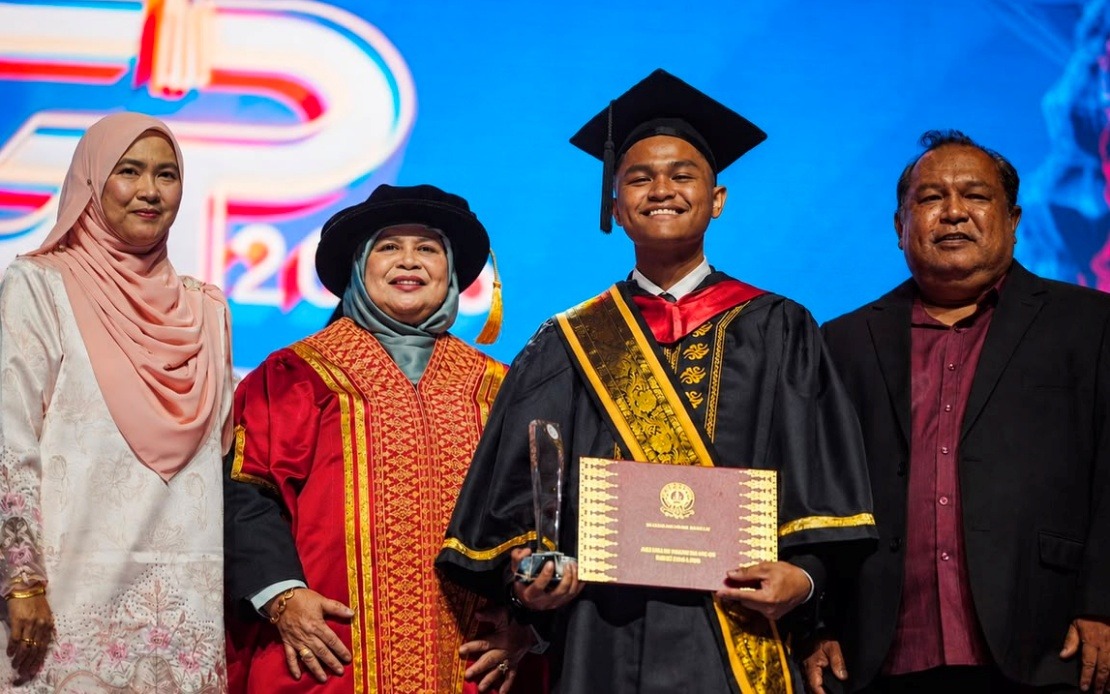
Muhammad Aaqif Dino Faezal's trajectory from MARA Science Junior College (MRSM) Tun Ghafar Baba in Melaka to the prestigious halls of Imperial College London illustrates the transformative potential of targeted educational sponsorship in developing Malaysia's future leaders and professionals. At just nineteen years old, the Selangor-born student has been honoured as the 2026 MARA College Graduate Icon, recognition that validates both his academic prowess and his broader contributions to institutional life. His forthcoming enrollment at Imperial College London to read Geology represents a milestone not only for his family but for Majlis Amanah Rakyat (MARA) as well, whose Young Talent Development Programme (YTP) provided the financial and educational scaffolding necessary for this achievement.
The significance of MARA's intervention in Aaqif's educational pathway becomes evident when examining the structural barriers that would have constrained his ambitions without institutional support. International education carries prohibitive costs, encompassing not merely tuition but also accommodation, living expenses, and the ancillary expenses that inevitably accompany tertiary study abroad. For many talented Malaysian students from middle-income households, these barriers remain insurmountable regardless of academic merit or potential. Aaqif's candid acknowledgment that he "would not have been able to afford the cost of studying and living abroad" underscores a critical reality: financial capacity often determines educational access more decisively than talent. By sponsoring his enrollment in the International Baccalaureate Diploma Programme (IBDP) at Kolej MARA Banting (KMB) from 2024 through May 2026, MARA addressed precisely this constraint, effectively unlocking pathways that would otherwise have remained closed.
The institutional ecosystem surrounding Aaqif's development reveals how comprehensive educational frameworks operate beyond the classroom. KMB's holistic approach—emphasizing not merely academic excellence but also leadership development, character building, and community engagement—shaped a student equipped to navigate international higher education with confidence. During his tenure at KMB, Aaqif achieved an exceptional 44 out of 45 points in the IBDP examination, a score that reflects sustained intellectual discipline and mastery of complex subject matter. Simultaneously, his election as president of the Students' Representative Council (MPP) and receipt of both the KMB Best Graduate Award and the Co-curricular Icon Award demonstrate his capacity to balance multiple responsibilities while maintaining institutional integrity.
Aaqif's selection as the 2026 MARA College Graduate Icon is not arbitrary recognition but rather an assessment based on rigorous criteria encompassing academic achievement, leadership qualities, societal contribution, and future potential as a MARA graduate icon. The selection process itself, drawing from among the Best Graduate Award recipients, establishes a competitive threshold that validates the distinction's significance. This recognition carries implications extending beyond personal achievement; it positions Aaqif as a representative exemplar of MARA's institutional mission and educational philosophy. The award thus functions as both personal validation and institutional affirmation, suggesting that his trajectory aligns with broader national objectives regarding talent development and international competitiveness.
Aaqif's prospective career trajectory in Geology carries particular relevance for Malaysia's strategic interests in the energy and extractive sectors. His explicit intention to leverage his Imperial College education to contribute to Malaysia's oil, gas, and energy industries reflects a mature understanding of how international qualification can be domesticated for national benefit. This orientation distinguishes his pursuit from purely individualistic aspirations; it positions his investment in elite international education as part of a broader compact between the scholar, the sponsoring institution, and the nation-state. For a country whose economy remains substantially dependent on hydrocarbon revenues and whose geological knowledge-base requires continuous sophisticated development, the cultivation of internationally-trained professionals in Geology and related disciplines represents strategic advantage.
The pedagogical environment at KMB clearly fostered capabilities extending well beyond subject mastery. KMB Director Arfaseela Amir's characterization of Aaqif's achievement emphasizes the college's aspiration to produce graduates who combine intellectual capability with strong character and interpersonal effectiveness. His role as Students' Representative Council president demonstrated his capacity to navigate institutional hierarchies while maintaining credibility with both management and student populations—a delicate balance requiring emotional intelligence and political acuity. These soft skills frequently determine success in international academic environments where students must function across cultural divides while managing heightened autonomy and complex peer relationships.
The pathway from MRSM to KMB to Imperial College London represents an intentionally structured progression through progressively more selective and international educational environments. This scaffolding approach—beginning with foundational scientific education at the MRSM level, advancing through internationally-recognized curriculum at KMB, and culminating in world-leading university instruction at Imperial—exemplifies strategic talent development. Each transition increases environmental complexity and international exposure, gradually acculturating students to operate effectively in genuinely cosmopolitan educational contexts. For Aaqif, this progression appears to have reinforced rather than destabilized his confidence and sense of purpose.
The emotional dimensionality of Aaqif's achievement, evident in his reflection that he was "deeply moved" upon receiving the award, suggests that recognition operates at multiple psychological registers. Beyond external validation, the honour prompted internal recalibration—a moment in which he consciously acknowledged the "challenges, sacrifices and support" that had enabled his trajectory. This capacity for reflective gratitude itself constitutes an important dimension of character development, particularly for students entering elite international institutions where arrogance and entitlement frequently undermine achievement. His explicit tribute to family, teachers, friends, and KMB reflects an understanding that individual accomplishment emerges from relational contexts and institutional frameworks rather than from isolated personal exertion.
For Malaysian educational policy more broadly, Aaqif's trajectory illustrates both the promise and the practical mechanisms through which targeted sponsorship can generate high-impact outcomes. MARA's Young Talent Development Programme demonstrates that strategic investment in students displaying both exceptional academic promise and character qualities can yield professionals positioned to operate at the highest international levels while maintaining commitment to national development priorities. The programme's emphasis on the International Baccalaureate curriculum—a globally recognized qualification providing direct pathways into leading universities—reflects sophisticated understanding of international educational architecture and credential hierarchies.
The recognition accorded to Aaqif also carries implications for peer institutions and prospective students throughout Malaysia's secondary and pre-tertiary education system. His achievement, widely publicized through MARA's institutional channels and Malaysian media coverage, communicates concrete evidence that pathways to international elite education do exist for talented Malaysian students, even those from non-wealthy backgrounds. This demonstration effect potentially encourages other capable students to aspire toward similar trajectories and to engage seriously with MARA's sponsorship opportunities. Conversely, it implicitly acknowledges that without such institutional support mechanisms, talent remains systematically underutilized and national human capital development suffers corresponding diminishment.
As Aaqif commences his degree in Geology at Imperial College London in September, his journey exemplifies both individual determination and the enabling power of institutional frameworks designed to cultivate excellence across multiple dimensions. His evolution from a MRSM student to MARA College Graduate Icon to Imperial College undergraduate reveals how structured educational pathways, combined with financial support and character development, can generate professionals equipped to operate at genuinely international levels while retaining orientation toward national contribution. For Malaysia, whose aspirations toward high-income status and technological sophistication depend substantially on human capital of precisely this calibre, Aaqif's trajectory represents an important template for how strategic educational investment yields compounding returns across individual, institutional, and national registers.

