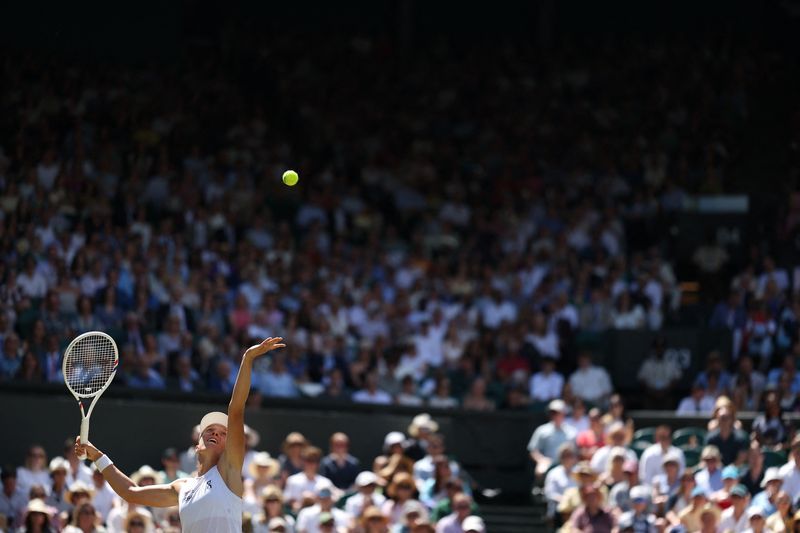
Rising Filipino tennis sensation Alexandra Eala delivered one of the tournament's most memorable upsets on Saturday, dismissing defending champion Iga Swiatek in straight sets at Wimbledon's hallowed Centre Court. The left-handed player from the Philippines claimed a commanding 7-6(9) 6-2 victory over the Polish third seed in a third-round encounter that showcased the dramatic shifts in momentum that define tennis at its highest level. The result marked a watershed moment for Eala, who has emerged as one of Asia's brightest prospects, while it ended Swiatek's bid to successfully defend her title at the All England Club.
Swiatek's defence of her Wimbledon crown unravelled under the relentless pressure applied by her opponent, particularly in the latter stages of the match. The Polish champion had arrived in London carrying the psychological burden of an early loss at the Bad Homburg warm-up event, an unexpected stumble that left questions lingering about her form and mental sharpness heading into the tournament. Her previous rounds had shown promise—solid victories over Taylor Townsend and Karolina Pliskova suggested she was finding her rhythm on the grass surface that has historically posed challenges for her clay-court dominance. Yet against Eala, Swiatek found herself outplayed in crucial moments, struggling to impose the control that has defined her career at the highest levels of professional tennis.
The opening set epitomised the competitive intensity of their clash, with neither player willing to concede ground easily. Both competitors displayed exceptional court positioning and baseline control, engaging in extended rallies that captivated the Centre Court crowd. The set went to a tie-break at 6-6, where Eala's nerve and aggressive shot-making ultimately proved decisive. Swiatek, despite showing glimpses of her technical brilliance, appeared unsettled by the electrifying atmosphere and the relentless quality of her opponent's play. The emotional toll of losing that first set became evident as Swiatek vented her frustration toward her coaching team in the stands and gestured dismissively at her equipment—visible signs of the mounting pressure she was experiencing.
Eala's transition into the second set demonstrated the growing confidence of a player seizing her moment on sport's grandest stage. The twenty-year-old accelerated her groundstroke tempo immediately, breaking Swiatek's serve twice in succession to establish a commanding 3-0 lead. Her powerful baseline shot-making, a defining feature of her technical arsenal, overwhelmed Swiatek during these crucial early games. The third seed attempted a recovery, retrieving one of the breaks to reduce the deficit, but Eala refused to yield, consolidating her advantage with another break to seal the set at 6-2. That dominant performance in the second set removed any lingering doubt about the legitimacy of her upset victory.
In the moments following her triumph, an emotionally overwhelmed Eala struggled to articulate the magnitude of her achievement. Speaking on Centre Court as the crowd continued to celebrate her victory, she reflected on her improbable journey from a young girl training after school in the Philippines with her brother and grandfather, wearing mismatched socks and light-up shoes, to competing against one of tennis's elite players. This narrative resonance—the contrast between her modest beginnings and her present glory—encapsulated the broader inspirational arc that transcends sport. Eala acknowledged the profound difference this victory represented for her career trajectory, conscious that such breakthroughs remain exceptional for athletes from emerging tennis nations in Southeast Asia.
Eala's emotional transparency during her on-court interview revealed the psychological investment she had made in the match. She candidly addressed the crowd, describing Centre Court as her dream venue and thanking supporters for the energy they had channelled toward her performance. This connection between player and audience, amplified by Eala's genuine passion and relatability, transformed the encounter from a mere sporting contest into a compelling human narrative. Her words—emphasising that she had worked tirelessly to reach this stage and that she recognised the opportunity as something to seize rather than squander—conveyed both humility and determination. Despite the emotion of the moment, Eala deliberately shifted focus toward the next challenge, signalling that satisfaction would not derail her quest to advance deeper into the tournament.
The history between these two competitors added another layer of intrigue to their third-round meeting. Swiatek had previously suffered a shock defeat to Eala at Miami, a loss that had surprised observers given Swiatek's dominance on the WTA tour. The Polish champion exacted revenge in their subsequent encounter on the clay courts of Madrid, suggesting a competitive equilibrium that masked underlying vulnerabilities. However, grass is a fundamentally different surface, rewarding aggressive baseline play and tactical variety in ways that clay often does not. Eala's power-hitting game appeared particularly well-suited to the faster court conditions, while Swiatek's typically devastating topspin and court positioning generated less pronounced advantages.
Swiatek's struggle on grass has been a recurring theme in her career narrative. Last year's Wimbledon triumph had seemed to finally silence critics who questioned whether the clay-court specialist possessed the adaptability to master tennis's fastest major surface. That breakthrough victory represented a maturation of her all-court game and suggested she had transcended the limitations that had previously constrained her on grass. The third-round loss to Eala, therefore, carries additional significance—it suggests that her Wimbledon success may have been a singular achievement rather than evidence of lasting versatility across all surfaces. Swiatek will need to conduct serious analysis of why her adaptation process has proven inconsistent from year to year.
Eala's advance to the fourth round pits her against 2024 runner-up Jasmine Paolini, the Italian seventh seed who reached last year's Wimbledon final. This pairing represents another significant test for the ascending Filipino star, against an opponent with recent Grand Slam final experience. Paolini's presence in another major final so quickly after her Wimbledon appearance last year demonstrates exceptional consistency at the highest level. However, Eala's demolition of Swiatek suggests she possesses the technical tools and mental resilience to compete against any opponent on her day. The trajectory of her tournament performance will provide valuable data regarding whether her victory over Swiatek was an exceptional outcome or evidence of her emergence as a sustained top-tier threat.
For Malaysian and broader Southeast Asian tennis followers, Eala's advancement holds particular resonance. The region has historically struggled to produce Grand Slam champions, with female representation at the highest levels remaining disappointingly sparse. Eala's aggressive, power-based game style and her willingness to compete fearlessly against more established rivals provide a template that younger players across Southeast Asia can reference. Her emotional articulation of the journey from modest circumstances to Centre Court glory creates an aspirational narrative that extends far beyond the tennis courts of Wimbledon. The implications for regional tennis development are substantial, as her success demonstrates that geographic and economic constraints need not ultimately determine professional achievement.
Swiatek's exit from the tournament will force a reassessment of grass-court preparation protocols and the broader question of surface adaptability that continues to vex elite players. The Polish champion had invested significant effort in transitioning her game to accommodate grass-court demands, yet a single defeat suggests that consistency on this surface remains elusive. For Swiatek, the focus must immediately shift toward understanding the technical and tactical adjustments required to prevent similar upsets in future grass-court seasons. Her coaching team will likely identify specific patterns in Eala's play that Swiatek struggled to counter, with particular attention to how the Filipino's aggressive groundstroke approach disrupted the Polish champion's rhythm and tactical flexibility.
The broader implications for tennis at Wimbledon extend to questions about competitive depth in women's tennis during the contemporary era. The emergence of players like Eala challenging established champions such as Swiatek suggests that the sport's talent pool continues to expand and diversify. While Swiatek remains a formidable competitor with multiple Grand Slam titles, her defeat demonstrates that no player remains impervious to upset at major tournaments. This dynamic—where rising talents can overcome established champions through aggressive, well-executed tennis—enhances the unpredictability and compelling narratives that define Grand Slam tournaments. For viewers across Malaysia and Southeast Asia, the Eala-Swiatek encounter provided compelling evidence that regional players can achieve extraordinary outcomes when they combine talent with unwavering determination.

