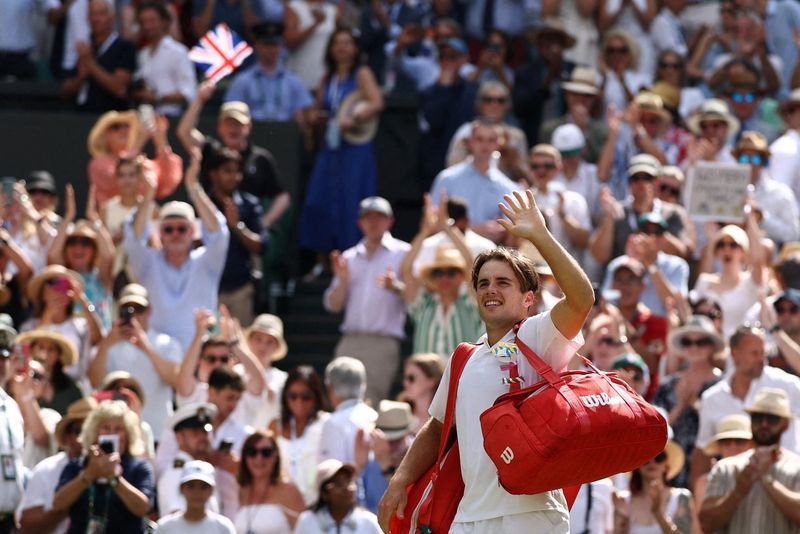
Arthur Fery's unexpected journey through Wimbledon this week has rewritten the script on what seemed destined to be a forgettable summer for the British hopeful. The 23-year-old, languishing at 114th in the world rankings, had resigned himself to watching the grass-court grand slam from the sidelines and was already planning a Mediterranean escape. Instead, his holiday plans crumbled with each successive victory as he navigated an increasingly improbable path through the draw, ultimately reaching the semi-finals before Alexander Zverev brought his extraordinary run to an end in straight sets on Friday.
Fery's rise through the Wimbledon bracket represents a watershed moment in men's tennis at the All England Club. By becoming the first wildcard in a quarter-century to reach the semi-finals, he has shattered the assumption that such invitations are merely consolation prizes for local players. The previous wildcard to achieve this feat in 1999 now stands as a distant historical reference point, making Fery's accomplishment genuinely remarkable in the modern era of professional tennis. Over eleven days in London's sweltering conditions, he dismantled five opponents in succession, each victory elevating the improbability of his continued presence on Centre Court.
The contrast between his pre-tournament expectations and actual results could hardly be starker. Fery had entered Wimbledon with only two previous victories across all major tournaments in his professional career, a statistic that underscores just how far he was from being considered a genuine threat at the sport's elite level. His Greek getaway with friends represented not an indulgence but rather a realistic assessment of how his time would be spent. One companion apparently harbored such little faith in his chances that he departed for Greece ahead of time, effectively betting against his childhood friend's success at the Championships. That the same friend returned within 48 hours to offer support speaks volumes about the gathering momentum of Fery's unexpected surge.
The national embrace that Fery has enjoyed throughout his fortnight at Wimbledon transcends typical sports fandom. Beyond the usual courtside crowds, he received a video message from England's World Cup football team, lending a cross-sport legitimacy to his achievement that few young tennis players experience. Perhaps most significantly, Queen Camilla and Princess Kate both attended matches to witness his performances, a level of royal patronage that underscores how thoroughly this narrative has captured the British imagination. For a player who had been invisible on the professional circuit merely weeks earlier, such attention represents not merely support but a form of collective national investment in his success.
The financial implications of Fery's semi-final appearance cannot be overlooked, particularly for a player operating at his previous ranking level. The £900,000 prize money he has already secured for reaching the last four provides immediate financial security and eliminates the constant struggle for funding that constrains many rising players. This windfall arrives at a critical juncture in his career development, removing the material anxieties that often derail promising young talent. Whether that Greek holiday resurfaces as an upgraded excursion or remains deferred depends on Fery's appetite for continued competition immediately following his Wimbledon exertions.
His ranking trajectory following this tournament promises to accelerate his entry into tennis's upper echelon. Projections place him in the mid-30s, a leap that fundamentally alters the landscape of opportunities available to him on the professional circuit. Fery himself recognizes this seismic shift, framing his immediate future in terms of expanded access to tour events and a full year or more of consistent inclusion in the calendar's most prestigious tournaments. This access, taken for granted by top-ranked players, represents the golden ticket that Fery has been desperately pursuing throughout his early career.
Yet Fery's candid reflection on the psychological challenges ahead demonstrates emotional maturity beyond his years. He explicitly acknowledges that the transition from anonymous journeyman to rising star carries profound mental burdens. The expectations that will now envelope his career, emanating simultaneously from himself, the British public, tournament organizers, and the broader tennis community, constitute a fundamentally different pressure environment from the relative anonymity of his previous existence. He recognizes these upcoming challenges not as obstacles but as integral aspects of the growth he seeks, framing his psychological adjustment as part of his ongoing development as a competitor.
Fery's stated intentions for the immediate future reveal a player balancing ambition with self-awareness. His explicit acknowledgment that he requires time to decompress and process the extraordinary events of the past two weeks suggests he understands that rushing back into competition without recovery could prove counterproductive. Rather than chasing momentum while riding the Wimbledon wave, he is articulating a measured approach that respects both his physical and mental needs. This prudent temperament contrasts sharply with the desperation that sometimes grips young players when fortune finally smiles upon them.
The U.S. hardcourt season looms as the next testing ground for Fery's elevated status. His maiden appearance at Flushing Meadows, once a distant aspiration, now represents an immediate and realistic objective. The transition from grass to hard courts will provide valuable data about the transferability of his current form, while the American swing itself offers opportunity for continued development against the tour's highest-ranked competitors. For Malaysian and Southeast Asian tennis followers, Fery's trajectory offers an instructive reminder that grand slam breakthroughs, while statistically improbable, remain achievable through the combination of opportunity, preparation, and the indefinable element of belief.
Fery's story ultimately transcends tennis as a mere sporting narrative. It exemplifies how institutional support through a wildcard invitation, when met with competitive execution and mental resilience, can transform a career trajectory within the space of a fortnight. His Greek holiday may yet materialize, but it will do so as a celebration of achievement rather than an escape from obscurity. The question now becomes whether Fery can sustain this momentum over the long term, converting a fairytale fortnight into the foundation of a genuine grand slam career.

