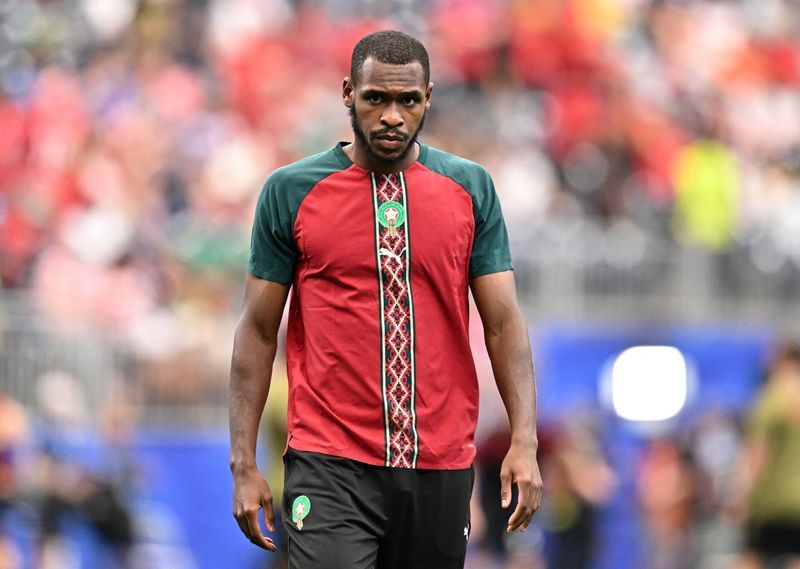
The narrative surrounding Moroccan centre-back Issa Diop reads like sporting fiction—a player who spent years rejecting overtures from his motherland and Senegal, insisting his allegiance lay exclusively with France, now finds himself tasked with neutralising one of the world's most devastating attacking talents from that very nation. In a World Cup quarter-final on Thursday, Diop must marshal Morocco's defence against Kylian Mbappé, a turn of events that injects compelling human drama into what would otherwise be a standard knockout encounter.
The 29-year-old's journey to this point encapsulates the complex realities of modern international football, where heritage, birthplace, and personal conviction intersect with sporting ambition. Born in Toulouse to a Senegalese father and Moroccan mother, Diop carried credentials that made him attractive to multiple nations. His paternal grandfather coached Senegal's national team during its formative years, establishing a historical connection to West African football. Yet Diop consistently spurned these opportunities, viewing them as second choices rather than genuine calling.
During his tenure with France's Under-21 programme seven years prior, Diop articulated his position with striking clarity during an interview with Canal Plus, declaring unequivocally that France had shaped his identity and trajectory. He dismissed the prospect of representing another nation merely because he had failed to secure senior selection as hypocritical and opportunistic. These words, spoken with apparent conviction, resonated across social media platforms at the time, establishing Diop as a player seemingly committed to pursuing his French ambitions regardless of obstacles.
Yet in March of this year, Diop announced his decision to commit internationally to Morocco, a reversal that provoked considerable online backlash and accusations of inconsistency. The timing proved strategic—Morocco sought defensive reinforcement before the World Cup commenced, particularly following the departure of experienced captain Romain Saiss after the Africa Cup of Nations in January and the injury to Nayef Aguerd in March. Coach Mohamed Ouahbi identified Diop as a solution to these defensive shortages, and the player ultimately accepted the opportunity.
Ouahbi's assessment of Diop during recruitment reveals how the coaching staff navigated past statements and shifting loyalties. The Moroccan manager observed a player genuinely committed to embracing Moroccan culture and identity beyond the footballing sphere, someone who maintained frequent connections to the nation and lived according to Moroccan values. Rather than dwelling extensively on previous declarations, Ouahbi emphasized that competitive performance and professional attitude mattered most. This pragmatic outlook enabled Morocco to integrate Diop without exhausting energy on historical grievances.
Diop made his Moroccan debut in March during a friendly encounter against Ecuador, subsequently establishing himself as first-choice central defender alongside Crystal Palace's Chadi Riad. His eight-season tenure in the English Premier League with West Ham United and Fulham provided extensive high-level experience that enhanced Morocco's defensive architecture. The player transitioned smoothly into his new continental role, adapting to tactical requirements and building defensive chemistry with his new partner.
However, Diop's true vindication arrived spectacularly during Morocco's Round of 32 encounter against the Netherlands. In the final minute of stoppage time, with the match locked at 2-2 and regulation time expiring, Diop powered home a header from Chemsdine Talbi's cross to force extra time. Morocco subsequently prevailed on penalties, advancing to face France. Describing the moment with characteristic understatement, Diop noted he had ventured forward seeking space late in the match, the ball arriving at his feet through fortune and positioning combined.
That equaliser fundamentally altered perceptions of Diop's commitment to Morocco. Supporters who initially questioned his sincerity witnessed a player delivering decisive contributions in pressure scenarios. The dramatic nature of his intervention—a defender scoring an injury-time equaliser to rescue his team—transcended the previous controversy surrounding his nationality switch. Moroccan fans embraced him not despite his journey but arguably because of it, viewing his goal as evidence of genuine dedication to his adopted national team.
The prospect of facing France's Mbappé, one of the tournament's most prolific and dynamic attackers, presents an entirely different defensive challenge. Mbappé's pace, technical proficiency, and positioning intelligence have dismantled defences throughout the competition. Diop must concentrate entirely on marshalling his backline, deploying the tactical discipline and positional awareness accumulated through Premier League seasons. There exists no room for lingering psychological conflict or distraction—Morocco's semi-final aspirations depend upon Diop performing his defensive responsibilities with complete focus.
Morocco seeks to replicate its previous World Cup performance, having reached the semi-finals at the 2022 tournament held in Qatar. That historical achievement demonstrated the nation's capacity to compete against elite football nations. Thursday's encounter against France offers opportunity to advance further, potentially into the final itself. Diop's role extends beyond individual defensive contribution; his presence symbolises Morocco's willingness to deploy talent wherever available, regardless of complicating narrative elements.
The irony that Diop must contain the very nation whose colours he previously coveted intensifies the subplot surrounding this quarter-final. Yet the player himself appears focused on the immediate footballing task rather than the historical paradox. His Premier League experience suggests familiarity with high-pressure defensive assignments against creative attacking talent. Whether he can successfully neutralise Mbappé will partially determine whether Morocco achieves another semi-final appearance—and whether Diop's World Cup transformation proves complete.

