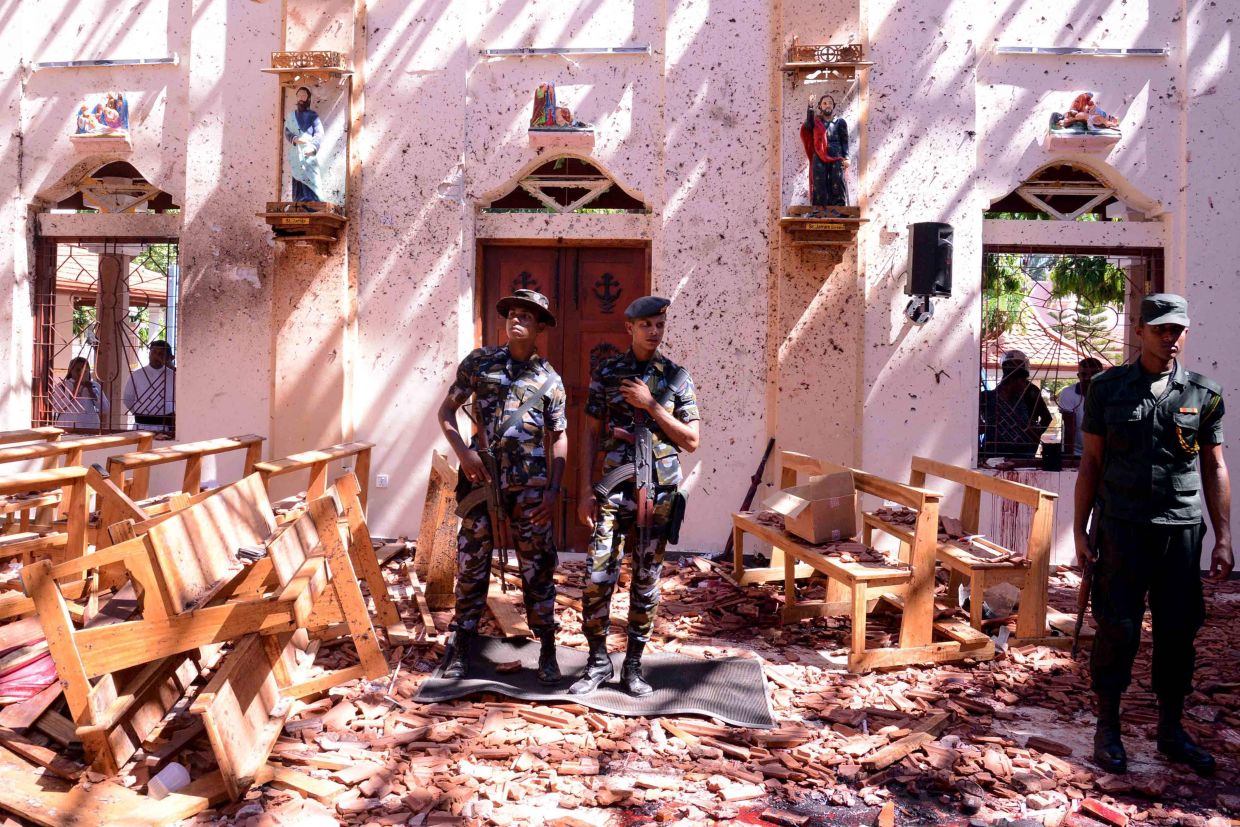
A decorated military officer who once lectured the Pentagon and United Nations on combating terrorism now finds himself imprisoned under the very anti-terrorism laws he spent his career defending. Suresh Sallay, a retired major general and former head of Sri Lanka's State Intelligence Service, was arrested in February and accused by the government of directing the deadliest civilian attacks in the nation's history. The allegation marks a stunning inversion of the official story surrounding the Easter bombings of April 21, 2019, which claimed 279 lives and injured over 500 more across luxury hotels and churches in coordinated suicide attacks.
The transformation of Sallay's status from decorated security expert to alleged mastermind reveals the turbulent political currents running beneath Sri Lanka's counterterrorism narrative. Sallay has consistently denied wrongdoing and remains uncharged despite months of detention, with court proceedings continuing into July. The case exemplifies how security crises can become entangled with political ambitions, and how official accounts of traumatic national events can undergo radical reinterpretation as new actors gain investigative control.
Official investigations initially blamed the attacks on seven Sunni Muslim suicide bombers acting under Islamic State inspiration. However, as evidence accumulated, questions emerged about the curious failure of intelligence services to act despite clear warnings from Indian counterparts in the weeks preceding the bombings. Rather than concentrating on systemic intelligence failures, investigators began tracing connections between the bombers and multiple state security agencies, ultimately proposing a fundamentally different explanation: that the attacks were deliberately cultivated and allowed to proceed as part of a calculated political operation.
Public Security Minister Ananda Wijepala provided the most explicit official accusation against Sallay when he told parliament in June that the retired general was the "mastermind" who "conspired with and strategically directed Islamic extremists until they carried out the attacks." According to Wijepala, Sallay met with Muslim men just three weeks before the bombings to gather tactical information about potential targets. This alleged coordination between a senior intelligence officer and the attack network forms the foundation of the government's revised narrative, suggesting that rather than representing an intelligence failure, the bombings were themselves an intelligence operation.
The motivations allegedly underlying this operation reveal the deep intersection of security concerns and political calculation. Investigators have suggested to the court that the supposed plot aimed to generate sufficient chaos and fear to position Gotabaya Rajapaksa, who won the presidency in November 2019, as the singular leader capable of protecting the nation from extremist threats. This narrative mirrors Rajapaksa's earlier triumphant positioning after his military campaign against Tamil rebels concluded a bitter civil war in 2009. Critics contend that a deliberate intelligence network was constructed not primarily to gather information on actual threats, but to manufacture a demonstrable enemy against which only the ruling political dynasty could effectively stand.
This interpretation gained credibility following a 2023 Channel 4 investigation based on whistleblower testimony. The report alleged that permitting the Easter attacks to proceed represented a deliberate strategy to generate the security crisis that would sweep Rajapaksa to electoral victory on a hardline platform. Observers note that the timing proved remarkably convenient: the attacks occurred less than eight months before the presidential election, providing the incumbent government precisely the domestic security emergency needed to justify expanded authoritarian powers and portraying opposition to such measures as dangerously naive.
Historical context adds weight to such concerns. Rajapaksa administrations have previously acknowledged that Sri Lankan state security forces cultivated and funded jihadist militants during the country's civil war from 1983 to 2009, ostensibly to gather intelligence on Tamil separatists. However, officials have consistently maintained that these militants subsequently betrayed their handlers and initiated the Easter attacks independently. This history of state cultivation of extremist networks creates a documented pattern upon which allegations of deliberate attack facilitation become more plausible rather than far-fetched, though it remains unproven.
Sallay's own profile complicates the narrative of a villainous conspirator. Born into Sri Lanka's Muslim minority, which comprises roughly 10 percent of the population, he married a Buddhist woman while maintaining familial connections to Catholicism through his mother, who has appealed to the Pope for his release. His career trajectory reflected cosmopolitan engagement with international security frameworks, including studies at India's National Defence College and Britain's University of Bradford, alongside military attaché postings in France and Malaysia. In 2003, he presented to the Pentagon on suicide terrorism, while his 2023 United Nations address emphasised the dangers of social media in radicalising vulnerable populations.
Yet Sallay's career under the Rajapaksas illuminates the vulnerabilities of security practitioners to political instrumentalisation. He became the first military officer appointed to head the State Intelligence Service, following Gotabaya Rajapaksa's 2019 election victory—a position that placed him at the intersection of national security and executive power. His detention of Muslim human rights lawyer Hejaaz Hizbullah in 2020, whom Sallay accused of masterminding the Easter attacks, provides an ironic precedent. Hizbullah was released after 22 months when authorities proved unable to construct a credible evidentiary case, a development that may now presage Sallay's own fate.
The implications for Malaysian and regional observers are significant. The Easter bombing investigation demonstrates how security apparatus can become politicised in ways that corrupt both truth-seeking and legitimate counterterrorism. The possibility that a senior intelligence officer orchestrated devastating attacks to engineer electoral advantage raises uncomfortable questions about the integrity of security institutions across South and Southeast Asia, where civil-military relations remain contested terrain. The case also underscores the vulnerability of religious minorities when security narratives become weaponised for political purposes.
Moreover, the investigation's shift from conventional counterterrorism toward deep-state conspiracy reflects broader scepticism about official security accounts in the region. As citizens across Southeast Asia have witnessed security forces blamed for intelligence failures that subsequently appear more deliberately orchestrated than negligent, public confidence in institutional explanations has eroded. The Sallay case exemplifies this phenomenon: the very officer credited with expertise in preventing extremism now stands accused of channelling it for political gain.
As Sallay awaits his next court hearing, the Easter bombing investigation remains suspended between competing narratives. Whether courts will establish sufficient evidence to transform accusations into conviction remains uncertain, but the very existence of these allegations reflects how profoundly Sri Lanka's understanding of its recent security history has been rewritten. The case ultimately illustrates the capacity of political transitions to reinterpret the same events through radically different interpretative frameworks, a phenomenon with sobering implications for truth and accountability across the region.

