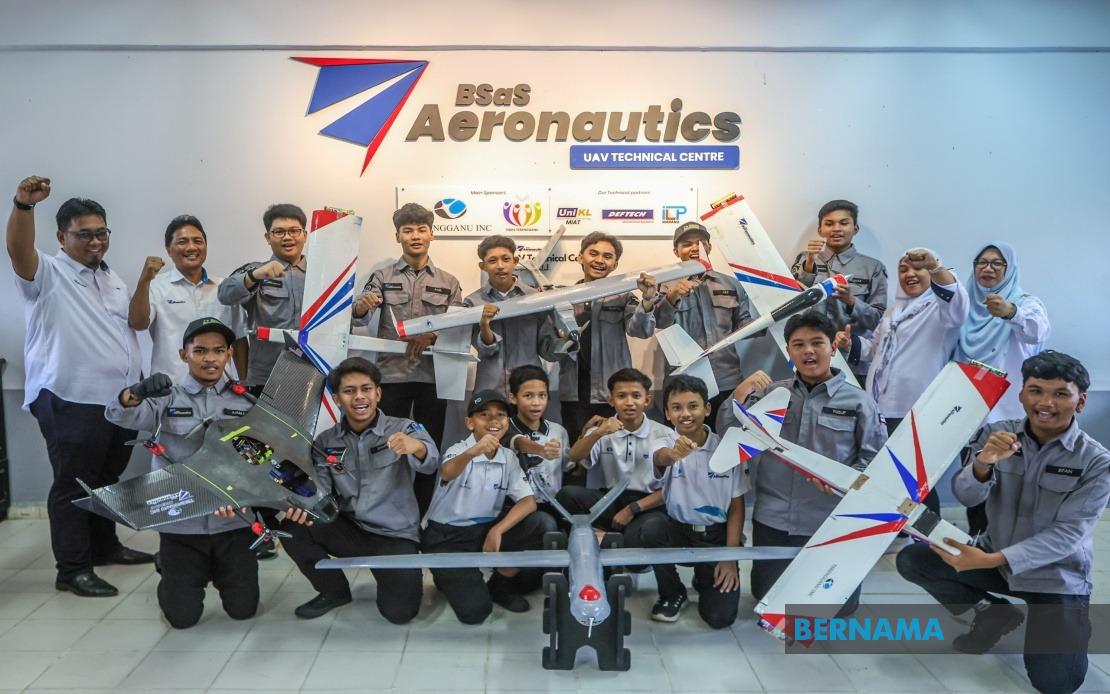
In Marang, Terengganu, a quiet revolution in technical education is unfolding at SMK Bukit Sawa, where students are constructing sophisticated unmanned aerial vehicles rather than merely studying aircraft design in textbooks. The driving force behind this initiative is Badrul Hisyam Zakaria, an English teacher whose passion for remote-controlled aviation has evolved into a comprehensive educational programme that engages 35 students in hands-on aeronautical engineering.
Launched in 2023 through the TI-BSAS UAV In School programme, this venture represents a deliberate strategy to build technical capacity within Malaysia's youth, particularly in the East Coast. The initiative has already yielded tangible results, with more than five fully functional UAVs constructed to meet professional aircraft specifications. Each vehicle carries a price tag between RM6,000 and RM10,000, reflecting the sophisticated engineering standards being taught at secondary level. The funding backbone comes primarily from Terengganu Incorporated Sdn Bhd, which has committed RM75,000 in corporate social responsibility support since the programme's inception.
What distinguishes this effort from typical school projects is its commitment to industrial-grade methodology. Badrul Hisyam emphasises that students employ identical techniques and materials to those utilised by aerospace professionals, though scaled appropriately for educational purposes. The current generation of UAVs relies on Global Positioning System technology for autonomous target detection and navigation. However, the programme is advancing rapidly toward more sophisticated capabilities—the next phase involves integrating artificial intelligence systems that can visually identify and track targets without pre-programmed coordinates, representing a significant leap in autonomy and capability.
The programme's credibility was substantially enhanced when SMK Bukit Sawa claimed the championship title in the UAV Avionics Integration Challenge at the MyAERO Challenge 2026 competition held at MAEPS in Serdang, Selangor, last June. This victory against secondary schools nationwide demonstrates that despite operating in a smaller town with fewer traditional advantages, the Terengganu school is producing results comparable to better-resourced competitors. The recognition validates both the teaching methodology and the dedication of participating students.
Evidence of the programme's downstream impact is already materialising. Two former SMK Bukit Sawa students who participated in the UAV initiative are now enrolled in aircraft engineering programmes at Universiti Kuala Lumpur, while three others have progressed to science-stream matriculation studies. These educational trajectories suggest that exposure to hands-on aerospace projects at secondary level meaningfully influences post-secondary choices and career aspirations. Badrul Hisyam projects that within three to four years, the first programme participants will graduate as certified aircraft engineers, a pipeline that reflects deliberate long-term planning rather than short-term publicity.
Beyond individual student outcomes, the programme addresses a structural concern within Malaysia's aerospace ecosystem. Currently, the nation relies significantly on imported UAV technology and expertise, creating dependency relationships that constrain local innovation and economic sovereignty. The TI-BSAS initiative is explicitly designed to nurture homegrown capacity to design, develop, and manufacture UAV systems domestically. By cultivating technical expertise among secondary students and shepherding them toward aviation careers, the programme attempts to establish foundations for a more self-sufficient industrial capability.
The socioeconomic dimension merits attention, particularly Terengganu Incorporated's explicit focus on B40 category students—those in the bottom 40 percent of household income distribution. Technical skills in high-demand aerospace fields typically command premium salaries and offer pathways to middle-class employment. By targeting economically disadvantaged youth, the programme functions simultaneously as skills development and social mobility mechanism. This targeting reflects a recognition that technological opportunity is not naturally distributed across income groups without deliberate intervention.
Terengganu Incorporated's financial commitment provides concrete evidence of private sector engagement with education infrastructure beyond conventional sponsorships. The company's RM45,000 initial contribution in 2023 was followed by an additional RM30,000 commitment in 2026, demonstrating sustained rather than opportunistic support. This phased investment approach aligns with the programme's own strategic timeline, suggesting coordination between corporate partner and educational institution around mutually reinforcing objectives.
The partnership between SMK Bukit Sawa, the Terengganu State Education Department, and multiple companies illustrates how public-private collaboration can enhance technical education quality. Individual teachers like Badrul Hisyam may harbour passion for their subject, but institutional capacity—funding, access to industry expertise, curriculum flexibility, parental acceptance of non-traditional projects—requires organisational alignment. The programme's success reflects this ecosystem cooperation rather than isolated enthusiasm.
For Malaysian education policy, this initiative raises questions about scaling. If 35 students at a single school can produce competitive UAVs and secure university placements in related fields, what would be required to replicate this model across Terengganu or nationwide? Resource constraints obviously limit rapid expansion, but the programme demonstrates feasibility. Secondary schools in other states might pursue similar aerospace or robotics initiatives, particularly in regions with relevant industries or institutions. The challenge lies in identifying or creating comparable private sector partners willing to sustain multi-year commitments.
The timing also reflects Malaysia's broader technology ambitions. As the nation seeks to transition toward higher-value manufacturing and knowledge-intensive sectors, grassroots programmes that embed technical capability within youth education become strategically important. The aviation industry specifically represents a potential growth corridor, particularly if domestic UAV capability attracts manufacturing investment or regional research activities. SMK Bukit Sawa students are essentially being positioned as the foundation for more ambitious aerospace ambitions.
Looking forward, the critical metric will be whether early successes translate into sustained pathways. Two university-enrolled former students and three matriculation participants represent encouraging early indicators, but sample sizes remain small. The true test emerges over the next five years when larger cohorts complete their secondary education and either pursue aviation-related tertiary study or enter the workforce. If employment outcomes match educational inputs, the programme will have proven both educationally sound and economically productive—a rare combination that might justify replication elsewhere in Malaysia.

