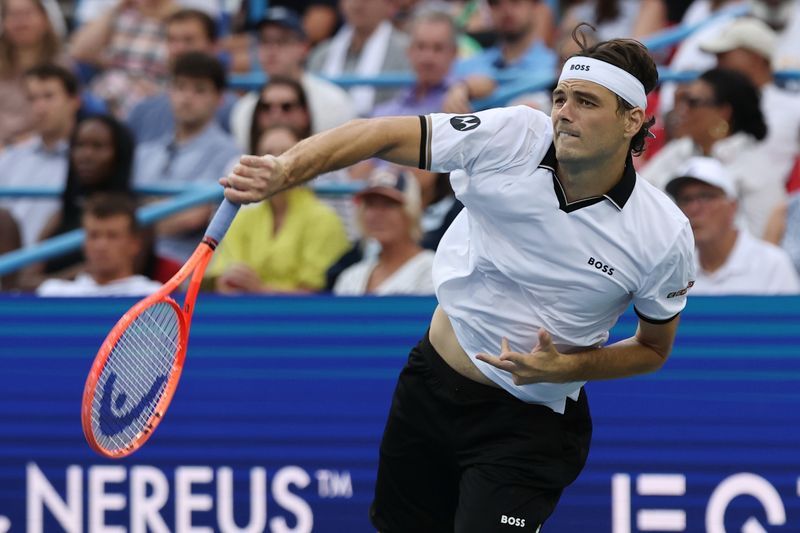
Taylor Fritz has secured a spot in the Washington Open final, where he will face Rafael Jodar after dismantling fellow American Brandon Nakashima in straight sets on Saturday. The world number 10 prevailed 6-3 3-6 6-2 in a semifinal match that showcased the 28-year-old's ability to weather competitive pressure and regain momentum when it mattered most. The victory marks Fritz's 23rd appearance in an ATP final and represents his continued surge towards becoming a consistent title contender on the professional tennis circuit.
The opening set belonged entirely to Fritz, who methodically built pressure through his service game and aggressive stroke play. After establishing a 4-3 advantage, he engineered the critical break that effectively decided the first frame, subsequently serving out cleanly in 34 minutes. His efficiency from the baseline was evident in his statistical profile: 13 aces, 24 winners, and a relatively controlled 16 unforced errors demonstrated the kind of disciplined, aggressive play that the American is increasingly known for at the highest levels of competition. For Nakashima, who harboured hopes of reaching his maiden ATP 500 final, the opening set proved instructive but ultimately demoralising.
Nakashima's response in the second set showed the competitive mettle and resilience that has defined his development as a rising American prospect. Breaking Fritz at 1-2, the younger player built his lead methodically, securing a commanding 5-2 advantage before closing the set two games later to force a decisive third frame. The 23-year-old committed 27 unforced errors across the match—11 more than his opponent—a differential that would ultimately prove costly. Nevertheless, his ability to seize the moment when Fritz became temporarily vulnerable illustrated why Nakashima continues to be regarded as a long-term fixture in American tennis.
The third set proved where Fritz's experience and mental fortitude separated the competitors. Immediately asserting dominance, he broke Nakashima in the second game and followed with a service hold to love, establishing an insurmountable 3-0 lead. From that juncture, the match's outcome was merely a formality. Fritz maintained his intensity and composure, systematically closing out the encounter to book his final berth. His post-match commentary reflected an athlete acutely aware of the fine margins that decide professional tennis encounters. "Grabbing that break in the third set made the difference," Fritz explained, emphasising how narrow the match had remained throughout. "It was really a narrow margin the whole time. Not a lot of chances either way."
Fritz's path to the final follows an intriguing narrative arc for American tennis. Once considered a prospect with substantial potential but inconsistent execution, the 28-year-old has matured into a player capable of maintaining standards across five-set matches and high-pressure moments. His Washington semifinal victory came against domestic competition, adding context to American tennis's depth at the professional level. The two countrywomen's advancement—or in this case, countrymen—in major tournaments remains a point of national pride and tactical interest for coaches and federations assessing talent development systems.
Meanwhile, Spain's Rafael Jodar delivered a performance that crystallised his meteoric ascent through professional tennis ranks. The 19-year-old recovered from a set down to eliminate Chile's Alejandro Tabilo 6-7(6) 6-4 6-4 in the second semifinal, reaching only his second ATP final ever. The psychological dimensions of Jodar's comeback proved particularly instructive: having accumulated multiple break opportunities in the opening set and early stages of the second without converting, the young Spaniard demonstrated the mental resilience required at tennis's elite level. "Accepting all the moments that I didn't break in the first set and the beginning of the second set, accepting those moments helped me get the break in the second set," Jodar reflected, articulating a philosophical approach to competitive adversity that distinguishes developing champions from journeymen professionals.
Jodar's recent trajectory represents one of professional tennis's most compelling narratives. Merely five months prior, in March at Indian Wells, Tabilo had dismantled the teenager 6-1 6-2, a scoreline suggesting vast experience and skill differentials. At that juncture, Jodar remained outside the top 100, a ranking position suggesting he occupied the margins of professional acceptability. However, an extraordinary run during the European clay season, culminating in his maiden ATP title victory at the Grand Prix Hassan II in Morocco, fundamentally altered perceptions of his ceiling as a competitor. The Washington Open semifinal victory represents further validation of that trajectory.
Jodar's ascent carries particular significance for Spanish tennis and the broader European competitive landscape. Young players reaching top-20 rankings remain relatively rare, yet the teenager's combination of technical proficiency, mental fortitude, and competitive intelligence suggests he possesses the foundational attributes necessary for sustained success. Following his Washington performance, Jodar will formally enter the world's top 20 when rankings are released on Monday—a milestone that typically heralds greater tournament invitations, higher-profile draw placements, and increased sponsorship opportunities. For Malaysian and Southeast Asian observers, the teenager's progress offers instructive lessons regarding talent development timescales and the importance of sustained investment in competitive infrastructure.
The Washington Open final pits two distinct player archetypes against each other. Fritz represents the established American professional entering his athletic prime, armed with refinement born through accumulated competition and coaching wisdom. Jodar embodies the next generation—technically accomplished, mentally resilient, and capable of executing at the sport's highest levels despite limited professional experience. Their final encounter will test whether Fritz's veteran steadiness can withstand Jodar's fearless, attacking tennis, or whether the teenager's ascendant trajectory continues unabated. The outcome will carry implications not merely for Washington title honours, but for how professional tennis's power structures continue evolving in 2024 and beyond.

