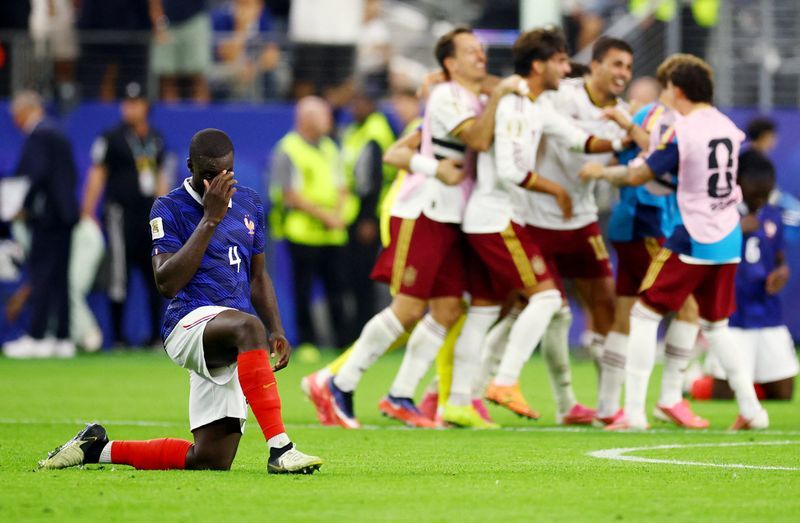
France's World Cup aspirations crumbled spectacularly in Arlington, Texas on Tuesday evening, with Spain's clinical 2-0 semi-final victory serving as a sobering reminder that tournament credentials cannot be assumed merely on reputation. The defending champions, installed as favourites despite concerns over their squad depth, encountered their most serious test and failed decisively when it mattered most. Coach Didier Deschamps acknowledged the fundamental gap between expectation and execution, conceding that France had been "second best" in every meaningful measure, a technical inferiority that no amount of character or resilience could overcome.
The contrast with France's 2022 World Cup final appearance against Argentina proved instructive. In that dramatic encounter in Qatar, the French team had similarly struggled during the opening period yet demonstrated the mental fortitude and attacking capacity to claw back into contention, ultimately losing only through the cruelest format of football's decisive moments. Tuesday offered no such redemptive narrative. Instead, Spain dismantled France's carefully constructed tactical framework with methodical precision, exposing weaknesses that observers had either overlooked or underestimated during the tournament's earlier rounds. The gulf in execution between the two teams suggested a fundamental misalignment in how the pre-match analysis had weighted each side's strengths and vulnerabilities.
Michael Olise's performance encapsulated France's broader midfield crisis. The playmaker, celebrated as a virtuoso capable of unlocking defensive structures through moments of individual brilliance, found himself completely neutralised by Rodri's commanding presence in Spain's engine room. Operating in an unfamiliar environment devoid of space and creative freedom, Olise surrendered possession twenty times across the ninety minutes whilst failing to complete a single dribble—a statistical indictment of a player France had relied upon to provide the creative spark their attack desperately required. Rodri, conversely, glided through proceedings with the authority of a midfielder comprehending every spatial advantage, dictating the rhythm and controlling the tempo with a sophistication that rendered France's pressing strategy ineffective.
France's attacking personnel, traditionally the squad's greatest strength, evaporated when confronted with Spanish defensive discipline. Ousmane Dembele offered minimal penetration despite his reputation for directness, whilst Bradley Barcola and his replacement Desire Doue proved equally ineffectual. Even Kylian Mbappe, the tournament's most dynamic and feared offensive weapon, found no moment of individual wizardry to shift the match's trajectory. The irony proved particularly poignant when the afternoon's loudest roar emanated not from French attacking prowess but from the appearance of David and Victoria Beckham on the stadium screen—a momentary distraction that symbolised France's inability to maintain audience engagement through their customary offensive dominance.
The structural breakdown began in midfield, where Deschamps' double pivot disintegrated under sustained Spanish pressure. Adrien Rabiot's early yellow card fundamentally altered his approach, forcing the midfielder to withdraw into a more conservative posture that stripped his typically aggressive engagement of any potency. Aurelien Tchouameni, still regaining rhythm following a two-match absence caused by hamstring concerns, lacked the positional awareness and lateral mobility required to shadow Spain's movement. This midfield vulnerability created cascading defensive problems, leaving the back line exposed to systematic Spanish exploitation that yielded two distinct defensive lapses.
Spain's opening goal arrived through a penalty converted by Mikel Oyarzabal in the twenty-second minute, a relatively straightforward conversion that nonetheless exemplified how France's defensive structure had become porous. Pedro Porro added a second goal approaching the hour mark, effectively concluding the contest as a genuine competition. The scoreline, whilst seemingly narrow on the surface, failed to reflect the comprehensive nature of Spain's dominance. France rarely threatened their opponents, instead operating largely in a reactive capacity, scrambling to contain sustained Spanish pressure rather than generating offensive sequences of their own.
Spain's assertiveness reflected the confidence emanating from teenage sensation Lamine Yamal, who had declared pre-match that France, rather than his Spanish team, ought to harbour fear about the encounter. Yamal's swagger proved vindicated through his squad's execution, demonstrating that psychological preparation and technical understanding mattered at least as significantly as reputation and historical precedent. The Spanish approach to controlling tempo—deliberately slowing the match to negate France's preferred rhythm—represented a strategic comprehension that France's preparation had apparently failed to adequately address. Rayan Cherki, France's second-half substitute, acknowledged this tactical miscalculation, noting that France recognised Spain's temporal control but proved unable to implement effective counter-measures.
The post-match scenes captured the devastation pervading the French camp with unusual starkness. Mbappe remained isolated on the pitch whilst his teammates either collapsed to their knees or buried their faces in their hands—visceral expressions of a squad confronting the unexpected reality of elimination. All the pre-match rhetoric regarding group cohesion and collective unity suddenly appeared hollow and disconnected from the events that unfolded on the Arlington pitch. For Malaysian and Southeast Asian observers, the lesson extended beyond tactical analysis: even well-resourced, historically successful squads cannot navigate tournament football through reputation alone, and the absence of psychological preparation for genuine adversity proved catastrophic when confronted with a team executing their strategic blueprint flawlessly.
France's exit removes one of the tournament's marquee narratives and raises significant questions about team construction and preparation heading into future competitions. The collapse of a supposed favourite against a determined challenger mirrors patterns observable across various tournament formats, suggesting that depth, versatility, and adaptability increasingly outweigh individual stardom in determining success. For French football officials and supporters alike, the semi-final defeat will necessitate comprehensive examination of selection decisions, tactical preparation, and squad balance—particularly regarding the integration of creative players like Olise into balanced midfield structures capable of withstanding sophisticated pressing systems. Spain's comprehensive victory serves as a stark reminder that football tournaments ultimately reward execution, preparation, and collective understanding rather than mere assembly of individual talent.

