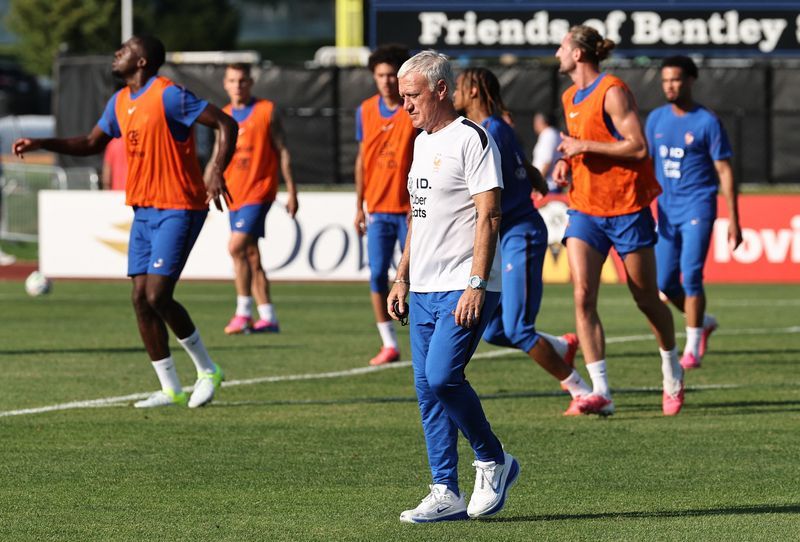
France progressed flawlessly from their opening World Cup group, accumulating ten goals across convincing victories against Senegal, Iraq and Norway to finish atop Group I without conceding defeat. The offensive arsenal assembled by head coach Didier Deschamps has distinguished itself as potentially the tournament's most formidable attacking ensemble, centred on the potency of Kylian Mbappé, Ousmane Dembélé and Michael Olise. Yet despite this commanding group-stage performance, vulnerabilities persist on the team's left flank heading into Tuesday's knockout encounter against Sweden, forcing Deschamps to reconsider his tactical setup.
The weakness along France's left defensive lane has become increasingly apparent as matches progressed. Left back Theo Hernandez has failed to command the position with the assurance expected of an elite international defender, prompting Deschamps to consider introducing Lucas Digne into the starting lineup against the Swedish side. Digne's inclusion would provide enhanced defensive stability and more reliable service from the wing, addressing a structural concern that could prove costly in knockout football where margins for error narrow considerably. This adjustment reflects a pragmatic approach from Deschamps, who recognises that group-stage dominance against moderate opposition cannot insulate France from exposure at this competitive level.
Offensive alterations accompany the defensive reshuffling. Bradley Barcola is expected to displace Désire Dué on the left wing of France's attacking unit, a change motivated by Deschamps' desire for more incisive penetration, explosive pace in transitional moments and genuine positional width to counterbalance the right-side dominance of Olise, Mbappé and Dembélé. Rather than fundamentally rebalancing the team's structural approach, this tactical modification seeks to create coherence across the left flank by pairing a more defensively secure full back with a more dynamically direct winger. The calculus suggests that synchronisation across this sector could enhance France's defensive resilience without compromising their attacking ambitions.
Sweden present the kind of resilient, deeply-organised defensive opponent that tends to expose any disharmony in opposing formations, particularly through set-piece opportunities and counterattacking ventures designed to exploit space behind high defensive lines. The Swedish approach, rooted in compact defending and disciplined structure rather than expansive play, will test whether France can maintain composure and precision against a team unlikely to offer the open, attacking contests that characterised their group fixtures. The restoration of William Saliba to central defence offers at least some reassurance regarding France's rearguard stability, introducing the kind of commanding presence that has been intermittently absent during their opening campaign.
Sweden's path to the knockout stage was considerably less ceremonious than France's masterclass. The Nordic outfit secured second place in Group F behind the Netherlands following an explosive 5-1 rout of Tunisia in their opener, only to suffer an identical scoreline in reverse against the Dutch, before salvaging a draw against Japan. This inconsistency reflects a team possessing genuine individual quality—particularly in Alexander Isak, Viktor Gyökeres and Anthony Elanga—yet lacking the collective cohesion and attacking sophistication that characterises Deschamps' squad. Nevertheless, Sweden's organisational discipline and physical presence could manufacture difficulties for a France side that has occasionally looked susceptible to sustained defensive pressure.
The transition from group-stage football to knockout competition introduces a fundamentally different strategic context. During the group phase, France's technical superiority and attacking abundance allowed them to overcome tactical deficiencies through sheer overwhelm, rendering occasional defensive oversights manageable. The knockout format, by contrast, demands absolute precision and consistency, as even momentary lapses can prove decisive. France's historical knockout record provides considerable confidence; apart from the 2022 World Cup final loss to Argentina, the nation has not suffered elimination at this stage since 2014, suggesting an institutional capacity to elevate performance when competitions tighten.
The offensive depth available to Deschamps remains perhaps international football's most formidable competitive advantage. Beyond the established trio of Mbappé, Dembélé and Olise—the latter two having demonstrated their lethality through Dembélé's hat-trick against Norway and Olise's creative orchestration—the French bench contains an embarrassment of attacking riches. Barcola, Dué, Rayan Cherki, Jean-Philippe Mateta and Marcus Thuram collectively represent an attacking arsenal unmatched by any rival, providing tactical flexibility and the capacity to sustain pressure across ninety minutes. This abundance positions France as heavy favourites regardless of whatever tactical adjustments Deschamps implements.
Former England international Gary Lineker, analysing the matchup for French sporting publication L'Équipe, expressed little concern regarding Sweden's capacity to trouble the French. Lineker acknowledged Sweden's competitive qualities while emphasizing the vast gulf separating the attacking calibre of both sides, suggesting that despite France's theoretical vulnerability to counterattack—a concern underscored by Norway's second-string performance on Friday—the sheer offensive productivity gap renders such vulnerabilities largely academic. His assessment encapsulates the statistical reality: France's superior firepower makes them prohibitive favourites, even accounting for structural adjustments and Swedish organisation.
Victory would propel France into the Round of 16 confrontation against either Germany or Paraguay, potentially the most significant fixture of their knockout campaign depending on which opponent emerges. The group-stage experience, regardless of its tactical refinements, has positioned France as a clear tournament favourite, though Deschamps' recognition of left-flank vulnerabilities suggests he remains attentive to the incremental improvements that separate championship contenders from one-dimensional attacking sides.

