The quarter-final between France and Morocco in Boston on Thursday represents far more than a simple knockout contest between two nations competing for a place in the semi-finals. The fixture carries the weight of shared history, cultural connections, and family ties that bind the two countries together in ways that extend well beyond the football pitch. From players raised in French academies to elite athletes who forged their bonds while playing together at Paris St Germain, the relationship between these two squads embodies the complex, multilayered ties that define contemporary Franco-Moroccan relations.
France's 44-year protectorate over Morocco, which lasted from 1912 until independence in 1956, created institutional and cultural links that persist to the present day. Rather than fading over decades, these connections have deepened through education, commerce, and sustained migration patterns that have woven Moroccan and French communities together across multiple generations. Football has emerged as one of the most tangible and emotionally resonant expressions of these enduring ties, transforming what might otherwise be a straightforward international match into something altogether more meaningful.
The composition of Morocco's squad itself tells the story of this interconnectedness. Six members of the team were born on French soil, their early lives spent in cities like Paris, Lyon, or Marseille before eventually choosing to represent the country of their parents' heritage. Others have passed through the academies and professional leagues of France before committing their international careers to Morocco, a pattern that speaks to the strategic way Moroccan football has leveraged its diaspora as a source of competitive advantage. This approach has proven remarkably successful, transforming what many viewed as a brain drain into a systematic talent pipeline.
The case of teenager Ayyoub Bouaddi exemplifies this phenomenon with particular clarity. Born in France and developed through Lille's youth system, Bouaddi represented France at youth international level before ultimately selecting Morocco as his senior international destination. His journey mirrors that of dozens of other players, yet it crystallises the dual sporting identity that gives this fixture its distinctive character. These are not players simply pursuing opportunities abroad; rather, they represent a deliberate strategy by Moroccan football to cultivate talent within Europe's most competitive leagues while maintaining cultural and familial ties to their ancestral homeland.
The Boston setting adds an unexpected dimension to what would otherwise be a fixture laden with tension and historical baggage. In French cities with substantial Moroccan populations, security concerns had necessitated heavy police presence ahead of the match. Boston, however, presents a different dynamic. While the Moroccan community in the greater Boston metropolitan area is smaller and less visible than in European urban centres, it is nonetheless established and flourishing, with second and third-generation residents having built professional networks, family units, and business interests throughout the region. For supporters from both nations living in proximity to one another, the match carries implications far beyond the ninety minutes of play.
This geographical and social reality fundamentally changes how the fixture is experienced by local communities. Mohammed Saadi, a 57-year-old taxi driver, articulated this perspective with striking candour, noting that many Moroccan and French residents inhabit the same neighbourhoods and apartment buildings. Rather than cleaving communities into opposing camps, the quarter-final in Boston would more likely become a shared cultural moment, with supporters gathering before the television sets and embracing afterward regardless of the result. The absence of historical baggage specific to Boston's Franco-Moroccan relations creates space for what Saadi characterised as a fundamentally familial atmosphere, one where footballing passion coexists with genuine affection and mutual respect.
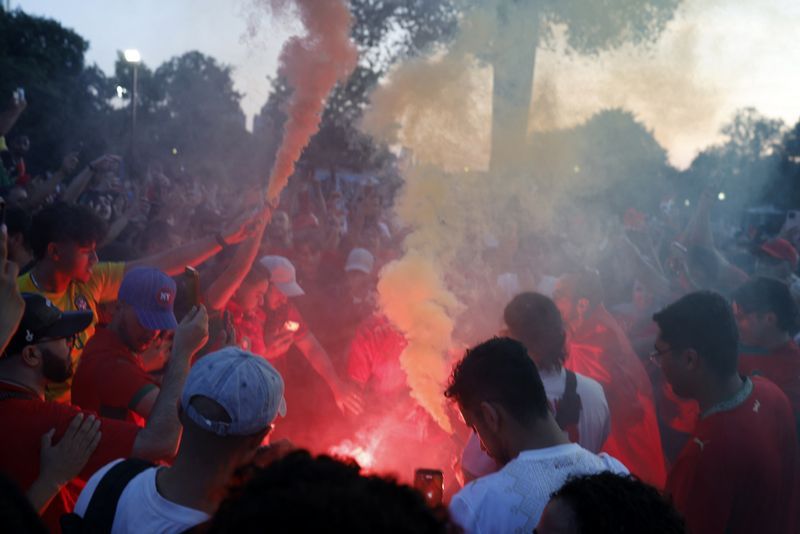
The gathering in Boston Common ahead of Thursday's fixture reinforced this sentiment. Over a thousand supporters assembled peacefully, singing Dima l-Maghrib (Always Morocco) and unfurling flags in a celebration that drew fans from across North America and beyond. Youssef Bennani, a 36-year-old software engineer who had travelled from Finland to attend all of Morocco's matches, found the Boston atmosphere particularly conducive to the kind of inclusive celebration he had sought. His observations highlighted how diaspora supporters experience World Cup football differently than domestic audiences, viewing matches as opportunities to gather with fellow expatriates and simultaneously engage with broader communities in their adopted cities.
Morocco's trajectory through this tournament has fundamentally altered the psychological tenor of this rematch. When the two nations met in Qatar in 2022, with France prevailing 2-0, Morocco competed as compelling underdogs whose unexpected run to the semi-finals had captivated global audiences and challenged assumptions about African football's place in the sport's hierarchy. The 2022 fixture, despite its emotional intensity, carried within it an implicit recognition of France's traditional superiority and Morocco's surprising ascent. Four years earlier, Morocco had become the first African nation to reach a World Cup semi-final, fundamentally reordering perceptions of what African teams could achieve at football's highest level.
Yet the landscape has shifted considerably. Morocco now arrives in Boston not as a plucky underdog but as an organised, strategically developed team with legitimate aspirations to challenge established powers. The federation's investment in player development, carefully cultivated connections with talent operating within Europe's top leagues, and the incremental professionalisation of domestic structures have combined to elevate Moroccan football to a new plane of sophistication. Their 3-0 demolition of Canada demonstrated precisely the combination of pace, tactical discipline, and attacking ambition that have carried them back to the quarter-finals and beyond preliminary expectations.
France, meanwhile, retain the credentials of world champions and the attacking weaponry expected from a team chasing a second World Cup title. Their progress to the quarter-finals came via a comfortable victory over Paraguay, yet the emergence of Morocco as a credible challenger reflects broader shifts within global football. The depth and quality of talent available to Moroccan selectors, much of it developed and refined within European football's most competitive environments, means that France cannot approach this fixture with the kind of assumed superiority that might have characterised earlier encounters between the nations.
The Boston setting thus becomes more than mere venue; it becomes a statement about how these two nations' football communities intersect and coexist in spaces removed from the historical and political contexts that have sometimes complicated their relationship. In a city where Moroccan and French supporters might share apartments, workplaces, and social circles, the quarter-final promises not division but rather a celebration of the remarkable permeability of contemporary football cultures. The match will be intensely competitive, with genuine sporting stakes, yet conducted within a broader framework of recognition, respect, and the understanding that these two footballing nations are bound together by ties far deeper than any match result.

