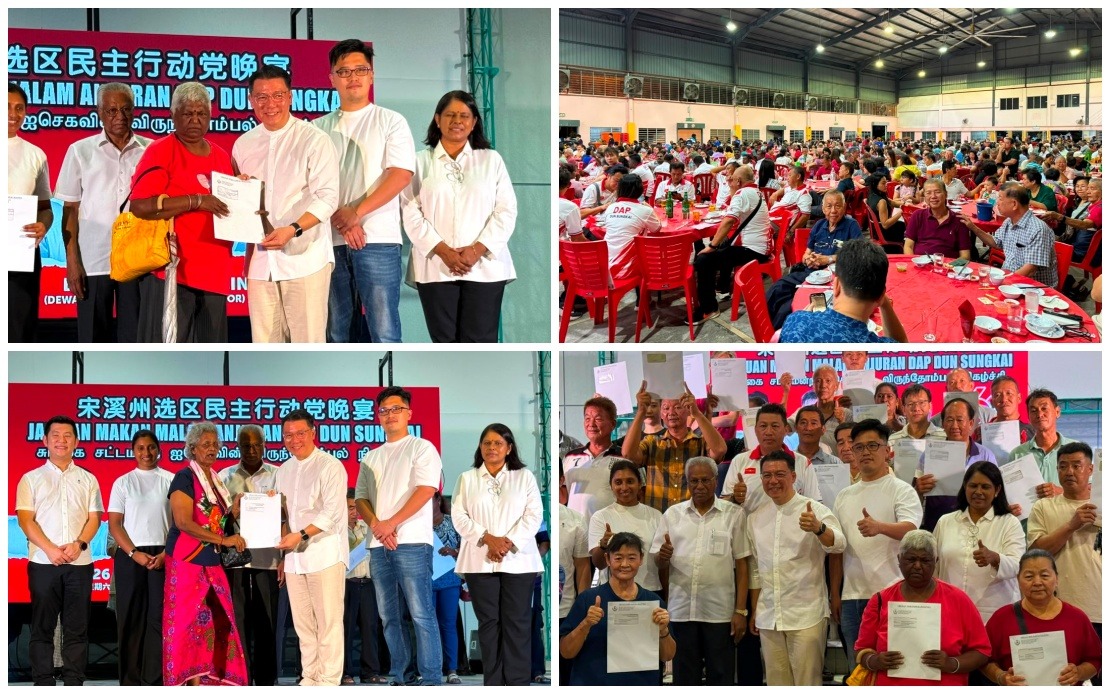
A significant milestone in Perak's social development was marked when Housing and Local Government Minister Nga Kor Ming distributed land grants to 120 squatter families in the Sungkai and Kuala Bikam areas on August 8, formally closing a protracted settlement dispute that has plagued these communities for over 40 years. The resolution represents one of the more tangible outcomes of the government's stated commitment to inclusive nation-building, addressing the plight of marginalised groups whose insecure tenure has constrained their ability to plan for the future.
Nga characterised the distribution as emblematic of the MADANI Government's governing philosophy, emphasising that development benefits must reach all Malaysians irrespective of ethnic identity or socioeconomic standing. He framed the resolution as evidence of a deliberate policy pivot toward ensuring equitable access to basic services and security, countering the perception that development gains concentrate among privileged communities. The event itself, held at a dinner organised by the DAP Sungkai state constituency division attended by more than 1,200 community members, underscored the political significance attached to resolving longstanding grievances within minority communities.
The 40-year timeline of this dispute carries particular weight in the Malaysian context, where squatter settlements have historically represented a blind spot in urban and rural planning frameworks. Many such communities emerged decades ago on marginal land, subsequently formalised through incremental occupation but never formally recognised through property rights. Residents endured precarious living conditions, exposure to eviction threats, and exclusion from basic infrastructure development. For the families receiving grants in Sungaki and Kuala Bikam, the resolution offers not merely shelter security but psychological affirmation that their presence within the nation's territorial and social fabric is acknowledged.
Nga explicitly credited Sungkai assemblyman Datuk A. Sivanesan, who chairs the state's Human Resources, Health, Indian Community Affairs and National Integration Committee, alongside the civil service apparatus that navigated the resolution process. This acknowledgment reflects the multi-layered bureaucratic coordination required to regularise land tenure, encompassing state land offices, local authorities, and potentially the federal government. Such administrative machinery often moves slowly, making the finalisation of this 40-year dispute noteworthy for demonstrating institutional capacity when political will aligns with implementation structures.
The grant distribution forms part of a broader package of initiatives directed toward the Indian community, mirroring demographic and political realities in constituencies like Sungkai. The government has allocated RM20 million for Indian settlements, RM50 million for Tamil vernacular schools, and increased the Malaysian Indian Transformation Unit budget to RM150 million. These complementary investments signal an attempt to address systemic gaps in service delivery and educational infrastructure affecting Indian Malaysians, particularly in peninsular states where this demographic has historically concentrated.
Under the stewardship of Prime Minister Datuk Seri Anwar Ibrahim, the MADANI Government has positioned inclusivity as a core governance principle, contrasting itself with earlier administrations. This rhetorical emphasis carries particular resonance given Malaysia's history of communal tensions and the persistent narrative that state development resources flow disproportionately to dominant communities. By publicly celebrating resolution of disputes affecting minority populations, the government attempts to reshape political perception and consolidate support among constituencies that previously felt marginalised.
Nga's remarks during the event advanced a broader political argument, urging constituents to evaluate government performance on substantive grounds rather than emotional or identity-based appeals. He cautioned against allowing perception to overshadow measurable outcomes, positioning the land grant distribution as evidence supporting this utilitarian calculus. This rhetorical strategy acknowledges the competitive political environment in which the government operates, where opposition narratives continue to circulate regarding inequality and neglect of minority interests.
The gathering brought together multiple tiers of elected representation, including Ipoh Timur Member of Parliament Howard Lee Chuan How, alongside state assemblymen representing surrounding constituencies. This breadth of attendance signified the significance attributed to the event within the local political establishment and reflected DAP's organisational capacity to mobilise community participation. The DAP Sungkai division's 60th anniversary provided the occasion for what functioned simultaneously as a celebratory event and political messaging platform.
For Malaysian policymakers and development specialists, this resolution offers instructive lessons regarding the mechanics of formalising tenure in long-established informal settlements. The four-decade duration suggests that earlier attempts at resolution encountered legal, financial, or political obstacles. Contemporary approaches appear to have overcome these barriers, potentially through clearer legislative frameworks governing land regularisation or through political determination to prioritise social stability over property rights absolutism. Understanding how this particular case was resolved could inform approaches to comparable settlement issues persisting elsewhere in Malaysia.
The regional significance extends beyond Perak's borders, as many Southeast Asian nations grapple with analogous squatter settlement crises. Malaysia's experience with formalising tenure in established communities may offer relevant models for governments across the region confronting similar demographic pressures and urbanisation-driven informality. The integration of such resolutions within broader targeted investment packages—as demonstrated through the supplementary allocation to Tamil schools and Indian settlements—reflects sophisticated understanding of how infrastructure and tenure security work synergistically to improve living standards.
Looking forward, the completion of this particular dispute raises questions about remaining settlement cases across Malaysia. State and local authorities maintain registers of informal settlements; the resolution in Sungkai and Kuala Bikam establishes a precedent and potentially raises public expectations for comparable action elsewhere. The government's political investment in this outcome suggests openness to similar initiatives, though budget constraints and competing developmental priorities will necessarily limit the pace of implementation across the nation's numerous informal communities.
The event ultimately reflects contemporary Malaysian governance balancing multiple imperatives: addressing historical inequities, consolidating political support among minority communities, demonstrating administrative competence, and promoting a unifying national narrative centered on inclusive development. Whether these various objectives successfully reinforce one another or whether tensions emerge between them will significantly influence the sustainability of the MADANI Government's political coalition and its capacity to implement subsequent phases of its development agenda.

