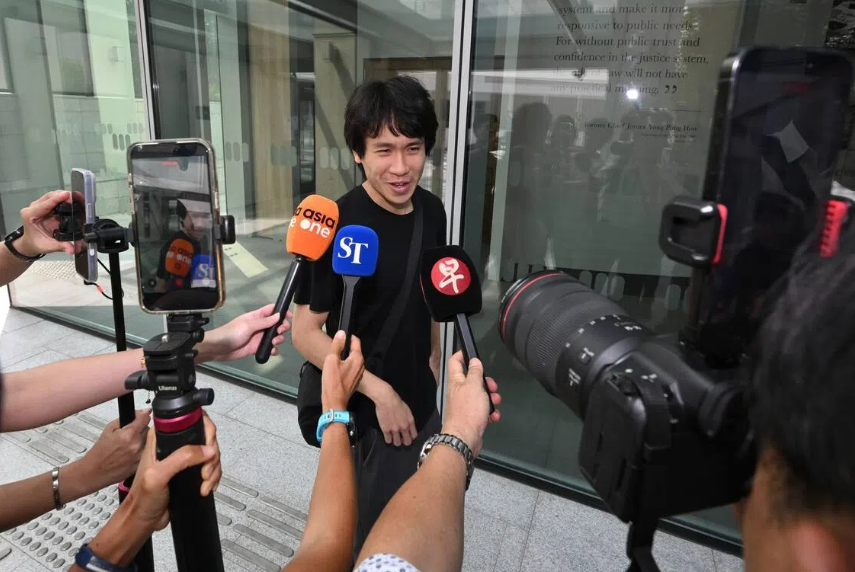
Former child actor Amos Yee appeared in Singapore's District Court on August 26 to face four additional charges, bringing his total tally to seven offences spanning months of online activity. The 27-year-old's legal troubles encompass a complex set of allegations ranging from racial incitement to advocacy of child sexual abuse, painting a picture of escalating online conduct that has triggered intervention from Singapore's law enforcement and tech platforms alike.
The prosecution alleges that Yee deliberately attempted to incite racial disharmony through blog posts published on April 7 and April 11, in which he claimed the Malay and Indian communities faced systematic discrimination from the Chinese majority in Singapore. According to the charges, he explicitly encouraged members of these minority groups to organise protests against the Government, thereby creating conditions for potential conflict along communal lines. If found guilty of knowingly attempting to promote racial disharmony, Yee faces a maximum prison sentence of three years, a fine, or both—a significant sanction that reflects how seriously Singapore treats such conduct.
The racial incitement allegations extend further. On May 27, Yee allegedly uploaded a video containing statements that the Malay and Muslim community experienced severe discrimination perpetrated by the Chinese population in Singapore. These assertions formed the basis of a separate charge under the same legislative framework, suggesting a pattern of escalating rhetoric rather than isolated incidents. The timing and frequency of these posts indicate deliberate intent to reach an audience through multiple platforms and formats, amplifying potential reach and impact.
Perhaps most significantly, Yee faces two charges under the Protection from Harassment Act for creating and distributing videos in 2021 that purportedly advocated for decriminalizing paedophilia and contested age-of-consent restrictions. According to the allegations, he made explicit claims that infants and children possessed the capacity to consent to sexual intercourse—contentions that fundamentally contradict established child protection principles and international safeguarding standards. In a further iteration of this advocacy, he allegedly published another post on June 30 advancing similar arguments whilst simultaneously calling for the abolishment of legislation criminalizing the production and possession of child abuse material.
These charges carry maximum penalties of S$5,000 fines for each violation under the Protection from Harassment Act if Yee is convicted. Beyond the serious nature of the allegations themselves, the breadth of charges reflects a multifaceted pattern of online behaviour designed to challenge and undermine core societal protections—both those safeguarding children from exploitation and those maintaining inter-communal harmony in a multicultural city-state.
Singapore's law enforcement response demonstrates the city-state's commitment to regulating online conduct that crosses defined legal thresholds. The Singapore Police Force confirmed receiving numerous reports between April and July concerning Yee's blog posts, triggering a formal investigation. On August 18, police issued a disabling direction to X (formerly Twitter) under the Online Criminal Harms Act, resulting in the removal of Yee's video content from the platform. Simultaneously, Yee received stop communication directions requiring him to remove the offending posts from his blog, effectively silencing the channels through which he had been disseminating his contentious material.
A third category of charges compounds the case against Yee: three offences under the Enlistment Act relating to national service compliance. He allegedly failed to report for pre-enlistment medical screening and departed Singapore without the requisite exit permit on two separate occasions—from December 13, 2015, to April 19, 2016, and again from December 15, 2016, to March 19, 2026. These violations accumulated across a decade, suggesting either deliberate evasion or persistent administrative neglect. Violations of national service enlistment requirements carry penalties of up to S$10,000 in fines, imprisonment for up to three years, or a combination thereof.
The court has granted Yee bail in the amount of S$15,000 pending trial, contingent upon stringent conditions that effectively restrict his online presence. Notably, he is prohibited from posting any content concerning his views on paedophilia and barred from creating any material likely to incite ill feelings amongst racial or religious groups. These conditions represent a judicial attempt to halt the alleged pattern whilst the case proceeds through the courts. Yee is scheduled to return for a pre-trial conference on September 18, marking the beginning of what could become a protracted legal process.
The case underscores Singapore's sophisticated regulatory infrastructure addressing online harms, particularly through the Online Criminal Harms Act and Protection from Harassment Act. These legislative tools enable authorities to move swiftly against content deemed threatening to social stability or child safety, with platform cooperation demonstrating the practical mechanisms through which legal directions are enforced. The incident also illustrates tensions between free expression and community protection—a dialogue familiar to Malaysian legal circles, where similar questions about permissible speech and hate speech protections remain subject to ongoing debate.
For regional observers, the Yee case demonstrates how city-states with strict regulatory frameworks enforce content removal and prosecute creators whose activities breach defined legal boundaries. Malaysia's own provisions addressing sedition and communal harmony—though structured differently and sometimes contentiously applied—share common objectives of maintaining interethnic peace. The case raises questions about consistency and proportionality in enforcing such provisions whilst balancing legitimate speech protections.
Yee's prosecution also highlights vulnerabilities in digital platforms despite removal mechanisms, as content can circulate across borders and persist through caching and redistribution before authorities intervene. The lag between initial publication and enforcement action reveals challenges inherent in regulating distributed online speech, particularly content targeting vulnerable populations such as children.

