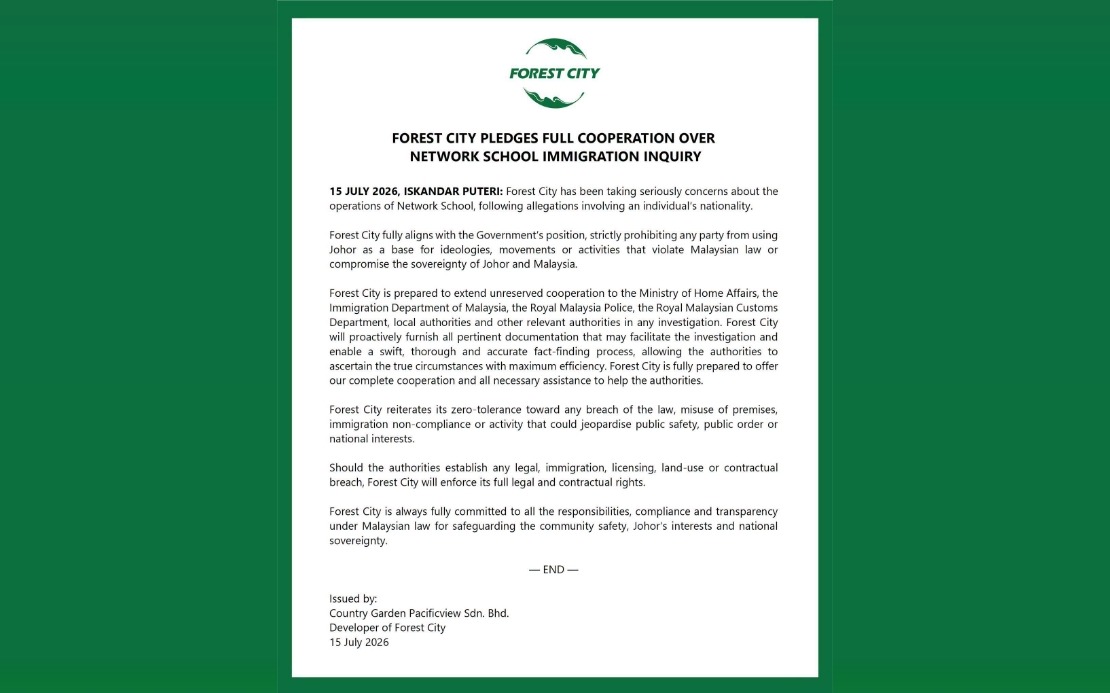
The developer of Forest City in Johor Bahru has signalled its readiness to assist government investigators examining allegations that a private educational institution operating within the massive residential and commercial complex has been hosting Israeli nationals. Country Garden Pacificview Sdn Bhd, the company behind the sprawling development, released a formal statement reaffirming its commitment to work alongside multiple law enforcement and regulatory bodies to establish the facts surrounding the controversy that has captured public attention in recent weeks.
The statement represents an important positioning by the developer at a time when questions linger about oversight and vetting procedures at one of Malaysia's most prominent property developments. Country Garden Pacificview emphasised that it views the allegations with utmost seriousness and fully endorses the government's principled stance that Johor—and Malaysia more broadly—cannot serve as a staging ground for activities that breach Malaysian law or compromise national sovereignty. This language signals the company's awareness that anything less than complete transparency could damage its reputation and future business prospects in the country.
The developer has committed to engaging with an extensive list of government institutions, including the Home Ministry, the Immigration Department, the Royal Malaysia Police, the Royal Malaysian Customs Department, and various local government authorities. This multi-agency cooperation framework reflects the complexity of the investigation, which touches on immigration compliance, national security concerns, and property management standards. Country Garden Pacificview stated it would supply all documentation deemed necessary by investigators to accelerate the fact-finding process and ensure thoroughness in determining what occurred.
The underlying controversy erupted when Johor Menteri Besar Datuk Onn Hafiz Ghazi called for an urgent inquiry into Network School's operations within Forest City. Onn Hafiz highlighted credible reports that foreign nationals with Israeli citizenship had allegedly participated in the school's programmes, reportedly gaining entry to Malaysia through the use of passports from other countries. This practice, if confirmed, would constitute a serious breach of immigration procedures and raise questions about how such individuals managed to circumvent established entry screening mechanisms.
Following the Menteri Besar's intervention, the Immigration Department launched a physical inspection of the Forest City residential area, examining 266 foreign nationals drawn from 40 different countries. Preliminary findings indicated that all individuals encountered during this sweep possessed valid immigration documentation at the time of inspection. However, immigration authorities have stressed that their investigation remains ongoing and incomplete, suggesting that deeper scrutiny into entry records, visa applications, and travel histories continues behind the scenes.
The broader context here involves long-standing questions about enforcement and compliance standards at major residential developments in Malaysia, particularly those involving foreign investors and international residents. Forest City itself has long been a subject of public debate due to its significant foreign investment component and its role in shaping Johor's demographic profile. The Network School controversy adds another dimension to discussions about how such developments are managed and monitored to ensure they adhere to Malaysian laws and national policies.
Country Garden Pacificview's statement additionally emphasised a strict zero-tolerance approach toward legal violations, misuse of premises, immigration regulation breaches, and activities that could threaten public safety or social order. This rhetorical positioning serves multiple purposes: it reassures stakeholders that the developer takes governance seriously, it demonstrates cooperation with authorities, and it potentially shields the company from liability by framing any wrongdoing as contrary to its stated policies. Whether such declarations translate into tangible improvements in oversight mechanisms remains to be seen.
The incident illuminates broader questions about how Malaysia manages the intersection of foreign investment, international education, and immigration enforcement. Forest City represents billions of ringgit in Chinese investment and has become home to thousands of foreign residents and their families. When controversies emerge involving foreign nationals within such developments, they inevitably invite scrutiny of both developer accountability and government regulatory capacity. The investigation into Network School will likely inform future policy discussions about how Malaysia balances attracting foreign capital and talent with maintaining strict adherence to immigration protocols and national security standards.
For Malaysian property investors and residents in Forest City, the unfolding investigation may prompt reassessments of how the development is perceived in terms of governance and community standards. The developer's swift commitment to cooperation, while not surprising for a major international company, does demonstrate awareness that reputational damage could extend beyond the immediate controversy. How thoroughly the authorities ultimately investigate, what findings emerge, and what corrective measures are subsequently implemented will all influence public confidence in both Forest City as a destination and the broader framework governing foreign-majority residential developments across Malaysia.

