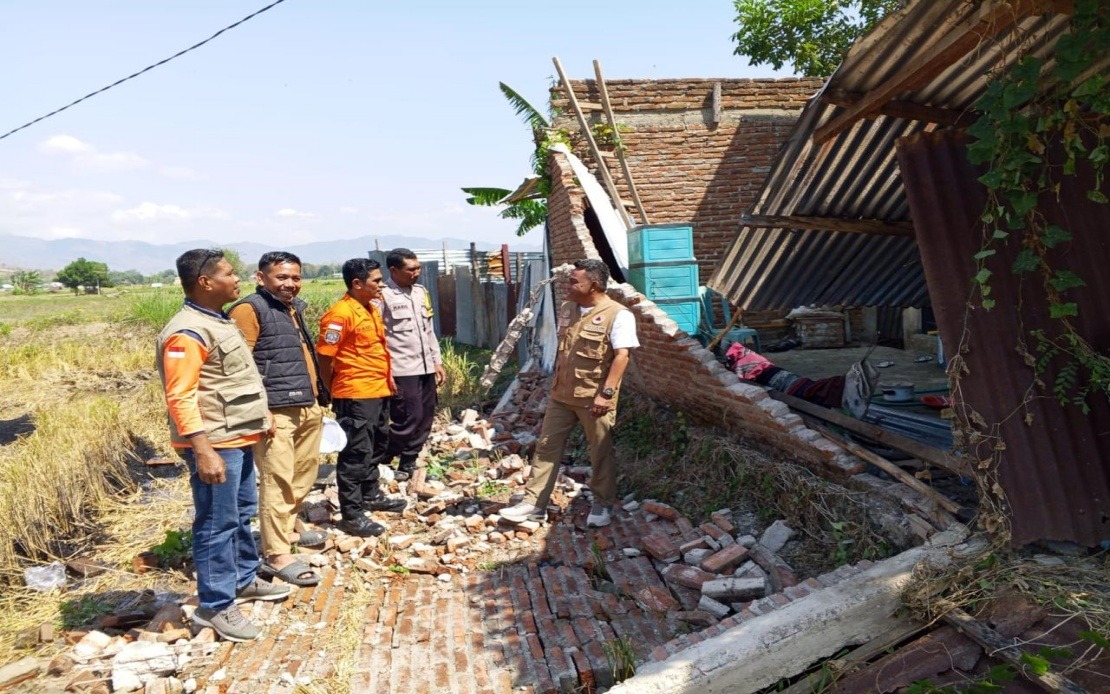
A devastating earthquake measuring magnitude 7.7 struck Indonesia's Flores Island in East Nusa Tenggara in the early hours of Saturday morning, triggering an immediate humanitarian response as authorities moved approximately 2,000 residents to safety. The tremor, which occurred at 4:58 am local time with its epicentre located roughly 30 kilometres offshore from Mbay at a depth of 15 kilometres, unleashed a cascade of secondary shocks that would continue to unsettle the region throughout the day. The initial quake was powerful enough to prompt the Meteorology, Climatology and Geophysics Agency (BMKG) to issue a tsunami warning, though the alert was lifted at 7:31 am after monitoring stations detected no significant rise in sea levels that would indicate a dangerous wave surge.
The evacuation operation demonstrated both the efficiency of Indonesia's disaster response apparatus and the sheer force of nature that compelled some residents to flee independently of official directives. According to Berton Suar Pelita Panjaitan, acting chief of the National Disaster Management Agency's (BNPB) Disaster Data, Information and Communication Centre, the dual approach—combining government-coordinated evacuations with spontaneous community self-protection—ensured that the majority of the population in the affected areas reached safety before significant harm could occur. This mixed response reflects the reality that in seismically active regions, public awareness and preparation often prove as valuable as formal emergency protocols.
The full scope of destruction across the island remained unclear in the immediate aftermath, with damage assessment teams still collecting and verifying reports from affected communities. Initial surveys indicated that 54 residential structures sustained severe damage, with an additional nine moderately affected and eleven showing minor structural compromise. Beyond housing, the earthquake's impact extended to critical community infrastructure, including five health facilities, one educational institution, three religious buildings, a warehouse operated by state food logistics agency Bulog, and six government offices. The distributed nature of this damage suggests the quake's energy radiated broadly across populated zones rather than concentrating devastation in a single locality.
Manggarai district emerged as the epicentre of destruction, recording 29 severely damaged houses alongside nine moderately impaired structures and nine with minor damage. The neighbouring East Manggarai district reported 23 houses with severe damage, indicating that the earthquake's most violent ground motion affected this particular corner of Flores disproportionately. This concentration of damage in specific districts typically reflects variations in local geology, building construction standards, and population density—factors that shape how earthquake energy translates into tangible human suffering and infrastructure loss.
The human toll climbed to at least 20 confirmed deaths, with six individuals sustaining injuries and two others initially reported trapped in collapsed or damaged structures. These figures, while representing a significant tragedy, could have been substantially higher had the evacuation efforts proven less effective or had the earthquake struck during daylight hours when more residents would have been indoors. The relatively low death toll in relation to the earthquake's magnitude underscores how preparation, early warning systems, and rapid response mechanisms can significantly mitigate disaster outcomes—a lesson increasingly relevant as climate change and tectonic activity continue to challenge vulnerable populations across Southeast Asia.
The seismic activity did not cease with the main quake. A total of 111 aftershocks rippled through the region following the initial magnitude 7.7 event, each tremor carrying the potential to further destabilize weakened structures and psychologically traumatize an already frightened population. Aftershocks of significant magnitude can trigger secondary failures in buildings already compromised by the main event, and they invariably complicate rescue and relief operations by forcing ongoing evacuations and hampering the movement of emergency personnel and supplies.
The disaster's impact extended beyond physical destruction into the digital realm, disrupting the communications infrastructure vital for coordinating disaster response and maintaining public confidence. The Communication and Digital Affairs Ministry identified 200 base transceiver station (BTS) sites across ten districts and cities in East Nusa Tenggara experiencing service interruptions, representing 16.35 per cent of the region's total BTS infrastructure. According to Wayan Toni Supriyanto, the ministry's digital infrastructure director-general, restoration efforts were underway in coordination with mobile operators. The loss of communications capacity during a disaster creates a secondary crisis, cutting off residents from warning systems, emergency services, and each other while simultaneously hampering official agencies' ability to assess conditions and deploy resources effectively.
The Indonesian government's response machinery mobilized rapidly, with the BNPB, military, police, and local government agencies all deploying personnel to affected areas. Damage verification, casualty confirmation, and needs assessment continued throughout Saturday and beyond, reflecting the meticulous process required to understand the full scale of a major disaster's consequences. This layered approach—prioritizing immediate life safety, followed by systematic impact evaluation—represents best practice in disaster management but also requires sustained commitment and resource allocation in the critical hours and days following impact.
For Malaysia and other Southeast Asian nations sharing similar tectonic vulnerabilities, the Flores earthquake offers both cautionary and instructive lessons. The region straddles the Pacific Ring of Fire and sits atop the Indo-Australian Plate's collision zone, making major earthquakes and tsunamis inevitable features of life rather than exceptional events. Indonesia's response—despite the significant challenges of coordinating across a sprawling archipelago—demonstrates institutional capacity that smaller or less-developed nations might struggle to replicate. The communications infrastructure failures highlight how modern disasters often compound in ways that transcend simple seismic damage, with secondary effects potentially exceeding primary impacts. Regional cooperation on early warning systems, mutual aid protocols, and shared expertise in post-disaster recovery remains essential as these nations confront the reality that earthquakes respect no international borders and their humanitarian consequences demand collective response.

