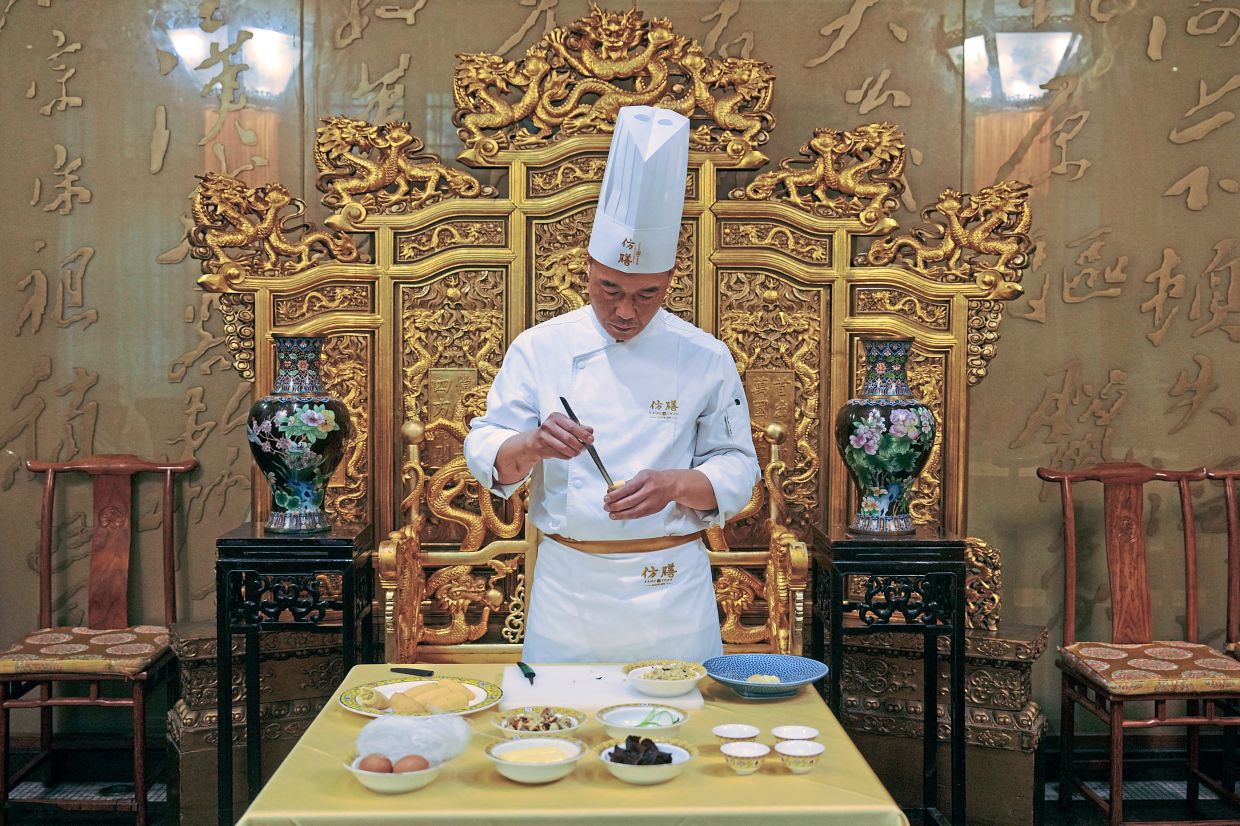
The culinary legacy of imperial China persists quietly in contemporary Beijing, where restaurants dedicated to court cuisine maintain recipes and techniques that have endured for nearly a century. At the heart of this living tradition stands Fangshan Restaurant, established in 1925 by former chefs who once served the Qing Dynasty emperors at Beihai Park—a sprawling garden where successive imperial dynasties conducted state affairs, held ceremonies, and sought respite. The restaurant's name itself reveals its mission: Fangshan translates as "imitating the imperial cuisine," a deliberate homage to the palace kitchens it seeks to perpetuate.
The origins of many imperial dishes carry the weight of legend intertwined with historical fact. Take, for instance, the pastry known as "dream pastry"—a creation whose very name emerged from the whims of Empress Dowager Cixi. According to kitchen lore preserved at Fangshan, Cixi once dreamed of a delicate pastry during the final decades of imperial rule. The following morning, her chef materialized the confection at her breakfast table, a feat of culinary prescience that earned him a silver ingot as reward. What had originally been termed a "minced pork pancake" became immortalized under its new name, demonstrating how the imperial court's desires could reshape not merely what was served, but how history itself remembered a dish.
Understanding imperial Chinese cuisine requires grasping that it encompassed far more than daily meals for the ruler. The court operated an elaborate system of ceremonial dining and ritual feasting that structured the imperial calendar and reinforced hierarchical relationships. These occasions were governed by precise protocols that combined aesthetic refinement with political symbolism. Qing Dynasty banquets, for example, invariably commenced with the ceremonial serving of milk tea—a practice documented by Palace Museum researcher Teng Deyong. As the banquet progressed, the emperor would bestow wine or food upon princes and officials, each recipient obligated to perform elaborate rites and pay formal respects before consuming what had been granted to them. Food, in this context, functioned as both nourishment and instrument of imperial authority.
Particularly revealing are the sacrificial rituals that occupied a distinct category within imperial culinary practice. The Palace of Earthly Tranquility witnessed one of the Qing court's most solemn ceremonies: the ritual consumption of boiled pork prepared without salt. The meat's preparation—deliberately unseasoned—carried deep significance that extended back centuries into classical Chinese thought. As Lehigh University scholar Wandi Wang explains, classical ritual texts such as the "Book of Rites" prescribe unseasoned broths for sacrificial ceremonies. This absence of seasoning was not oversight or austerity but intentional symbolism. The plain preparation evoked an idealized antiquity, a simpler epoch of cooking that honoured cultural origins and demonstrated respect for tradition. Receiving such sacrificial meat was deemed an extraordinary honour, linking the recipient to the sacred ceremonial function of the emperor himself.
Pastries achieved particular prominence within the imperial kitchen's hierarchy of specializations. The court maintained a dedicated institution devoted entirely to pastry production, recognition that these delicate confections demanded mastery of techniques unavailable to ordinary cooks. Contemporary Fangshan pastry chef Zhou Tong carries forward these traditions through direct apprenticeship lineage—a chain of master-to-student transmission spanning generations. His repertoire includes Cixi's legendary dream pastry and small steamed corn buns, each recipe rooted in documented imperial practice. Customers ordering these items receive not merely food but narratives; Fangshan's servers deliberately recount the historical anecdotes surrounding each dish, transforming consumption into an act of cultural engagement and historical memory.
The technical demands of imperial pastry-making reveal why these recipes could not simply be recorded and mechanically replicated. Traditional methods explicitly forbid modern labour-saving devices—no blenders, no food processors, no machines that might expedite production. Beans must be ground using sieves; certain flours require handling in custom-made copper pots. Zhou emphasizes that mechanization destroys what machine-free labour creates: the delicate graininess and distinctive sandy mouthfeel characteristic of authentic imperial pastries. This commitment to hand-work—seemingly inefficient in contemporary commercial kitchens—represents an assertion that certain culinary qualities cannot be compromised without fundamentally altering the dish itself. The pea flour cakes and red bean rolls that constitute Fangshan's bestselling items, now numbering over 200 orders daily during peak seasons, testify to contemporary diners' appreciation for these labour-intensive traditions.
When executive chef Fan Liangliang joined Fangshan as a kitchen apprentice, he discovered that his formal culinary training required unlearning. Culinary school had taught him efficiency and speed; the imperial kitchen demanded patience and elaboration. He encountered techniques entirely absent from standard culinary curricula, among them "Nizihuo," a method involving the meticulous mincing of fish, shrimp, or chicken into smooth paste, subsequently reshaped into decorative forms—frogs, birds, blossoms—that transformed ingredient into edible art. This labour-intensive approach embodied a fundamental principle of imperial cuisine: every presentation ascending to the imperial table required innovation, visual beauty, nutritional value, and worthiness of the emperor's scrutiny. No component escaped this standard of excellence.
Modern preservation of imperial recipes necessarily involves adaptation when historical ingredients become unavailable or ethically problematic. Rare ingredients such as bear paws no longer appear on contemporary menus, yet Chef Fan maintains that such substitutions preserve the spirit and essence of each dish rather than betray it. This represents an evolving interpretation of culinary heritage—one that distinguishes between a recipe's literal components and its underlying philosophical intentions. The approach reflects broader scholarly understanding, articulated by Professor Wang, that Chinese cuisine historically transcended mere nutrition or taste. Dishes carried meaning rooted in politics, aesthetics, and cultural identity. A classical poem describing cold noodles prepared with pagoda-tree leaves becomes, through the verses of poet Du Fu, an expression of political loyalty and frustrated ambition to serve the emperor—transforming a simple preparation into encoded emotional and political statement.
The survival of Qing Dynasty court cuisine in twenty-first-century Beijing reflects conscious choices about cultural memory and identity. Preserving such traditions demands what Wang describes as "taking history seriously"—understanding that culinary heritage functions as historical document and cultural repository simultaneously. It reveals not only what people consumed but how present generations choose to remember and reinterpret the past. Fangshan exemplifies this interpretive approach, presenting imperial cuisine as fusion of Manchu and Han traditions, acknowledging that Qing court cooking synthesized the culinary practices of its Jurchen rulers with those of the Han majority they governed. This culinary fusion mirrored and expressed the dynasty's political structure and cultural complexity.
For Southeast Asian observers, the persistence of imperial Chinese culinary traditions offers instructive parallels regarding cultural continuity and diaspora. Chinese communities throughout the region maintain ancestral foodways, yet few have institutional frameworks comparable to Fangshan for systematic preservation and transmission. The restaurant model—combining commercial viability with cultural mission—demonstrates how living heritage can sustain itself without becoming ossified museum piece or nostalgic fantasy. Zhou and Fan represent contemporary practitioners who have chosen demanding paths of traditional mastery despite modern alternatives. Their decisions reflect conviction that certain human practices—the feel of dough worked by hand, the judgment required for unseasoned ceremonial pork, the artistry of shaped pastes—embody knowledge worth preserving. Imperial cuisine, through their stewardship, remains not antiquarian curiosity but active, evolving practice grounded in historical consciousness and contemporary choice.

