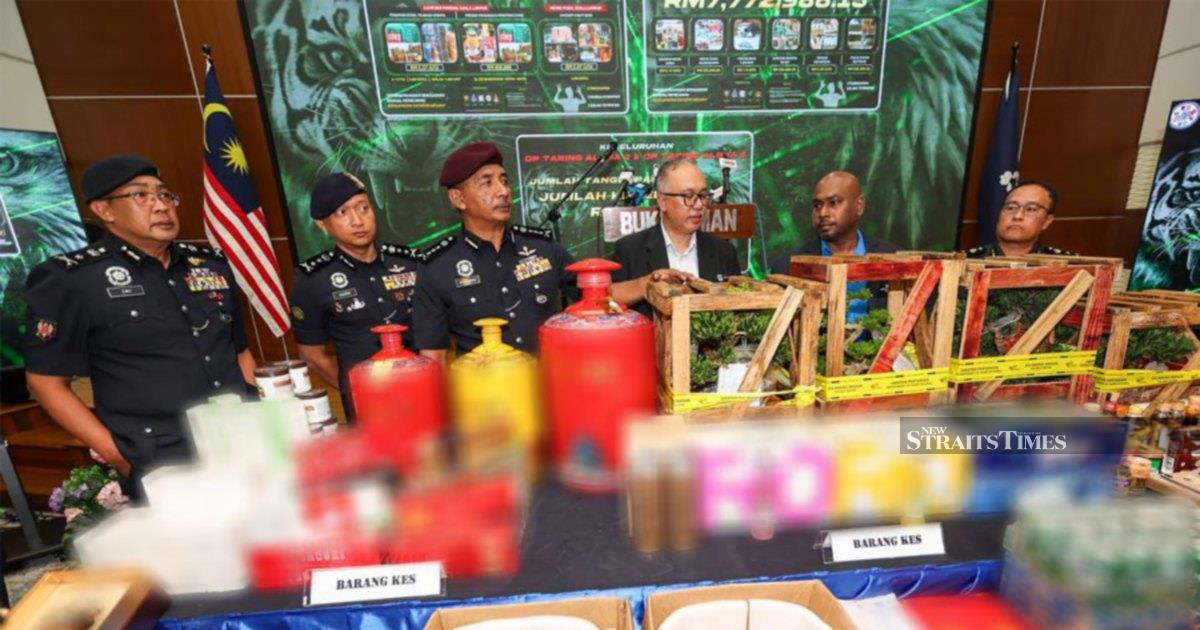
A coordinated crackdown by Malaysian police has yielded significant results in the ongoing battle against smuggling operations, with authorities announcing the arrest of five individuals and the recovery of contraband and merchandise valued at RM12.8 million across two separate operations conducted in Kuala Lumpur and Klang. The operations underscore the police force's commitment to disrupting the supply chains of illegal goods that continue to pose economic challenges to legitimate businesses and threaten national security.
The two enforcement actions represent part of a broader strategy to target organised smuggling networks that have become increasingly sophisticated in their methods and distribution channels. Such operations typically involve the illicit movement of goods across borders or through unofficial channels, depriving the government of substantial tax revenue while undercutting legitimate traders who comply with regulatory requirements. The substantial value of recovered goods indicates that these were not small-scale operations but rather coordinated criminal enterprises with significant financial backing and logistical capabilities.
Smuggling activities have long represented a persistent challenge for Malaysia's law enforcement agencies and customs authorities. The proximity of the Klang Valley to Kuala Lumpur International Airport, major seaports, and international border crossings makes the region particularly vulnerable to such criminal activities. Smugglers exploit these transportation networks and the high volume of legitimate commerce to conceal illegal shipments, making detection and interdiction a complex undertaking requiring sustained intelligence gathering and coordinated enforcement efforts.
The geographic focus on Kuala Lumpur and Klang reflects law enforcement priorities in Malaysia's most economically significant region, where the concentration of trade infrastructure creates both opportunities and vulnerabilities. These areas serve as critical nodes in the nation's import-export ecosystem, meaning that smuggling operations discovered here often indicate wider distribution networks spanning multiple states. The two operations therefore likely represent the visible portion of larger criminal enterprises still under investigation.
The arrest of five suspects provides investigators with potential leads into broader smuggling networks, as those detained in major operations are frequently part of hierarchical criminal organisations with members stationed at various points along supply chains. Police will likely conduct extensive interrogations to map the full extent of these networks, identify suppliers and distributors, and trace the ultimate destinations of the recovered goods. Intelligence gathered from such operations feeds into broader anti-smuggling efforts and helps authorities understand evolving smuggling tactics and routes.
The RM12.8 million valuation of recovered merchandise is substantial by any measure and reflects the economic significance of Malaysia's smuggling problem. This figure encompasses the market value of the contraband at the point of seizure, meaning the true wholesale value and the intended retail value could be considerably higher. For context, such seizures annually represent a meaningful portion of total smuggling interdictions across Southeast Asia, where the region experiences pervasive challenges related to the illicit movement of goods ranging from counterfeit products to restricted materials.
Effective anti-smuggling operations depend upon intelligence sharing and coordination between multiple enforcement bodies including the Royal Malaysia Police, the Malaysian Customs Department, the Maritime Enforcement Agency, and the Department of Civil Aviation. The success of these parallel operations suggests a level of interagency coordination that, while essential for tackling organised crime, requires sustained institutional investment and information-sharing protocols. Regional cooperation also plays a role, as smuggling networks frequently operate across international borders and involve transnational criminal syndicates.
The implications of these seizures extend beyond the immediate law enforcement achievement. Smuggling operations represent a significant drain on government revenue through unpaid duties and taxes, revenue that would otherwise support public services and infrastructure development. Additionally, smuggled goods often circumvent quality and safety standards, potentially placing consumers at risk while creating unfair competitive advantages for criminals over law-abiding businesses. Malaysian retailers and manufacturers operating within the formal economy face constant pressure from illegally imported products sold at artificially low prices.
Looking forward, authorities face the challenge of sustaining momentum in anti-smuggling efforts while continuing to address the root factors that make smuggling economically attractive to criminal networks. Price differentials between Malaysia and neighbouring jurisdictions, gaps in enforcement capacity, and demand for contraband goods all create conditions favourable to smugglers. Police will need to maintain intelligence operations, enforce penalties that serve as genuine deterrents, and work with trading partners to address cross-border dimensions of these criminal enterprises as the region moves toward greater trade integration.

