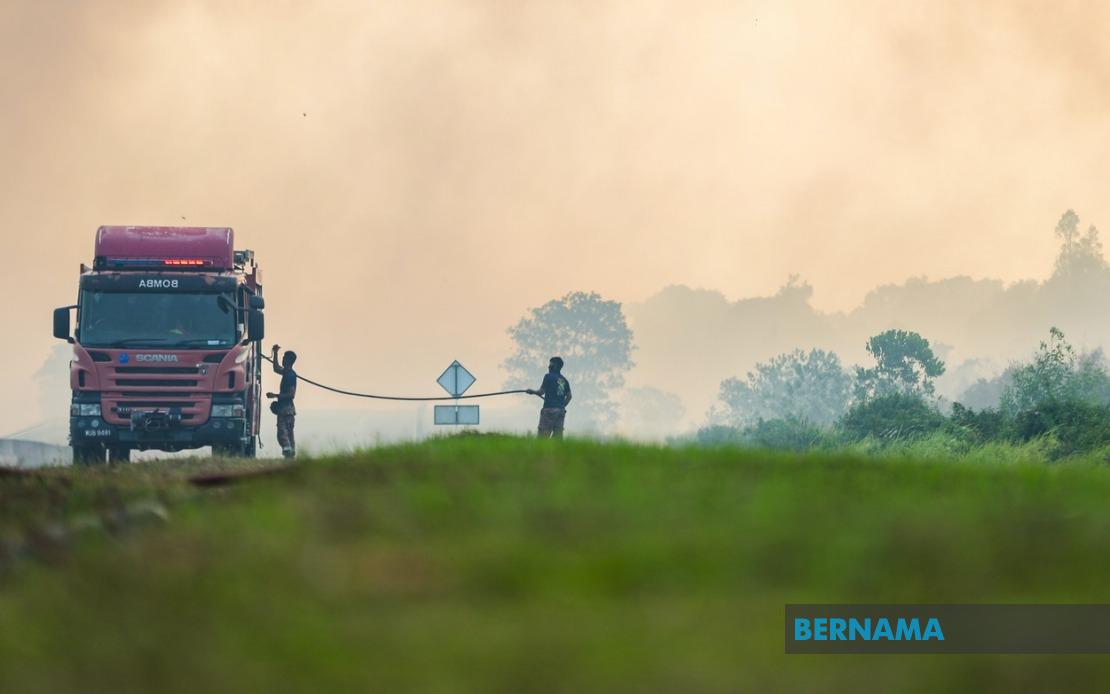
Firefighting operations at a major peatland fire in Pengerang, Johor, have progressed significantly, with over 29 hectares of the 51.4-hectare affected zone brought under control by Monday afternoon. The blaze, which erupted on the Jalan Bypass Punggai-Sebana Cove site in the Kota Tinggi district, has triggered a substantial inter-agency response involving dozens of personnel working in continuous 24-hour shifts to contain and extinguish the flames.
According to Fire Superintendent II Baharuddin Idris, the operations commander at Sungai Rengit Fire and Rescue Station, the firefighting effort spans two distinct operational sectors, both of which have been engaged since the fire's initial outbreak. Baharuddin outlined that the team's strategy centres on three interconnected objectives: extinguishing active flames, establishing control over the affected perimeter, and preventing any lateral spread that could expand the disaster zone. Peatland fires present particularly complex challenges compared to conventional terrestrial blazes, as underground peat deposits can smoulder for extended periods and reignite if not properly managed, necessitating intensive monitoring protocols.
The breakdown of progress reveals notable disparities between the two sectors. Sector B has reached near-complete extinguishment status, signalling successful containment in that portion of the fire zone. Conversely, Sector A remains more demanding, with approximately 21 hectares still requiring active firefighting and firebreak construction. This variation likely reflects differences in terrain accessibility, peat density, and ground moisture levels across the two operational areas. Firebreaks, strips of cleared land designed to halt advancing flames, require substantial manual labour and coordination to establish effectively, particularly in challenging landscape conditions.
A pivotal development in the containment strategy came Monday afternoon when an aircraft deployed for aerial firefighting assistance achieved takeoff at 2:30 pm, following formal approval from the Air Operations Control Centre (PGOU). Aerial bombardment using water or fire retardant represents a force multiplier that ground crews cannot replicate, enabling responders to target difficult-to-access zones and simultaneously suppress multiple ignition points. This escalation underscores the severity of the incident and the commitment of authorities to resolve it rapidly.
The response mobilisation demonstrates the coordinated nature of modern disaster management in Malaysia, extending well beyond individual fire brigades. The operation engaged 36 firefighters as its backbone, supplemented by nine personnel from the Malaysian Civil Defence Force (APM), who provide both direct firefighting support and logistics coordination. An additional 14 responders from Ranhill SAJ—a private water utility company with established emergency protocols—contributed specialised equipment and expertise. Environmental specialists from the Department of Environment, numbering two, assessed ecological impacts and advised on containment strategies that minimise broader environmental degradation. Finally, three representatives from the Pengerang Municipal Council ensured local administrative coordination and community interface management.
Peatland fires carry particular significance for Malaysia and broader Southeast Asia, where peat swamps represent critical ecosystems and carbon repositories. The Johor incident, while contained to a single location, reflects the persistent vulnerability of peatland areas to both natural ignition and human-induced fires. Peat's combustibility stems from its composition of partially decomposed organic matter, which ignites readily when exposed to sufficient heat and maintains smouldering combustion even under suboptimal conditions. Large-scale peatland fires can generate transboundary haze affecting neighbouring nations and contribute substantially to regional greenhouse gas emissions, making them matters of environmental as well as immediate emergency concern.
The continuous 24-hour operational tempo reflects standard protocol for major fire incidents in Malaysia, ensuring that progress achieved during daylight hours is maintained through nighttime periods when visibility diminishes and fatigue risks increase. Rotating shift structures protect personnel from exhaustion-related safety compromises while maintaining consistent suppression intensity. The substantial personnel deployment—totalling over 60 responders across multiple organisations—indicates that local authorities have classified this event as beyond routine capacity and warranting mobilisation of regional and specialist resources.
Pengerang's location in the Kota Tinggi district places it within one of Johor's more industrialised zones, though peatland remnants persist in this region despite historical land conversion. The proximity to developed areas means that any air quality deterioration or smoke dispersion generates rapid impacts on residential and commercial populations. Monitoring air quality indices and issuing timely public health advisories during such incidents form essential components of comprehensive emergency response, protecting vulnerable populations including children, elderly residents, and those with respiratory conditions.
The strategic approval of aerial support by the Air Operations Control Centre reflects decision-making protocols designed to deploy expensive resources optimally while maintaining coordination across multiple emergency response tiers. Aircraft deployment represents a costlier intervention than ground-based operations, justifying centralised approval mechanisms that weigh incident severity, ground progress, resource availability, and operational feasibility before authorising deployment. The approval granted Monday afternoon suggests that incident commanders assessed the situation as sufficiently critical to warrant these additional expenditures and operational complexity.
Looking forward, the trajectory established by Monday's progress indicates potential containment within extended timeframes, though peatland fire dynamics introduce unpredictability. Underground peat reserves may sustain smouldering combustion even after surface flames disappear, requiring prolonged monitoring and targeted suppression of subsurface hotspots. Post-fire ecological recovery of peatland ecosystems proceeds over years or decades, as peat regeneration rates remain notably slow compared to other terrestrial plant communities. The incident underscores ongoing vulnerabilities in Malaysia's peatland management and the resource intensity required when fire containment becomes necessary.

