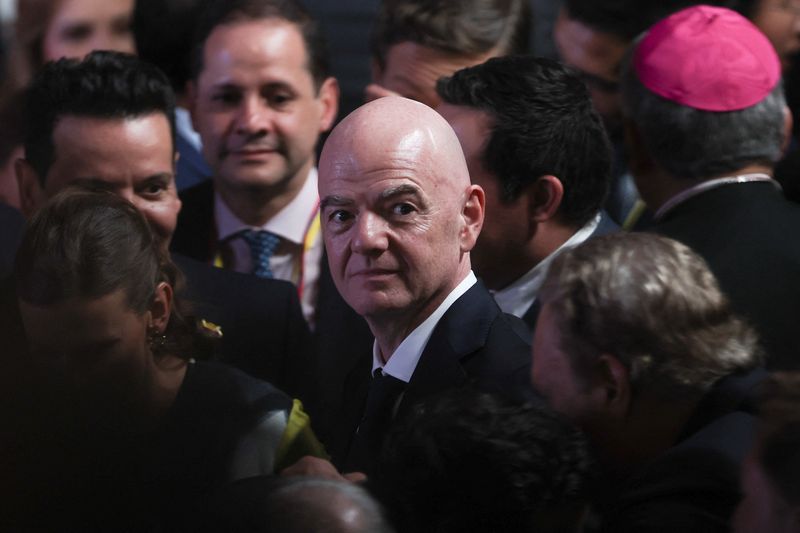
The leadership question engulfing FIFA could be resolved through democratic process rather than backroom pressure, according to Confederation of African Football president Patrice Motsepe, who believes the organisation's 211 member associations should determine Gianni Infantino's political future when they gather for the 77th Congress in Rabat, Morocco on March 18 next year. Motsepe's intervention marks a significant position within the confederation landscape as Infantino navigates open criticism from UEFA, AFC and CONCACAF, three of FIFA's six continental bodies that have openly questioned his leadership following his unsuccessful attempt to attract private investment into global football competitions, including the World Cup itself.
Infantino's push to commercialise FIFA tournaments through private equity involvement sparked unprecedented institutional resistance, with the three confederations issuing extraordinary calls for his resignation. This coalition of dissent has placed his re-election prospects under genuine scrutiny, creating a rare moment of vulnerability for a president who has dominated FIFA decision-making since his election in 2016. The convergence of opposition from Europe, Asia, and the Americas represents a challenge that extends beyond routine electoral positioning.
Yet Motsepe, speaking to Sky News in a direct intervention in the dispute, argued that circumventing FIFA's established electoral mechanism would fundamentally undermine the organisation's legitimacy and set a troubling precedent. Rather than yielding to concentrated institutional pressure from powerful confederations, the proper course involves allowing the full membership to exercise its franchise within formal procedures. His framing positions the dispute not as a referendum on Infantino's specific decisions but as a question about how football's global governance should function when controversy arises.
The CAF president articulated a distinction between legitimate scrutiny of leadership conduct and what he characterised as an irregular attempt to pre-empt the electoral process. He acknowledged that leaders deserve intense examination and should be held accountable to rigorous governance standards, yet argued that mechanisms already embedded within FIFA's structures exist to address grievances and resolve disputes. This perspective reflects a broader concern that allowing confederations to effectively overturn or preempt membership votes through coordinated pressure could establish dangerous institutional patterns.
Motsepe's emphasis on process and due diligence carries particular weight given African football's historical experience with governance disputes and institutional instability. The CAF, representing 54 national associations across the continent, wields substantial voting power within FIFA's broader assembly. His explicit backing for allowing the democratic process to proceed intact signals that a significant voting bloc remains committed to Infantino's candidacy, or at minimum is unwilling to abandon procedural norms even when disagreeing with particular policies.
The African confederation leader's remarks also illuminate the philosophical divide between those who view FIFA's membership as possessing ultimate authority over its leadership and those who believe that concentrated power wielded by major confederations legitimately shapes institutional direction. Motsepe positioned himself squarely in the former camp, insisting that 211 voices matter more than a coalition of three continental bodies, regardless of their economic or sporting significance. This stance could resonate with smaller football associations that fear being marginalised by power politics among the largest confederations.
Meanwhile, Motsepe confirmed that CAF maintains formal support for Infantino, citing his demonstrated commitment to African football's development and his responsiveness to continental priorities. This backing proves strategically significant given that Africa's 54 votes represent approximately one quarter of FIFA's total membership. Losing African support would substantially complicate any re-election campaign, whereas maintaining it provides a foundational base that could prove decisive if the three opposing confederations field a credible alternative candidate.
The CAF president's call for competing candidates to declare themselves openly suggests confidence that Infantino either faces no serious challengers or that he would prevail in a competitive election. By inviting opponents to formally enter the race rather than relying on informal coalitions, Motsepe framed the matter as a test of genuine membership opinion rather than backstage manoeuvring. This approach theoretically benefits whoever commands majority confidence among the full membership, whether that proves to be Infantino or a rival.
Motsepe's intervention carries implications for Southeast Asian football associations, which collectively represent multiple FIFA votes through both AFC membership and individual national federation participation. How Asian confederations ultimately position themselves in the dispute—AFC has already joined UEFA and CONCACAF in criticising Infantino—could prove determinative. Southeast Asian federations within AFC would find themselves pulled between continental confederal directives and Motsepe's argument for membership sovereignty.
The dispute ultimately reflects broader tensions within global sports governance regarding the balance between democratic membership structures and concentrated power held by large or wealthy confederations. Motsepe's position essentially argues that FIFA's legitimacy depends on respecting its foundational democratic principles even when those principles might produce unwelcome outcomes. Whether the organisation's actual decision-making culture respects that principle remains uncertain, particularly given the extraordinary pressure three confederations have mounted against an incumbent president.
For Malaysian football observers and administrators, the FIFA leadership question holds more than symbolic importance. Malaysian football's standing within AFC and global football governance structures depends partly on how these continental and international power dynamics evolve. An Infantino re-election would likely preserve the current institutional architecture, whereas a successful challenge might introduce different priorities or approaches to global competition management and investment strategies that could affect Southeast Asian national teams' opportunities.
The March 2027 Congress will ultimately test whether FIFA's membership truly retains meaningful authority over its executive leadership or whether that authority has effectively devolved to the largest confederations. Motsepe's public defence of democratic process suggests that at least one major confederation remains committed to membership-based governance, yet the outcome remains genuinely uncertain given the coordinated opposition Infantino faces from three separate continental bodies representing football's most economically powerful regions.

