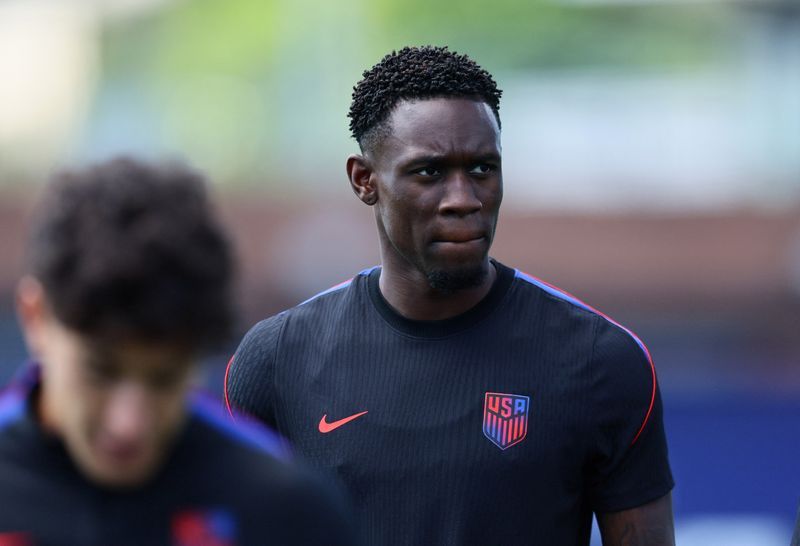
FIFA's move to suspend the enforcement of Folarin Balogun's automatic red-card suspension ahead of the United States' World Cup last-16 encounter with Belgium has ignited a firestorm of protest from multiple European football associations, who view the decision as a dangerous precedent that undermines the fundamental principles governing competitive sport. The reversal came after United States President Donald Trump directly contacted FIFA President Gianni Infantino requesting a review of the disciplinary action, raising uncomfortable questions about the extent to which political pressure can reshape decisions made by international sporting bodies tasked with upholding neutral rule enforcement.
The Italian Football Federation's response was particularly scathing, arguing that FIFA has crossed a critical threshold by treating automatic suspensions as discretionary matters subject to exception. The federation contended that the principle of mandatory one-match bans following red-card dismissals is not merely a guideline or regulatory preference but rather an immutable foundation of competitive fairness embedded within the disciplinary framework. By suspending enforcement on a probationary basis for a year, the federation suggested, FIFA had fundamentally compromised the certainty that players, coaches, and supporters rely upon when interpreting what constitutes equitable enforcement across all competing nations. This framing positions the decision not simply as a sporting mistake but as an institutional betrayal of the very consistency that legitimises international competition.
What particularly troubles governing bodies across Europe is the tournament-specific implications of FIFA's action. Multiple players from different nations have already served automatic one-match suspensions during this World Cup competition, having accepted the penalty as an inevitable consequence of receiving a red card. The decision to retroactively suspend Balogun's ban now creates a two-tiered system where some players bore the consequences of standard disciplinary protocol while others benefit from exceptional treatment, fundamentally fracturing the principle of equal application that underpins sporting legitimacy. The Italian federation explicitly warned that this precedent demands similar treatment in comparable future situations, thereby creating a cascading problem throughout the tournament that could only be resolved through further exceptions.
The Royal Belgian Football Association adopted a more technical approach, meticulously citing the specific provisions within FIFA's own disciplinary code to demonstrate that Article 66.4 clearly stipulates automatic suspension for sending-offs. While acknowledging that Article 27 grants the FIFA Disciplinary Committee discretionary power to suspend enforcement of previously imposed sanctions, the Belgian body emphasised that this provision was never intended to override the mandatory nature of red-card consequences, particularly not during an active tournament where consistency is essential. This distinction—between exceptional powers and their appropriate application—proved crucial to the federation's objection, suggesting that FIFA may have technically operated within its authority while nonetheless catastrophically misapplied that authority.
German Football Association President Bernd Neuendorf's statements added a dimension of institutional concern about the broader implications for FIFA's reputation and autonomy. Neuendorf explicitly called for immediate clarification regarding the reported telephone conversation between Trump and Infantino, framing the issue as a matter of protecting sport from direct political interference. His invocation of April Fools' Day served as pointed sarcasm, suggesting that the decision appeared so incongruous with established sporting principles that it bordered on absurdity. The DFB president articulated a distinction between defending national sporting interests and defending the foundational integrity of football itself, positioning his critique as defending the latter against erosion.
Analysts and football personalities closely examined the logical inconsistency within FIFA's position. One prominent voice questioned the reversal in light of VAR's independent confirmation that the original dismissal met the criteria for a red card, asking on what grounds FIFA could overturn a decision that had already survived multilayered technical review by multiple officials. This observation highlights a persistent tension in modern football administration: as technology becomes more embedded within decision-making architecture, the authority of human appeal processes correspondingly diminishes. If three VAR officials and the on-field referee collectively determined that Balogun's action warranted dismissal, the question becomes whether any subsequent review process can legitimately reverse that technical consensus without appearing arbitrary.
The broader concern articulated by multiple observers centres on the reputational damage that extends beyond this single match. Should the United States advance past Belgium, the asterisk attached to their progression would follow them throughout the tournament, potentially undermining any subsequent achievements as suspect in the eyes of other competing nations. This concern reflects how exceptional rule applications in sport do not simply resolve immediate competitive questions but rather contaminate the legitimacy of all downstream outcomes. A team advancing despite benefiting from exceptional disciplinary treatment carries that exception forward through every subsequent match, creating a structural problem that cannot be resolved through sporting performance alone.
For Malaysian and Southeast Asian observers, this incident carries instructive implications about the vulnerability of international sporting governance to external political pressure. The ASEAN region has increasingly invested in hosting major international sporting events and developing homegrown football competitions; the Balogun incident demonstrates how even the world's largest sporting organisation can be perceived as susceptible to pressure from powerful political figures when interests align. This raises questions about what protections remain available to ensure that regional sporting bodies maintain independence from political interference, particularly when tournaments involve participating nations whose governments might seek to influence outcomes or exceptions.
The incident also exposes the fundamental difference between written rules and the discretionary mechanisms that exist nominally to enforce them. While FIFA's disciplinary code technically permits the exception invoked in Balogun's case, the decision to exercise that power under circumstances involving direct presidential intervention reveals how formal procedures can be weaponised in ways that contradict their original purpose. This distinction between legal possibility and legitimate application will likely shape ongoing discussions about governance reform across international sports bodies, particularly as discussions intensify about enhancing transparency and limiting political involvement in competitive decision-making.
The controversy underscores a persistent tension within modern sport between preserving flexibility to address genuine injustices and maintaining rigid consistency that prevents favouritism. While FIFA argued it was exercising appropriate discretion, critics contend that the circumstances—particularly the reported presidential phone call—render that discretion itself suspect, regardless of whether the underlying legal mechanism technically permits the action. This tension between principle and pragmatism, consistency and fairness, will likely define ongoing conversations about how international sports organisations should balance rulebook precision against the need for contextual judgment, and how they can shield that judgment from political manipulation.

