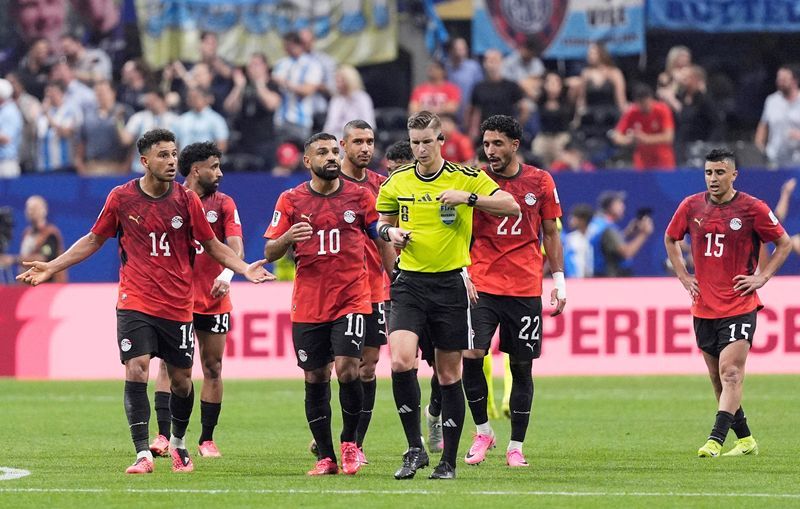
FIFA's refereeing chief Pierluigi Collina has moved to quash growing controversy surrounding Argentina's dramatic 3-2 defeat of Egypt in a World Cup knockout match, firmly defending the integrity of the match officials and the video assistant referee (VAR) system that made several pivotal decisions. In comments published on the official FIFA platform on Thursday, Collina addressed escalating complaints from the Egyptian Football Association and coaching staff, who questioned whether certain rulings had been applied fairly during the tournament fixture.
The Argentine team's comeback from a 2-0 deficit, culminating in a stoppage-time goal by Enzo Fernandez, prompted immediate scrutiny from Egypt's delegation, who argued that critical decisions had directly altered the match's trajectory. Coach Hossam Hassan suggested publicly that external pressure may have influenced the referee's judgment in Argentina's favour, reflecting broader anxieties about whether tournament favouritism affects officiating standards at the highest level of international football. The Egyptian Football Association subsequently issued a formal statement contending that multiple controversial moments demonstrated inconsistent application of the laws of the game.
Collina distinguished between legitimate tactical discussion and unfounded accusations, maintaining that while debate about refereeing choices remains inherent to professional football, questioning officials' impartiality crosses an ethical line that the sport cannot tolerate. His comments underscore FIFA's determination to protect its match officials from reputational damage, particularly given the personal security implications that can arise when integrity is publicly questioned. The FIFA official emphasized that institutional safeguards exist specifically to insulate referees from external interference, whether from presidents, national federations, or other stakeholders seeking to influence outcomes.
At the centre of Egypt's grievance was Mostafa Zico's disallowed second-half goal, which VAR overturned after identifying what officials deemed a foul by defender Marwan Attia on Argentina's Lisandro Martinez during the build-up play. The Egyptian team disputed the existence of this foul entirely, viewing the decision as overly strict and inconsistently applied given other contact that went unpunalised during the contest. Collina's defence rested on the principle that referees need not witness a violation directly if VAR establishes that a foul occurred; the video system's intervention therefore operates within established protocol rather than representing arbitrary intervention.
Equally contentious was the moment preceding Argentina's winning goal, when Egyptian winger Mohamed Salah appeared to be challenged without penalty being awarded. Egypt's officials argued that this contact should have resulted in a free kick or penalty, thereby preventing the attacking sequence that yielded Enzo Fernandez's winner. The proximity of this non-decision to the decisive goal crystallized Egyptian frustration, creating the perception that opposing challenges were subject to fundamentally different standards.
Collina directly addressed the Salah incident by characterizing the contact between the Egyptian player and Argentina defender Julian Alvarez as routine physical engagement rather than a punishable offence. Under football's laws, he explained, contact becomes foul play only when it is excessive or prevents a player from fairly competing; defenders who make legitimate contact with the ball before engaging an opponent have committed no violation. This distinction between lawful and unlawful contact often determines matches, yet remains inherently subjective and dependent on match officials' split-second judgment in dynamic situations.
The VAR protocol for Zico's disallowed goal followed established procedures for detecting infractions that referees might miss during open play. Collina emphasized that the threshold for VAR intervention does not require an infraction to be glaringly obvious; if video review identifies any foul, regardless of how subtle, VAR's responsibility is to alert the on-pitch referee to ensure accurate enforcement of the laws. This interpretation has generated recurring debate in international football, with competing philosophical positions on whether subtle or marginal fouls warrant stopping play and overturning goals.
For Malaysian and Southeast Asian followers of international football, these controversies reflect broader tensions within modern refereeing about consistency, technology's role, and fair competition. Regional national teams frequently encounter situations where VAR interpretations appear inconsistent or culturally influenced, making debates about refereeing standards directly relevant to Asian football audiences who question whether major tournaments apply uniform standards across different confederations and footballing traditions.
Collina acknowledged that subjective judgment will always characterize certain refereeing decisions, a candid admission that no system achieves absolute objectivity in sport. Nevertheless, he asserted that FIFA remains confident VAR principles were correctly applied throughout the tournament, suggesting that while individual decisions might be debatable, the overall framework operated appropriately. This position provides some institutional accountability while defending officials against accusations of systematic bias.
The dispute between Egypt and FIFA reflects deeper anxieties about tournament integrity, particularly when outcomes favour established footballing powers. Argentina's status as a traditional powerhouse, combined with the dramatic nature of their comeback, invited suspicions that refereeing decisions had been influenced by factors beyond the match itself. Such narratives gain traction when decisions appear to benefit stronger nations, even absent concrete evidence, creating lasting impressions of unfairness that extend beyond individual matches to broader perceptions of tournament administration.
Collina's defence of his officials also serves to protect FIFA's institutional credibility during a period when the organization faces broader governance scrutiny. Any sustained narrative suggesting that corruption or favouritism influences tournament outcomes threatens FIFA's legitimacy and commercial relationships with broadcasters and sponsors who depend on competitive integrity. By moving quickly to dismiss Egyptian claims, FIFA signalled that such allegations would not gain institutional currency, regardless of whether individual decisions provoked legitimate debate.
The incident ultimately highlights the persistent challenge of applying uniform refereeing standards across diverse cultural contexts and football traditions within international competition. As video technology becomes increasingly central to match decisions, debates will intensify about which interpretations constitute correct applications of the laws versus subjective choices that differ between matches or matches officials. For regional football supporters observing from Southeast Asia, these disputes underscore why transparent, consistent refereeing standards remain essential to maintaining confidence that international tournaments reflect competitive merit rather than institutional or geopolitical preferences.

