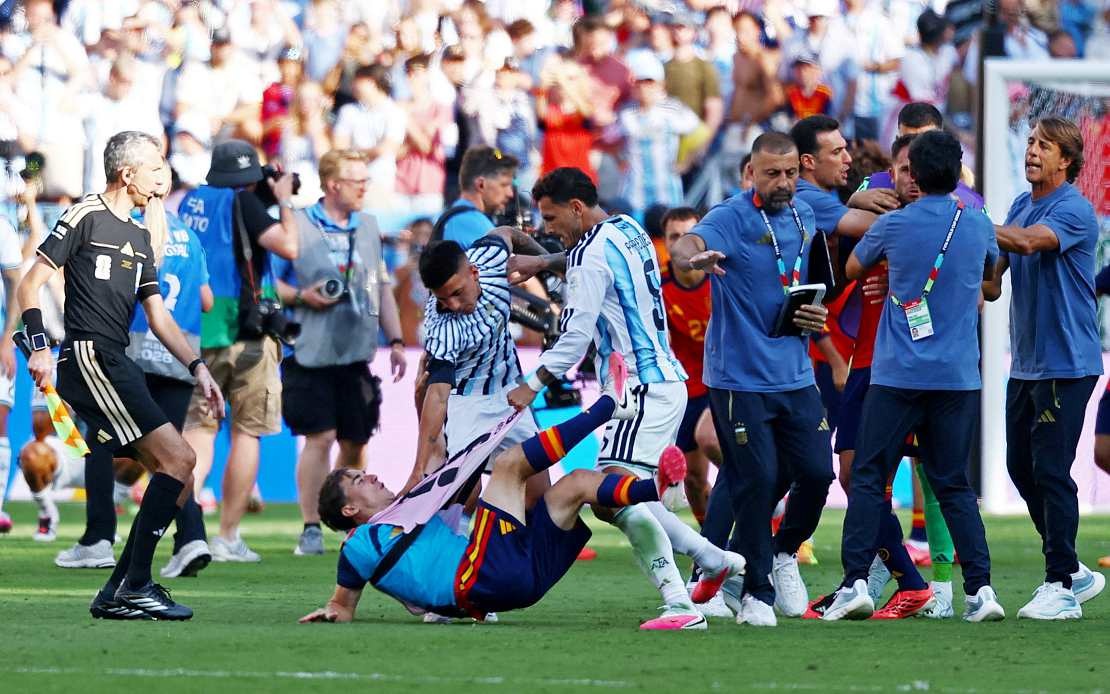
FIFA has formally opened an investigation into Argentina's behaviour during and after the World Cup final against Spain, with the governing body appointing a Disciplinary and Ethics Prosecutor to examine potential violations of the FIFA disciplinary code. The decision follows a comprehensive review of match reports and detailed documentation from the fixture held in New Jersey, where Spain ultimately emerged victorious. This move signals FIFA's commitment to enforcing conduct standards at the tournament's highest stakes, though the scope and severity of findings remain uncertain.
The investigation centres on events that unfolded after the final whistle, when Argentina midfielder Leandro Paredes appeared to engage in physical altercations with Spanish players celebrating their triumph on the pitch. Video footage from the match has circulated widely, showing the apparent confrontation, which prompted FIFA's match commissioner to flag the incidents in official reports. Such post-match conduct falls under specific provisions within the FIFA disciplinary framework, and the appointment of a dedicated prosecutor indicates the world football body views the matter with sufficient gravity to warrant formal examination rather than swift dismissal.
Argentina's disciplinary record throughout the tournament had already drawn scrutiny from football observers and officials alike. The South American side faced criticism for their physical, at times aggressive style of play, which became particularly evident during their semi-final encounter with England. Midfielder Enzo Fernandez received a red card in that match for accumulating two yellow card offences, reflecting the intensity and occasional lack of restraint displayed by the Argentine contingent. This pattern of conduct, culminating in the post-final incidents, has reinforced perceptions among some quarters that Argentina pushed beyond acceptable limits of physicality.
Beyond the on-pitch altercation, FIFA's investigation may also encompass separate alleged breaches relating to political symbolism. Following Argentina's victory over England in the semi-final, the squad displayed a banner asserting Argentine sovereignty over the Falkland Islands—a territory whose sovereignty remains disputed between Argentina and the United Kingdom. Such action potentially violated Article 34.3 of the tournament regulations, which typically restrict political statements and gestures. However, FIFA has not publicly confirmed whether this specific incident falls within the current investigation's scope, leaving observers uncertain about the full breadth of the disciplinary examination.
The precedent for how FIFA handles political gestures and statements has evolved inconsistently over recent years, creating ambiguity about potential outcomes. The Argentine Football Association (AFA) previously incurred a fine for a similar Falkland Islands banner display during a 2014 friendly match against Slovenia, suggesting FIFA's earlier tolerance for such conduct. Conversely, UEFA, European football's governing body, adopted a markedly stricter approach when addressing comparable incidents following Euro 2024. Spain defender Rodri and forward Alvaro Morata both received one-match bans after chanting about Spain's territorial claims to Gibraltar, demonstrating significantly harsher penalties than FIFA imposed on Argentina nine years earlier.
This inconsistency in enforcement across different competitions and governing bodies raises important questions about the coherence of disciplinary standards in international football. When comparable political gestures receive vastly different consequences depending on the administrator, legitimacy concerns arise about whether penalties reflect the severity of violations or rather the varying approaches of individual organisations. For teams and players navigating international tournaments, such unpredictability creates uncertainty about which conduct crosses definitive lines into prohibited territory versus what might be tolerated or subject only to minor sanctions.
FIFA's broader track record suggests the organisation has increasingly vigilant about political expression and gestures at major tournaments, though the severity of enforcement remains variable. During the 2022 FIFA World Cup in Qatar, FIFA explicitly threatened the English Football Association with sporting consequences if captain Harry Kane wore the 'OneLove' rainbow-coloured armband, a gesture intended to signal support for LGBTQ+ rights. Kane faced the prospect of a yellow card sanction if he proceeded with wearing the armband in a nation where homosexuality remains criminalised under local law. This incident highlighted FIFA's determination to suppress certain forms of expression, even when they relate to fundamental human rights advocacy rather than territorial or nationalist claims.
The divergence between FIFA's treatment of political gestures and its handling of on-field violence presents a notable tension in the organisation's disciplinary philosophy. While politically motivated armband wearing faced explicit threat of immediate sanctions, Argentina's apparent physical altercations required formal investigation with timelines and prosecutorial review. This asymmetry suggests FIFA may prioritise preventing political statements over addressing player conduct, a prioritisation that has drawn criticism from various quarters within the football community and beyond. The investigation into Argentina's behaviour provides an opportunity to clarify where FIFA genuinely positions violence and aggressive conduct within its enforcement hierarchy.
For Argentine football and the broader South American perspective, the investigation carries implications beyond immediate disciplinary outcomes. A World Cup final victory, regardless of the controversy surrounding post-match behaviour, represents an achievement of immense national significance. However, if FIFA determines that breaches occurred and imposes substantial penalties against players or the federation, such actions could cast shadows over the tournament's legacy in Argentina and raise broader questions about how different football associations face accountability. The precedent established here will likely influence how similar incidents are handled in future tournaments, making the investigation outcome consequential for international football governance.
The completion timeline for FIFA's investigation remains unspecified, though FIFA's statement indicated that further details would be communicated following the prosecutor's report. This deliberate pace contrasts with the immediate nature of disciplinary decisions during matches themselves, where referees must make instantaneous judgments. The investigative approach allows for thorough documentary review and witness statements but introduces extended uncertainty for all parties involved. As FIFA's Disciplinary Committee awaits the prosecutor's findings, the football world watches to see whether Argentina faces meaningful consequences and what such outcomes signal about the organisation's enforcement priorities moving forward.

