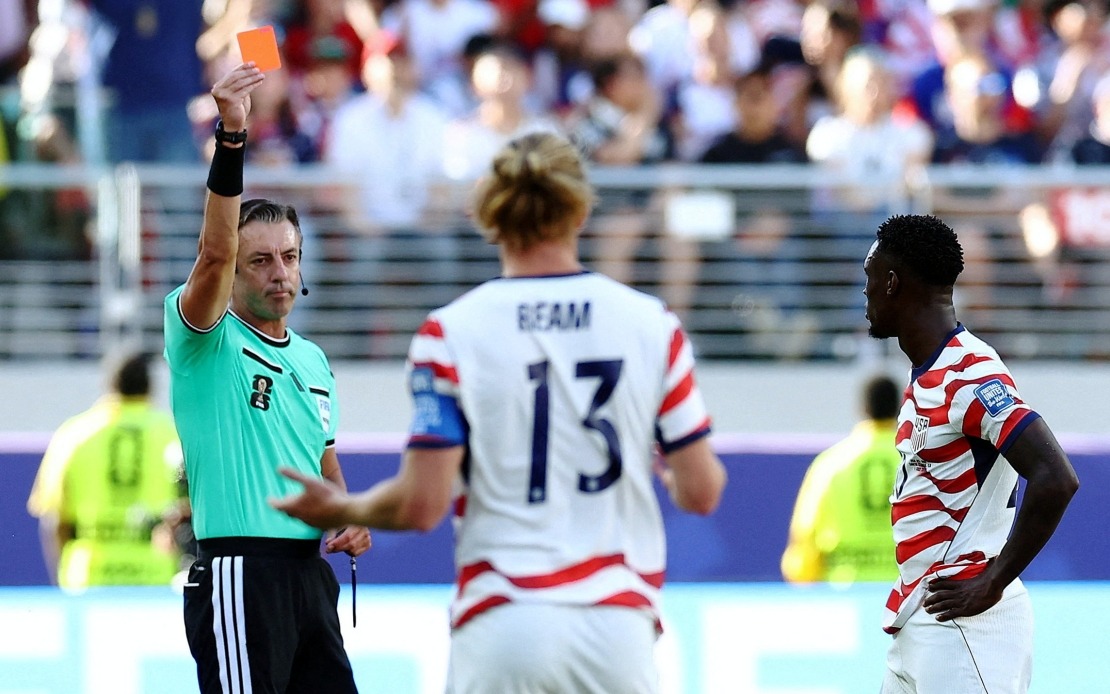
In a controversial decision that has triggered diplomatic tensions between two major football nations, FIFA announced on Sunday that it would suspend enforcement of the one-match suspension handed to American striker Folarin Balogun, permitting him to participate in Monday's critical World Cup round-of-16 encounter against Belgium in Seattle. The ruling has fundamentally altered the competitive landscape of what was already shaping up to be a tightly contested clash, with a quarterfinal berth hanging in the balance for both teams.
Balogun's original suspension stemmed from a red card issued during the United States' 2-0 victory over Bosnia and Herzegovina on July 1, when he was dismissed for stamping on defender Tarik Muharemovic. The FIFA Disciplinary Committee initially determined that his conduct constituted violations of Articles 14 and 66 of the FIFA Disciplinary Code, leading to a one-match ban. However, invoking Article 27 of the same code, which grants the disciplinary committee discretionary power to suspend enforcement of sanctions, FIFA opted to defer the punishment for a probationary period of one year.
The implications of this decision extend well beyond the immediate match-up between the Americans and Belgians. Balogun has emerged as a linchpin in the US offensive strategy, having already recorded three goals throughout the tournament and serving as a primary threat to opposing defences. His availability fundamentally strengthens the American squad's attacking capabilities at a critical juncture in the competition. The ruling has effectively granted the United States a significant competitive advantage precisely when it matters most, as the team pursues its first quarterfinal appearance since 2002.
The Belgian football establishment has responded with marked displeasure, with the Royal Belgian Football Association issuing a formal statement expressing its "astonishment" at FIFA's interpretation. The Belgian federation has initiated a comprehensive review of its legal options and has indicated its intention to challenge the decision through available channels. At the core of Belgium's objection lies their contention that FIFA has selectively applied its own regulatory framework, creating an inconsistency that undermines the integrity of tournament competition.
Belgium's primary argument hinges on Article 66.4 of the FIFA Disciplinary Code, which stipulates that any player receiving a direct red card faces an automatic suspension for their team's immediate subsequent match. The Belgian federation points out that this provision has been uniformly enforced throughout the tournament, applied consistently to every previous red card incident without exception or discretionary modification. Their position suggests that Balogun's case should have been treated identically to all other infractions of comparable nature.
Furthermore, the Belgian federation has invoked the FIFA World Cup 2026 Competition Regulations, specifically Article 10.5, which mandates that players dismissed by direct red card or accumulated cautions "will automatically be suspended from their team's subsequent match," with additional disciplinary measures potentially applicable. This regulatory language appears unambiguous and leaves minimal room for interpretive flexibility. According to Belgium's account, these automatic suspension principles were formally reinforced through FIFA World Cup 2026 Circular No. 16, circulated to all participating member associations on May 12, and were subsequently reaffirmed during both match coordination meetings and official tournament workshops conducted throughout the competition.
The tension between Article 27's discretionary provisions and Article 66.4's mandatory language has created what Belgian officials characterise as a fundamental contradiction within FIFA's regulatory structure. While FIFA's Disciplinary Committee theoretically possesses the authority under Article 27 to suspend implementation of sanctions, Belgium contends that this discretionary power cannot override the automatic suspension mechanisms embedded within other sections of the code. The federation's legal position rests on the principle that more specific provisions governing red cards should supersede general discretionary clauses.
From a broader perspective, this dispute exemplifies recurring tensions surrounding FIFA's governance and regulatory consistency. The perception of selective application of disciplinary rules—whether founded in reality or not—poses genuine risks to the credibility and perceived fairness of international football competitions. When major football nations publicly challenge FIFA's interpretations, particularly in high-stakes tournament scenarios, confidence in the governing body's impartiality erodes. The precedent established by Balogun's case may shape disciplinary approaches throughout future tournaments.
For Malaysian football observers and Southeast Asian readers generally, this incident carries particular relevance as it illustrates how global football governance decisions can appear inconsistent and unpredictable, with profound competitive consequences. The region's nations, despite limited presence in elite World Cup competitions, have vested interests in understanding and participating in football's regulatory discussions. The willingness of established football powers like Belgium to publicly challenge FIFA's rulings demonstrates that even wealthy, well-resourced football associations cannot always influence major disciplinary outcomes.
The suspension decision also reflects broader questions about how FIFA weighs competitive balance against strict rule adherence. While suspending Balogun's ban might appear to serve tournament entertainment value by ensuring a marquee match features a top scorer, such considerations should theoretically remain secondary to regulatory consistency and transparent application of established rules. The question of whether FIFA made this decision because of Balogun's nationality, scoring record, or the commercial appeal of a full-strength United States team remains unanswered and consequently fuels speculation.
Belgium's comprehensive statement reveals the federation is pursuing all available remedies, suggesting possible appeals or formal complaints to FIFA's higher regulatory bodies. Whether such efforts will prove successful remains uncertain, given FIFA's institutional tendency to defend disciplinary committee decisions. The immediate practical consequence is that both teams will prepare for Monday's match with full knowledge of the regulatory landscape, though Belgium must process the considerable frustration of competing against a player it believes should be ineligible.
The resolution of this controversy will likely receive further attention during post-tournament reviews of FIFA's disciplinary procedures and regulatory coherence. For now, Balogun remains available for selection, Belgium has lodged its formal protest, and both teams prepare for a match that will determine which advances toward the quarterfinals. The decision has injected an element of controversy into the sporting narrative that transcends the mere tactical implications on the pitch, raising questions about fairness and consistency that will resonate throughout the global football community.

