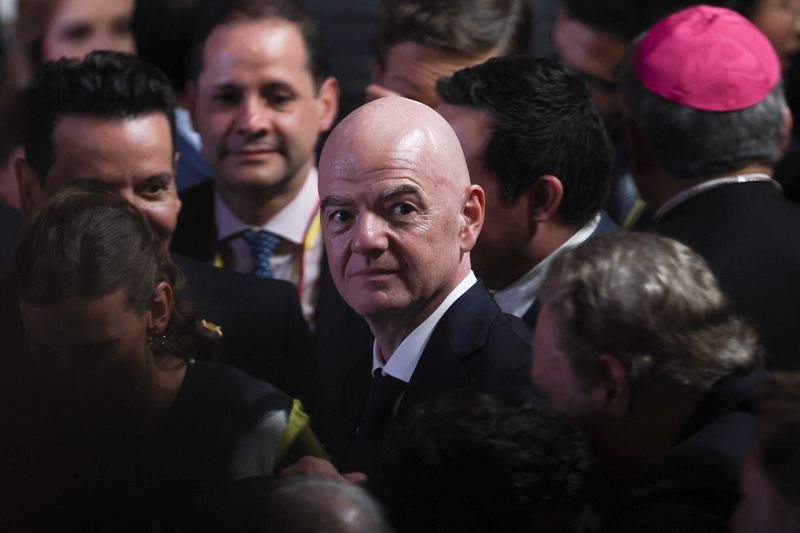
FIFA has moved to shield President Gianni Infantino from mounting pressure by issuing a forceful warning against what the governing body characterizes as a "concerted and ongoing effort" to destabilize his position. The statement, released on Saturday, emphasizes that any legitimate challenge to Infantino's leadership must navigate FIFA's formal democratic channels and statutory requirements, effectively drawing a line against what leadership views as coordinated attacks from multiple quarters.
The defense comes as Infantino finds himself engulfed in controversy following the spectacular collapse of his ambitious proposal to unlock approximately $4.2 billion in capital by monetizing the commercial rights associated with the FIFA World Cup and other international tournaments. The scheme had promised to distribute substantial financial benefits to member associations globally, but its sudden withdrawal after fierce opposition left FIFA's governance structure fractured and raised serious questions about the decision-making processes at the top of the organization.
Opposition to Infantino's leadership has crystallized around several European and Scandinavian federations, most prominently UEFA, which issued a statement declaring it no longer maintains confidence in the FIFA president. Norwegian Football Federation President Lise Klaveness amplified these concerns by explicitly calling for Infantino's resignation, arguing that the institutional trust necessary to lead a global sports organization had been fundamentally eroded by recent events. Her intervention marked a significant escalation, moving beyond technical criticism into direct challenges to his fitness for office.
The FIFA statement did not name specific opponents or identify which media reports and allegations it considered unfounded, instead speaking broadly about "unsubstantiated assertions and demonstrably false claims" circulating in recent coverage. However, observers immediately recognized the reference to reporting by The Daily Telegraph concerning payments UEFA made to a former employee during Infantino's tenure as general secretary of the European body. Infantino has categorically denied any wrongdoing related to those payments, and FIFA has similarly rejected the allegations as baseless.
Despite the visible cracks in Infantino's support structure, his position remains far from untenable. The FIFA president continues to command backing from geographically and politically significant member associations that collectively represent the bulk of the organization's voting power. The Confederation of African Football unanimously reaffirmed its support for Infantino on Thursday, a decisive show of solidarity from a continental bloc representing 54 member nations. Similarly, South America's CONMEBOL rejected any attempts to remove Infantino that circumvented the established electoral process requiring a full vote of all 211 FIFA members.
Mexico's football federation has also pledged its backing for Infantino, though notably this support came despite CONCACAF, the regional confederation encompassing North America and the Caribbean, calling for a "comprehensive reckoning" with his presidency. This split highlights the complexity of FIFA's political landscape, where national federations sometimes diverge from their continental confederations on matters of global governance. The Mexican federation's explicit rejection of any "process convened outside of that institutional framework" underscores how defenders of Infantino are weaponizing procedural regularity against his challengers.
The crisis meeting convened in Morocco on Wednesday represented an attempt to stabilize Infantino's situation through reaffirmation of confidence from FIFA's executive structures. Following that gathering, FIFA issued an apology to its 211 member associations for mishandling the World Cup monetization proposal, acknowledging mistakes in how the initiative had been presented and pursued. The gesture appeared designed to separate Infantino personally from the flawed execution of his flagship policy, portraying the president as a leader capable of course correction rather than an obstinate figure unwilling to admit error.
Infantino's immediate political horizon centers on the FIFA Congress scheduled for March in Morocco, where he is expected to seek election to a fourth consecutive term as president. No clear challenger has yet emerged to contest his reelection, despite the drumbeat of criticism from UEFA and various European federations. This absence of an alternative candidate substantially strengthens his position, as FIFA members favoring change would need to coalesce behind a viable competitor within the coming months. The window for organizing a credible opposition candidacy remains open but increasingly narrow.
The depth of the current institutional crisis extends beyond personnel disputes into fundamental questions about FIFA's governance model and how it balances the interests of wealthy European confederations against developing nations that increasingly dominate the organization's membership. Infantino has built his power base substantially on the support of African, Asian, and South American federations, which represent the numerical majority within FIFA's voting structure. His European critics, despite their institutional prominence and historical influence, lack the numerical advantage necessary to dislodge him without winning over members from other continents.
For Malaysian football followers and Southeast Asian observers more broadly, the unfolding crisis carries broader implications for how FIFA navigates governance challenges and whether global sports organizations can effectively balance competing interests while maintaining institutional integrity. Malaysia and its ASEAN neighbors operate within AFC, the Asian confederation, which has not prominently entered the public debate over Infantino's future. How the Asian bloc positions itself in the lead-up to the March Congress could prove decisive, particularly if regional associations view the current tumult as an opportunity to advance their own priorities within FIFA's power structure.
The FIFA statement's emphasis on adherence to democratic procedures and statutory requirements represents a calculated gambit to position Infantino as the defender of institutional regularity against forces seeking to overturn established processes. Whether this framing proves persuasive to undecided member associations will substantially shape the outcome of the coming months. The organization faces a genuine test of whether its governance architecture can accommodate legitimate challenges to leadership while preventing what FIFA characterizes as illegitimate attempts at destabilization through external pressure and media campaigns.

