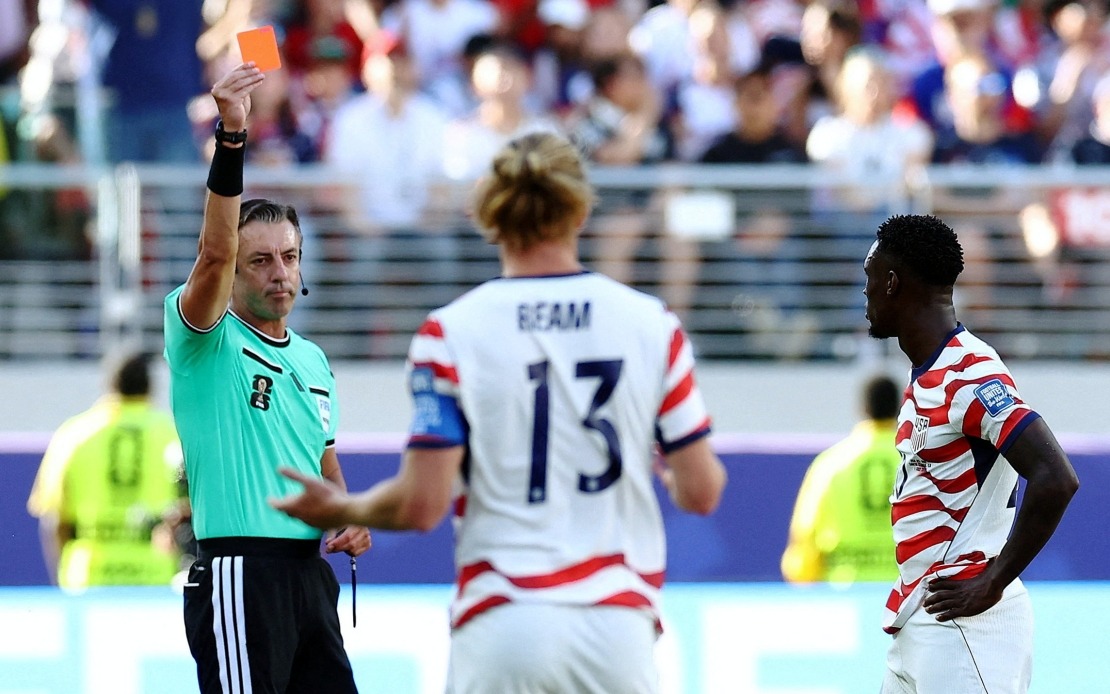
FIFA's head of referees Pierluigi Collina has publicly backed Brazilian official Raphael Claus, days after United States President Donald Trump labelled the match official as "suspect" over a controversial sending-off during World Cup play. The dispute centres on Claus's decision to dismiss US striker Folarin Balogun following a VAR review in the knockout stage encounter between the Americans and Bosnia and Herzegovina, a ruling that attracted considerable scrutiny from the highest political levels.
Balogun's dismissal initially appeared to derail American hopes in the tournament, yet the suspension was ultimately overturned on Sunday, enabling the forward to feature in the subsequent round-of-16 clash against Belgium in Seattle. That match ended in a heavy 4-1 defeat for the United States, shifting focus somewhat from the earlier refereeing controversy, though Trump's intervention kept the matter in the international spotlight. The presidential intervention represents an unusual instance of a sitting head of state wading into the technical details of World Cup officiating and requesting a formal review of a match decision.
FIFA responded to the criticism by issuing a formal statement defending Claus's standing within international football. The governing body characterised the Brazilian official as "one of the world's leading professional referees and a valued member of Team One" at the current tournament, while emphasising that throughout his career he had "consistently demonstrated the highest standards of professionalism and integrity." This language underscores FIFA's institutional commitment to its appointed officials and signals that politically motivated pressure will not alter the organisation's assessment of their competence.
Collina elaborated on the endorsement by noting that Claus brings substantial experience to the tournament, having previously officiated at the 2022 FIFA World Cup in Qatar. The experienced referee chief stated that the Brazilian carries the full confidence of FIFA leadership as a trusted match official, framing the position not as a defensive posture but as recognition of Claus's ongoing track record of excellence. Such statements are typically reserved for officials performing exceptionally well, suggesting FIFA views this as an opportunity to reaffirm institutional standards rather than merely weather political criticism.
Notably, Claus's positioning and reputation appear sufficiently robust that he could potentially be selected to officiate the tournament final, an assignment typically awarded only to the most accomplished referees. Brazil's elimination from the competition at the last-16 stage removes any perception of national bias that might otherwise complicate such an appointment, allowing Claus to remain in contention for the showpiece match. This scenario would represent vindication of Claus's credibility and an implicit rejection of the narrative Trump promoted regarding his competence.
FIFA President Gianni Infantino addressed the controversy indirectly, offering a broader defence of the tournament's match officials without specifically naming Claus. Infantino, who fielded a direct call from Trump requesting the Balogun decision be reviewed, chose to frame his response in terms of systemic excellence rather than individual exoneration. The Swiss executive took to Instagram to celebrate what he described as an "overwhelming success" for the 2026 World Cup, crediting match officials as a major contributor to that success.
Infantino's statement emphasised that all referees selected for the tournament underwent rigorous evaluation processes examining their skills, consistency, and demonstrated quality over extended periods. This methodological framing implicitly addresses Trump's suggestion that Claus might be unsuitable by highlighting the thoroughness with which FIFA vets its officials. The president reiterated that respect for referees and adherence to the rules governing football are fundamental to the sport itself, positioning referee authority as non-negotiable and above political reproach.
The entire episode illuminates the delicate tension between national interests and institutional integrity within international sport. Trump's intervention, while unprecedented in its directness, reflects the high stakes surrounding World Cup participation and the intense scrutiny that major refereeing decisions attract from invested governments. However, FIFA's coordinated response demonstrates resolve in defending its appointed officials against external pressure, a stance critical to maintaining the credibility of the officiating apparatus across all tournaments.
For Southeast Asian football stakeholders and Malaysian observers particularly, the incident carries implications regarding how international football governance handles pressure from powerful nations. The outcome of this dispute will signal whether FIFA can be swayed by political influence at the highest levels or whether institutional processes and standards remain inviolate. Claus's defence by Collina and Infantino suggests FIFA is committed to the latter position, potentially setting a precedent that should provide reassurance to smaller football federations that objective standards will be applied consistently regardless of political pressure.

