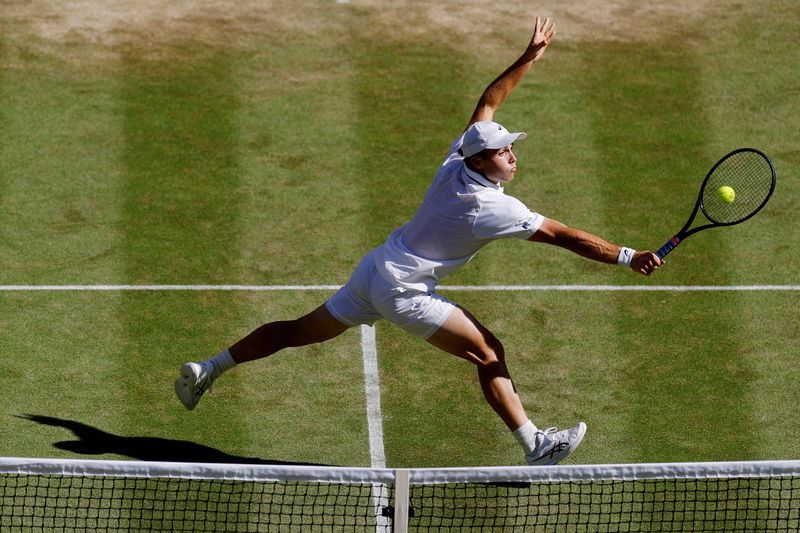
Arthur Fery's improbable run at Wimbledon has captured the imagination of British tennis fans and delivered an unexpected source of national pride at a tournament where homegrown talent has traditionally struggled. The London-raised wildcard, who celebrates his 24th birthday on the same day as the men's singles final, faces world number 10 Flavio Cobolli in the quarterfinals having survived yet another five-set thriller, this time against the seasoned Grigor Dimitrov, to secure his passage to the last eight. For a player who entered the Championships ranked 114th in the world, his trajectory through the draw represents nothing short of a sporting fairy tale.
Fery's ascent has assumed particular significance given the early departure of the majority of Britain's representatives. Of the 19 British singles competitors, 15 crashed out in the opening round, leaving the 24-year-old Fery to shoulder the weight of British expectations almost entirely alone. This concentration of hope on a single player, unfamiliar with the pressure of major tournament tennis on grass, would ordinarily seem an untenable burden. Yet Fery has responded with the composure and resilience of a seasoned competitor, somehow finding reserves of mental fortitude that belie his relative inexperience at the highest levels of the professional game.
The nature of Fery's victories has been particularly striking, as he has twice been forced to recover from deeply precarious positions. His third-round triumph over Zizou Bergs demanded an astonishing comeback from two sets to one down and facing a double break deficit in the fourth set. Rather than capitulating, Fery manufactured the longest match of the tournament to that point, all while battling a succession of nosebleeds that would have provided legitimate reason to withdraw. Such physical and mental obstinacy suggests a player possessed of uncommon determination, a quality that transcends ranking points and tournament seeding.
Monday's encounter against Dimitrov, a player who once held the world number three ranking and remains a formidable opponent despite his 35 years, unfolded with remarkable drama. The Bulgarian navigated to 4-3 in the fourth set with a break of serve, positioning himself seemingly within striking distance of victory. The crowd, energised by England's concurrent World Cup triumph over Mexico—news of which had filtered through to the grass courts—erupted when Fery miraculously clawed his way back into the contest. The roar that accompanied his match-clinching point reverberated through the ground with an intensity rarely witnessed at Wimbledon in recent memory, suggesting that Fery's journey has tapped into something deeper than mere sporting appreciation.
The timing of Fery's breakthrough deserves examination beyond mere coincidence. His appearance on Centre Court arrived during a moment of exceptional British sporting success, with the nation's football team simultaneously advancing through the World Cup in Mexico. Fery himself acknowledged this convergence of circumstances, observing that English sport was garnering global recognition. For Malaysian and Southeast Asian observers, the phenomenon illustrates how international sporting success transcends individual discipline or national boundary, creating a broader cultural current that lifts all competitors carrying their nation's colours.
Fery's unlikely elevation through the tournament has provoked recognition from established professionals who have encountered his abilities in practice environments. American sixth seed Taylor Fritz, having trained alongside Fery ahead of the 2024 World Tour Finals, publicly endorsed the British wildcard's capabilities, noting that he had been consistently outplayed during their practice sessions. Fritz highlighted Fery's exceptional serving capability and powerful forehand, technical assets that occasionally compensate for physical limitations. Such peer testimony carries particular weight in professional tennis, where players themselves recognise quality that statistical rankings have not yet fully absorbed.
The trajectory from a ranking of 114th at the tournament's commencement to inside the top 70 represents a seismic shift in Fery's professional standing, one that cannot be dismissed as mere statistical fluctuation. His accumulation of ranking points through consecutive deep rounds has fundamentally altered his career trajectory in a matter of days. For younger players seeking to break into elite professional tennis, Fery's example demonstrates that opportunities can materialise unexpectedly, particularly for those possessed of sufficient technical skill and mental resilience to capitalise when fortune intervenes.
Fery's background as a Stanford-educated player educated in the American college system adds another layer to his narrative. The France-born, London-raised competitor represents the increasingly globalised nature of elite tennis, where talent development occurs across multiple countries and institutional frameworks. His journey from collegiate tennis through the professional ranks follows a well-established pathway for Americans, yet his British nationality has positioned him as a representative of domestic tennis during a period of relative scarcity of homegrown champions. This geographical and institutional complexity enriches his story for international audiences, particularly those from Commonwealth nations familiar with similar patterns of athlete development.
The encounter with Cobolli in the quarterfinals holds particular significance given that Fery has already defeated the Italian earlier in 2024 at the Australian Open. Prior victory suggests familiarity with his opponent's patterns and tendencies, yet such advantages in tennis frequently prove ephemeral, dependent upon form, confidence, and the particular characteristics of the playing surface. Wimbledon's grass courts have favoured Fery's aggressive serving and attacking game, but Cobolli's ranking and experience suggest a formidable obstacle to further progress.
Beyond the immediate sporting narrative, Fery's breakthrough raises questions about the nature of wildcard selection and opportunity in professional tennis. The decision to grant him entry to the Championships, rather than reserving space for established British players, has been vindicated spectacularly by his performances. Yet such selection decisions remain inherently speculative, dependent upon judgements about potential that cannot be precisely quantified beforehand. For organisers of major tournaments across Southeast Asia and the Commonwealth, Fery's success offers instructive lessons about the value of supporting emerging talent, even when statistical ranking might suggest more cautious approaches.
The psychological dimensions of Fery's run merit deeper consideration as well. Playing before partisan crowds, carrying the hopes of an underperforming national team, and managing the pressure of successive five-set encounters demands mental capabilities often overshadowed by technical discussion. Fery's capacity to remain composed while physically compromised—as evidenced by his nosebleeds against Bergs—suggests psychological development that promises future tournament success regardless of his immediate Wimbledon trajectory.
Looking toward the quarterfinal encounter with Cobolli, Fery's continuation in the tournament remains uncertain, as the trajectory from unlikely qualifier to major finalist has often terminated abruptly for previous beneficiaries of such good fortune. Yet whatever the outcome of subsequent matches, his presence on Centre Court has already enriched Wimbledon's narrative and provided British tennis with an unexpected symbol of possibility.

