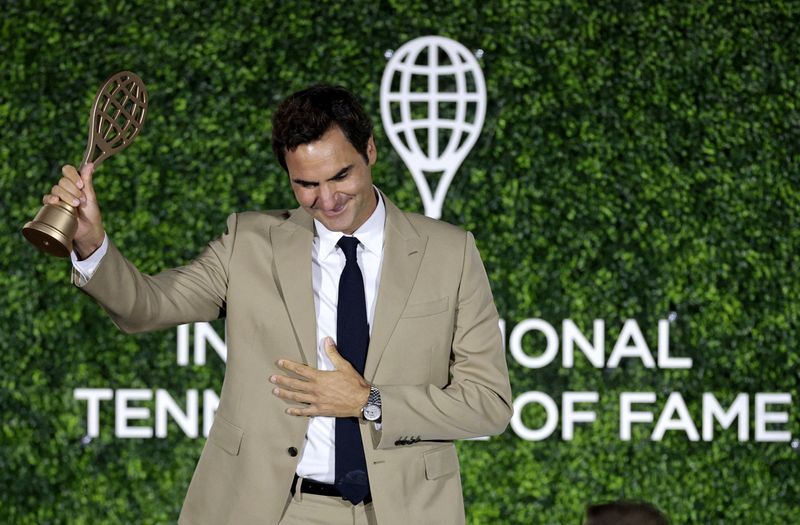
Roger Federer's induction into the International Tennis Hall of Fame on Saturday became a deeply personal reflection on a career that transcended competitive achievement. The 45-year-old Swiss champion, tears flowing at points during his address in Newport, Rhode Island, articulated a philosophy that has long distinguished him from contemporaries: his pursuit of excellence was always secondary to a deeper passion for the sport itself and the human connections it fostered. Inducted alongside broadcaster and journalist Mary Carillo, Federer delivered remarks that revealed how his record 20 Grand Slam titles, while remarkable, represent only part of what his relationship with tennis has meant.
Central to Federer's reflection was his consistent refusal to be defined solely by achievement metrics. "They call this the Hall of Fame, but fame was never the goal," he told the assembled audience. Instead, Federer emphasized that his fundamental aspiration was fundamentally about lifestyle—spending decades engaged in an activity he loved, surrounded by others equally devoted to the sport. This distinction carries particular resonance for Southeast Asian athletes and audiences, where career pathways are often framed exclusively through medals and rankings. Federer's articulation of purpose beyond the scoreboard suggests an alternative framework for understanding what constitutes a meaningful sporting life.
The statistics of Federer's career are nonetheless staggering. His eight Wimbledon titles remain a men's record, achieved during an era when he held the world number one ranking for 310 weeks. He accumulated six Australian Open championships, five U.S. Open titles, and claimed the French Open once, bringing his Grand Slam total to 20 before his retirement in 2022. Beyond these major tournaments, Federer amassed 103 ATP Tour victories, representing consistency across the professional circuit that few athletes in any sport have matched. Yet throughout his address, Federer spoke of these accomplishments as vehicles for something more profound: the opportunity to innovate within competitive sport while maintaining its essential character.
Federer's distinctive approach to the game itself became a theme of his induction remarks. He referenced his signature style choices—the now-iconic headband (over 5,000 worn throughout his career, by his own count) and his characteristic double socks—as expressions of personality within the sport's formal environment. More substantively, he discussed his willingness to experiment tactically, transitioning between serve-and-volley approaches, playing from the baseline, and even developing what the tennis world now calls the SABR (Sneak Attack by Roger), an unorthodox returning technique that exemplified his creative engagement with match play. For younger athletes in the region, this emphasis on innovation within established frameworks offers a model for how tradition and experimentation can coexist.
The emotional core of Federer's speech emerged as he acknowledged the off-court dimensions of his journey. He credited his coaches, medical team, and family—particularly his wife Mirka—for enabling his career while grounding him in values beyond tennis. This vulnerability was striking for an athlete whose public persona has often emphasized composed perfection. Federer's willingness to acknowledge dependence on others and the centrality of family relationships reflects a growing recognition in professional sports that sustainable excellence requires emotional support systems. For Malaysian audiences, where family structures remain culturally prominent, this framing resonates beyond the tennis court.
Federer's identification with Switzerland held special significance in his remarks. He recalled watching tennis as a 13-year-old ball boy in Basel, connecting his induction to the aspirations of a young person in his home country. This biographical continuity—from fan to champion to Hall of Fame inductee—illustrates how athletic excellence can emerge from grassroots engagement rather than elite academies alone. The implication for developing tennis nations in Southeast Asia is that sustained investment in community-level participation can produce world-class talent, provided young players maintain genuine enthusiasm for the sport.
Notably, Federer positioned his Hall of Fame induction not as a conclusion but as a transition. "I'm still writing my love letter to tennis, and my time as a player is done, but tennis will always stand at the intersection of everything I care most about," he stated. This framing suggests that retirement from professional competition need not mark the end of meaningful engagement with sport. For Malaysian athletes contemplating post-competitive careers, Federer's language implies multiple pathways through which one can remain connected to the athletic endeavors that have defined significant portions of life. His emphasis that the induction represents "not a goodbye" indicates an ongoing relationship with tennis in whatever form that may take.
Federer reflected extensively on his competitive relationships across multiple generations of tennis. He cited encounters with Andre Agassi and Lleyton Hewitt from earlier in his career, progressing through Andy Roddick, Rafael Nadal, and Novak Djokovic. This spanning of generational cohorts within professional tennis reveals how his career longevity allowed him to influence and be influenced by diverse competitive philosophies. For Southeast Asian sports observers, this pattern demonstrates how sustained excellence at the highest levels permits athletes to mentor younger competitors while learning from them—a reciprocal relationship that benefits the sport's overall development.
As Federer addressed the future of professional tennis, his remarks took on an almost mentoring tone toward contemporary and emerging players. He expressed hope that even as the sport accelerates—with faster serves, more intensive training regimens, and increasingly global participation—it will preserve what he termed "that amateur spirit." He called for maintained camaraderie among players, urging them to stay young at heart and true to their authentic selves. Particularly significant was his injunction to "never stop asking questions or taking risks," suggesting that innovation and intellectual curiosity remain vital even within the context of professional sport's growing commercialization and systematization.
Federer's specific encouragement for the sport to continue evolving—to "do things with the game we've never seen before"—projects confidence in tennis's capacity to renew itself. This optimism contrasts with occasional anxiety in sports commentary about whether professional athletics have become overly standardized or formulaic. His vision of pushing the sport "to the next level and keep getting better, better, and better" suggests that excellence need not calcify into mere repetition of proven methods. For developing tennis programs throughout Southeast Asia, this philosophy implies that success involves not simply copying established elite pathways but generating locally distinctive contributions to how the sport evolves globally.

