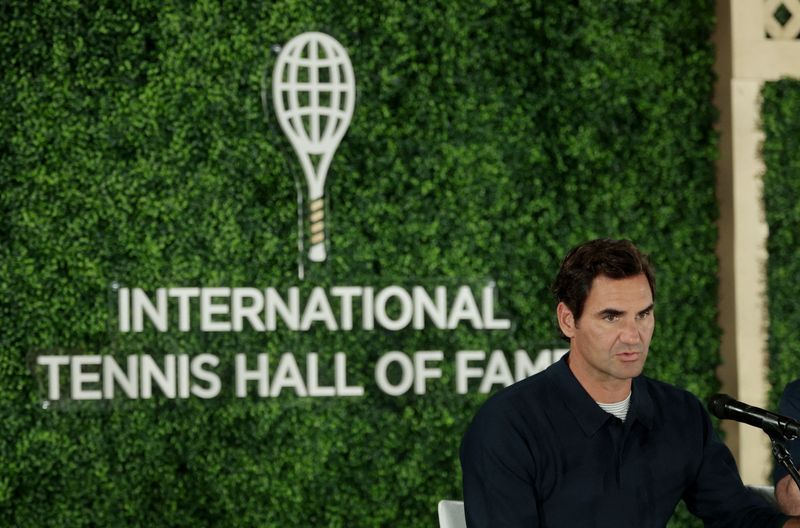
Roger Federer's induction into the International Tennis Hall of Fame this weekend represents a watershed moment for the Swiss champion to examine what his quarter-century of excellence has meant to the sport beyond the glittering trophy cabinet. At 45, the legendary competitor will formally join one of sport's most exclusive clubs alongside broadcaster and journalist Mary Carillo during ceremonies in Newport on Saturday, an honour Federer characterised at a Friday news conference as among the most significant achievements in professional tennis.
The numerical achievements that have long defined Federer's career remain staggering in their scope. His eight Wimbledon titles stand unmatched in the men's game, complemented by six Australian Open victories, five U.S. Open crowns, and the 2009 French Open triumph that sealed his career Grand Slam completion. Beyond the four majors, Federer accumulated 103 ATP Tour titles across his professional life and claimed 310 weeks atop the world rankings following his retirement in 2022. He also secured Olympic doubles gold alongside Stan Wawrinka in 2008 and contributed to Switzerland's 2014 Davis Cup victory, cementing his status among tennis's all-time greats.
Yet Federer's own assessment of his contribution to tennis diverges sharply from the conventional metrics of success that dominated his playing career. Speaking through Hall of Fame president Patrick McEnroe, the Swiss champion articulated a vision of legacy rooted in the tangible improvements he helped shepherd through the sport's governance structures. His involvement in discussions with ATP leadership, Grand Slam organisers, and player councils focused attention on material improvements that extended far beyond the winner's circle. Prize money expansion represented perhaps the most visible outcome, with Federer pointing to increased purses not merely for champions but for first and second-round competitors—a democratisation of earnings that fundamentally altered the economic viability of professional tennis for mid-tier players.
The infrastructural enhancements Federer championed touched nearly every constituency within professional tennis. Players benefited from improved training and recovery facilities, while medical staff gained better resources and working conditions. Stadium modernisation, media accommodations, and support services all reflected Federer's philosophical conviction that tennis as a sport required systemic strengthening rather than individual excellence alone. This institutional perspective suggests an evolution in how elite athletes conceptualise their responsibilities to their chosen disciplines, moving beyond personal achievement toward sector-wide stewardship that ripples through generations of competitors.
Federer's emphasis on broadened opportunity within professional tennis carries particular resonance for emerging tennis nations and developing economies across Southeast Asia and beyond. When prize money flows more equitably throughout tournament draws, players from regions with less established tennis infrastructure gain realistic pathways to sustainable careers. The Swiss champion's recognition that "way more players can make a living" reflects a fundamental shift in how professional sports distribute economic rewards, with potential implications for talent development pipelines globally. Malaysia and neighbouring nations with growing tennis programmes could benefit meaningfully from the structural changes Federer helped institutionalise.
The psychological dimension of Federer's reflection reveals another layer of his engagement with competitive excellence. Rather than portraying his dominance as inevitable or effortless, the 45-year-old discussed his deliberate cultivation of winning mentality from his earliest professional days. His preference for Centre Court over lesser-known surfaces during his rise demonstrated a psychological orientation toward competitive environments that demanded peak performance. Federer's acknowledgment that he "embraced the pressure" provides insight into how elite athletes constructively channel the expectations accompanying superstardom, transforming external pressure into internal motivation rather than allowing it to become debilitating.
However, Federer also recognised the psychological perils that accompany elite sport's increasingly intense scrutiny and judgment. The cumulative weight of external commentary, media analysis, and social discourse creates what he characterised as a "big storm" within an athlete's consciousness. His candid assessment that performers sometimes lose enjoyment amid constant evaluation speaks to contemporary challenges facing elite tennis, where constant documentation and instantaneous criticism have intensified beyond levels his earlier career experienced. Federer's ability to maintain competitive satisfaction throughout his career despite this mounting external noise represents an underappreciated component of his longevity and consistency.
Looking toward his post-playing future, Federer indicated openness to several pathways for remaining engaged with professional tennis. Possibilities range from becoming a Laver Cup captain and mentoring emerging talent to pursuing broadcasting opportunities that would leverage his intimate understanding of elite competition. His commitment to attending three to four events annually suggests a deliberate strategy to maintain connection with professional tennis while resisting the complete withdrawal that retirement might otherwise entail. This approach differs markedly from predecessors who largely disappeared from the sport following their playing careers.
Federer's continued involvement in professional tennis extends a pattern established during his playing years—using his platform and influence to strengthen the sport's institutional architecture. For Southeast Asian tennis observers, his Hall of Fame reflection demonstrates how elite athletes can leverage their accomplishments and access to sport's leadership structures toward broader developmental goals. The systemic improvements Federer championed represent an alternative model of athletic legacy, one that complements individual achievement with collective advancement and positions excellence as a catalyst for sector-wide improvement rather than merely personal glory.

