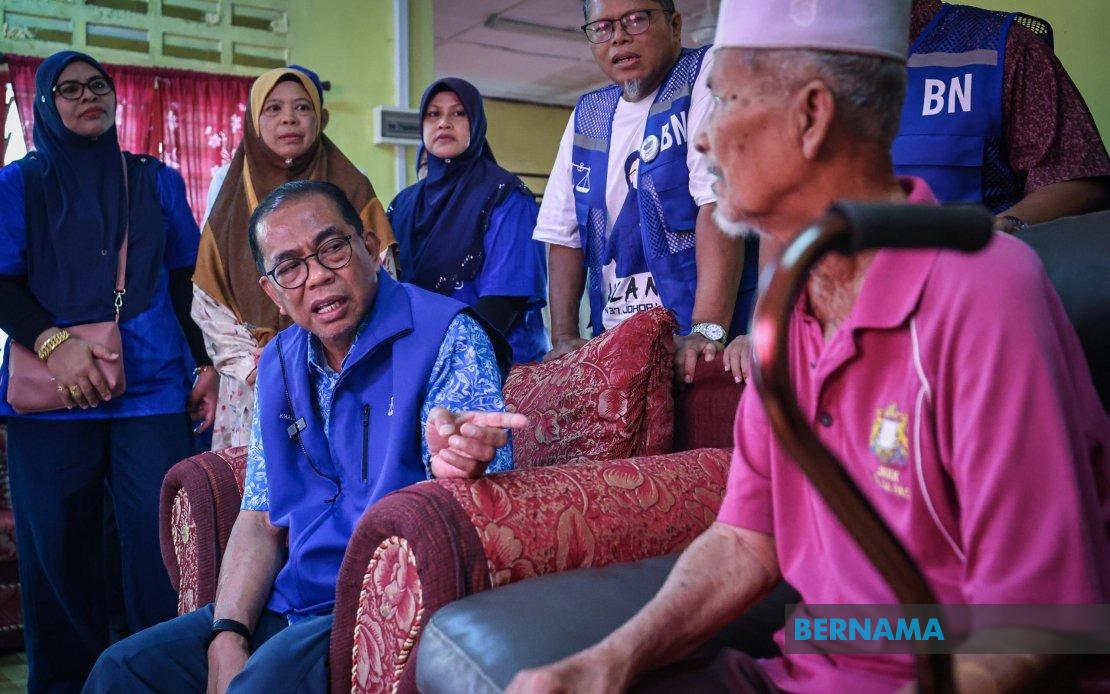
As Johor heads towards its 16th state election on July 11, Defence Minister and UMNO vice-president Datuk Seri Mohamed Khaled Nordin sought to ease voter concerns about potential governance friction if different political coalitions win at federal and state levels. Speaking at a Ziarah Kasih programme in Kota Tinggi on July 9, Mohamed Khaled underscored that the Federal Constitution explicitly defines the division of powers and responsibilities between federal and state governments, creating a legal framework that transcends partisan boundaries.
The reassurance comes at a time when Malaysia's political landscape has become increasingly fragmented across different levels of government. The notion that voters might face difficulties should they elect a state government from one coalition while another coalition holds federal power remains a concern in some quarters. Mohamed Khaled addressed this head-on, emphasizing that constitutional provisions establish clear expectations for both tiers of administration to operate within defined spheres and maintain a cooperative relationship. This architectural separation of powers, he argued, prevents the political composition of either level from destabilizing governance at the other.
Mohammed Khaled elaborated that both the UMNO president and party leadership have consistently affirmed this constitutional reality. The message being conveyed is that regardless of electoral outcomes, institutional mechanisms exist to ensure continuity of service delivery and policy implementation. He stressed that mutual respect and cooperation between federal and state governments remain constitutional obligations, not merely political preferences. This framing transforms the issue from one of political rivalry into one of institutional duty, suggesting that professional governance standards supersede factional considerations.
The implicit message to Johor voters is significant: they need not feel constrained by federal-level political calculations when casting their state ballots. The Defence Minister explicitly stated that citizens voting for a different state government than the federal ruling coalition would encounter no impediments to development or administrative effectiveness. This positioning potentially widens the electoral choices available to voters who might otherwise feel pressure to maintain partisan alignment across both levels.
Barisan Nasional, which has governed Johor for decades, is contesting all 56 state seats in the election with 172 candidates vying for office. In the 2022 state election, BN secured 40 of the 56 seats, maintaining its dominance despite the complex political environment. The coalition remains optimistic about its prospects, with Mohamed Khaled expressing confidence that voters will continue their support based on BN's historical track record and perceived competence. The statement represents part of BN's broader campaign messaging ahead of polling day.
With 2,727,926 registered voters eligible to participate in Saturday's election, the stakes extend beyond Johor itself. The state represents one of Malaysia's most politically and economically significant jurisdictions, and electoral outcomes here often carry national implications. A BN victory would reinforce the coalition's grip on state governance at a moment when its federal position appears more secure following recent parliamentary developments. Conversely, any loss of seats would signal shifting voter sentiment that political analysts would scrutinize carefully.
The constitutional dimension that Mohamed Khaled emphasized deserves closer examination within the Malaysian context. The Federal Constitution indeed delineates state and federal powers through Lists in the Ninth Schedule, though practical application sometimes generates disputes about jurisdiction and resource allocation. Mohamed Khaled's invocation of this framework suggests that BN intends to run a campaign emphasizing institutional stability and proven governance capacity rather than engaging in deeper divisive rhetoric about coalition politics. This approach may appeal particularly to voters prioritizing development outcomes over partisan considerations.
For Malaysia's broader political system, the statement also reflects a maturing of inter-governmental relations. The explicit acknowledgment that different coalitions can govern different levels without dysfunction represents a departure from earlier periods when such configurations were rare. It suggests an evolving institutional culture where constitutional frameworks are expected to function effectively regardless of partisan composition. This development strengthens democratic resilience by demonstrating that electoral choices at one level need not be constrained by political considerations at another.
The timing of Mohamed Khaled's remarks, just two days before voting, indicates that BN recognizes potential voter concerns about coalition alignment and seeks to neutralize them through constitutional reassurance. Whether this messaging resonates with voters will become clear after July 11, but it signals a strategic decision to emphasize institutional stability and legal frameworks rather than partisan dominance. The election outcome will reveal whether Johor voters reward such messaging or instead opt for alternative governance arrangements, and whether constitutional assurances genuinely shape electoral behaviour in contemporary Malaysian politics.

