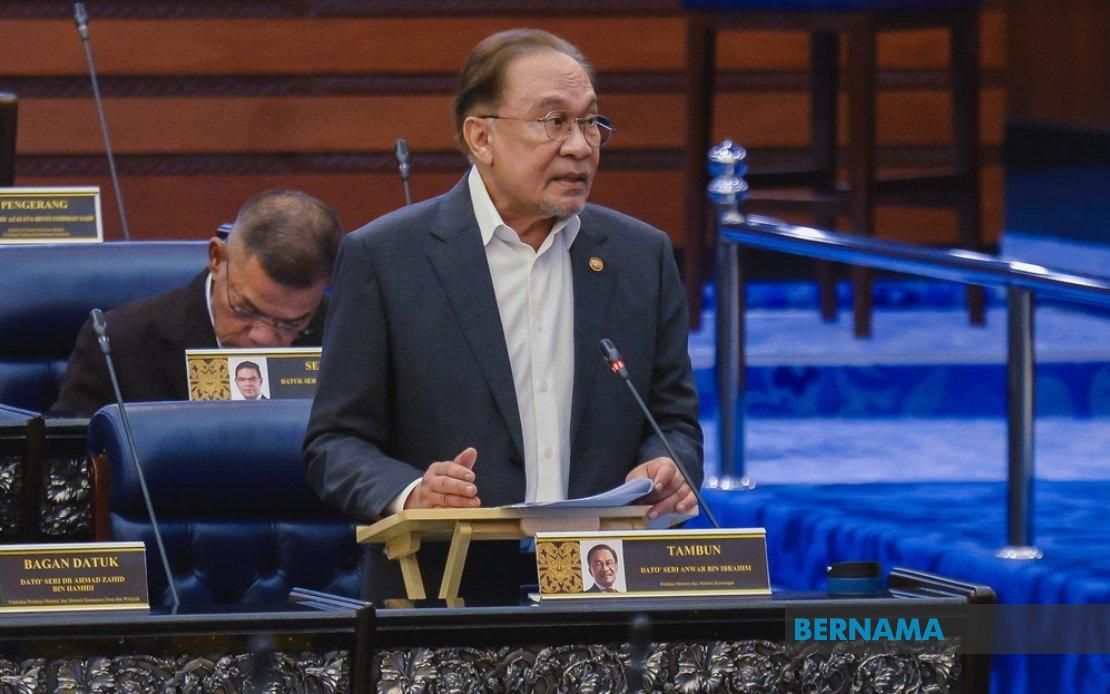
Prime Minister Datuk Seri Anwar Ibrahim has drawn a firm line on how federal finances will be managed when state development projects require additional funding through a Notice of Change, signalling that Putrajaya will not rubber-stamp every cost escalation request that crosses its desk. Speaking in Parliament today, Anwar outlined a rigorous process that must precede any federal allocation or loan approval, effectively establishing guardrails around federal-state financial arrangements that have long been a source of tension and fiscal strain.
The Prime Minister's remarks came in response to parliamentary questioning about Kedah's funding application for the Pulau Bunting Water Treatment Plant project, which necessitates issuing a Notice of Change—the formal mechanism by which development contracts are modified. Such notices carry significant financial consequences, as they typically signal cost overruns that require additional resources beyond the original project allocation. Rather than treating these requests as administrative formalities, Anwar framed them as opportunities for serious scrutiny and reassessment of project fundamentals.
Under the framework outlined by the Prime Minister, the federal government will require states to justify cost increases by establishing accountability chains. Crucially, Putrajaya will demand clarity on whether contractors bear responsibility for inflation in project costs or whether external factors—such as commodity price movements or unforeseen site conditions—have driven the escalation. This distinction matters considerably, as it determines whether financial responsibility should rest with the executing agency, the contractor, or the public purse. By insisting on contractor accountability, Anwar is signalling that the federal government will not indemnify poor procurement decisions or contractor performance failures originating at the state level.
The second and perhaps more significant principle Anwar articulated concerns federal autonomy in budget allocation. He stressed that the Federal Government operates under its own fiscal constraints and cannot be automatically bound by cost determinations made unilaterally by state authorities. This represents a pushback against what appears to be an established pattern wherein states present federal authorities with fait accompli decisions regarding project scope and cost, leaving Putrajaya with limited room to manoeuvre. By reasserting federal discretion, Anwar is attempting to recalibrate the balance of power in infrastructure financing—a recalibration that carries implications for how Malaysia's federal system manages shared development responsibilities.
The timing of this intervention is significant within Malaysia's broader fiscal context. State governments, particularly those in less-developed regions, often rely heavily on federal transfers and loan guarantees to finance infrastructure. When projects encounter cost pressures—whether from inflation, design changes, or contractor disputes—states have historically looked to the centre for financial relief. This pattern has contributed to structural imbalances in federal-state finances and has sometimes enabled wasteful spending by reducing the consequences of poor planning or oversight at the state level. Anwar's insistence on renegotiation rather than automatic approval suggests the federal government is attempting to introduce fiscal discipline into an arena where such discipline has been notably absent.
The Pulau Bunting Water Treatment Plant serves as a concrete illustration of these abstract principles. This Kedah project's cost trajectory and the circumstances requiring an NOC are emblematic of challenges facing state infrastructure managers across Malaysia. Water supply systems, which fall primarily under state jurisdiction, represent critical national infrastructure yet often struggle with funding constraints and execution challenges. By requiring detailed renegotiation rather than expedited approval, the federal government is signalling that it will scrutinise even essential infrastructure projects—a position that could either improve project outcomes through enhanced due diligence or potentially delay necessary investments if renegotiation processes become protracted.
Deputy Prime Minister and Energy Transition and Water Transformation Minister Datuk Seri Fadillah Yusof has been tasked with providing technical elaboration on these principles. Given Fadillah's portfolio responsibilities for water transformation—a sector where Malaysia has significant infrastructure deficits—his explanation will likely elaborate on how the federal government intends to balance its insistence on fiscal discipline with the genuine need to expand and upgrade water infrastructure. This balancing act will be crucial, as overly rigid enforcement of renegotiation requirements could jeopardise essential services in less wealthy states that lack alternative revenue sources.
For state governments, Anwar's pronouncement represents a marked shift in the rules governing federal-state fiscal relationships. Chief ministers and state financial officers will need to strengthen their internal project management systems, implement more rigorous cost estimation during the planning phase, and establish clearer contractor accountability mechanisms. States that have previously relied on federal bailouts for project overruns will face heightened pressure to absorb or mitigate cost increases themselves. This could incentivise more careful procurement practices but might also strain state budgets, particularly in the short term as systems are tightened.
The broader implications extend to Malaysia's infrastructure development trajectory. If federal discipline regarding cost overruns becomes systematic and rigorous, it could reduce the overall fiscal burden of development projects and improve project efficiency nationwide. Conversely, if renegotiation processes become bureaucratic obstacles, they could slow infrastructure deployment at a time when Malaysia faces significant gaps in transport, utilities, and digital infrastructure. The federal government will need to ensure that its insistence on accountability does not inadvertently transform into an impediment to progress.
From a federalism perspective, Anwar's intervention raises important questions about power distribution within Malaysia's constitutional framework. States retain significant infrastructure responsibilities, yet the federal government controls the financial resources necessary to discharge those responsibilities effectively. By conditioning additional federal support on comprehensive renegotiation, the centre is extending its oversight reach while simultaneously insisting that states take greater responsibility for initial planning rigour. This dynamic will likely shape federal-state relations throughout the remainder of this government's term and potentially beyond.

