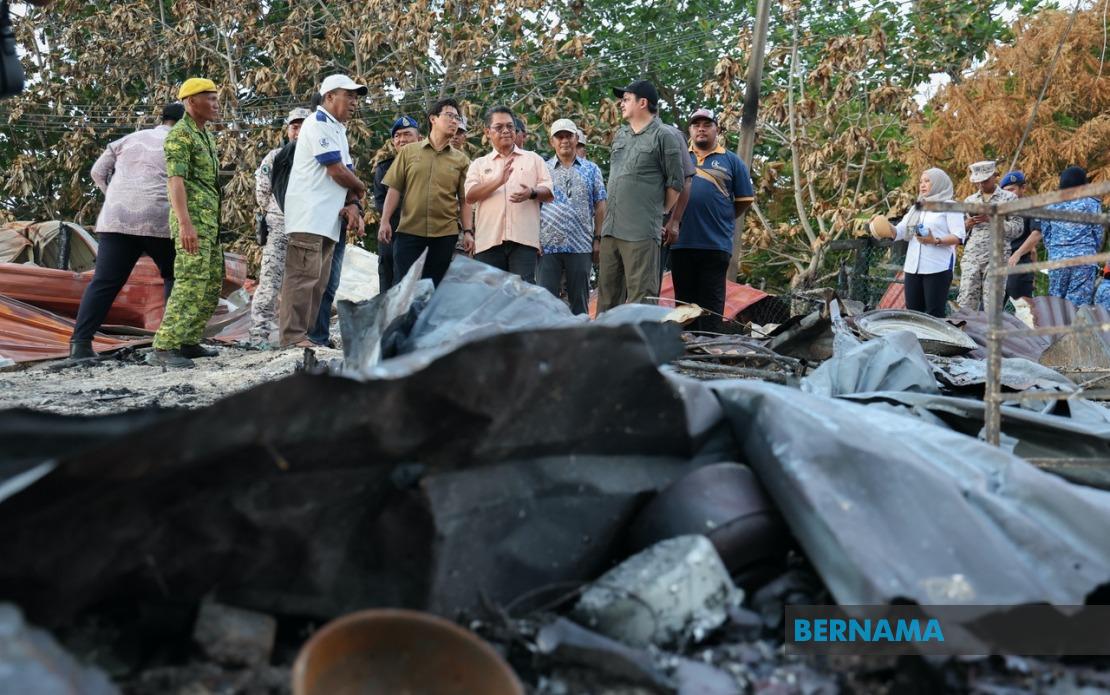
The Prime Minister's Department (JPM) has moved swiftly to support residents affected by a devastating fire that swept through Kampung Nunuyan Laut in the early hours of yesterday morning. Initial relief packages have already reached 29 heads of households impacted by the disaster, which claimed 28 residences and left over 100 people homeless when the blaze struck around 3 am. This rapid response underscores the federal government's commitment to assisting vulnerable communities in Sabah during times of crisis.
Datak Mustapha Sakmud, the Minister in the Prime Minister's Department responsible for Sabah and Sarawak affairs, visited the fire site today alongside Sandakan Municipal Council (MPS) president Datuk Walter Kenson to assess the situation firsthand. During his inspection, Mustapha announced that the Implementation Coordination Unit within his department had already begun coordinating relief efforts, extending assistance beyond immediate cash aid to include wheelchairs for elderly residents requiring mobility support. This tailored approach recognises that disaster recovery extends beyond financial compensation to address the specific vulnerabilities of different demographic groups within affected communities.
The minister emphasised that the government intends to undertake a comprehensive needs assessment across all affected households in collaboration with MPS and other relevant agencies. Mustapha highlighted the particular concern for disruptions to children's education, noting that the jetty serving as the primary route for schoolchildren accessing their institutions has sustained damage requiring urgent repairs. By prioritising the restoration of this critical infrastructure, the authorities aim to minimise the educational impact of the disaster and ensure that displaced students can resume their studies without further delay.
The relocation challenge presents considerable complexity, as the fire victims have been residing on private land comprising two separate land titles owned by private proprietors. Rather than attempting immediate resettlement, the Rural Development Department will lead consultations with both landowners to determine the most appropriate long-term housing solution. This measured approach suggests the government recognises the legal and practical complications inherent in relocating a large displaced population, particularly in island communities where land availability remains constrained.
Walter explained that relocation discussions will extend to identifying suitable areas, potentially including village reserve land administered by local authorities. The planned resettlement scheme goes beyond simply providing new accommodation, with authorities committing to establishing comprehensive basic amenities including electricity connections, reliable water supply systems, and functional jetty infrastructure. These provisions acknowledge that sustainable recovery requires not merely replacing destroyed structures but ensuring relocated communities maintain living standards equivalent to or exceeding their pre-disaster conditions.
The disaster affecting this small island community reflects broader vulnerabilities facing remote settlements throughout Malaysian Borneo, where isolation from mainland infrastructure and limited emergency response capabilities can compound disaster impacts. Pulau Nunuyan Laut's dependence on maritime transport means that damage to jetties disrupts not only social connections but also access to healthcare, education, and commercial opportunities. The government's emphasis on restoring this infrastructure demonstrates understanding of how disaster recovery in island communities demands attention to connectivity as much as to physical rebuilding.
The involvement of multiple agencies—from the Implementation Coordination Unit to the Municipal Council, Rural Development Department, and local landowners—reflects the multi-faceted coordination required for effective disaster response. Such integrated approaches have become increasingly standard following earlier major disasters throughout Malaysia, where siloed responses proved inefficient. The coordination framework announced today suggests lessons learned from previous emergencies are being applied to this Sandakan incident.
For Malaysian policymakers and regional observers, the Pulau Nunuyan Laut response illustrates the evolving sophistication of federal disaster management, particularly regarding vulnerable populations in remote areas. The provision of wheelchairs and consideration of elderly residents' needs alongside infrastructure restoration demonstrates that contemporary disaster response frameworks attempt to balance immediate relief with longer-term community recovery. However, the reliance on private land for housing displaced residents and the need to negotiate with multiple proprietors highlights enduring challenges in rapid resettlement of large populations within limited geographical areas.
The 100 individuals now homeless face an uncertain period as relocation planning proceeds. While initial federal assistance has provided immediate relief, the success of this recovery effort will ultimately depend on how expeditiously authorities can secure agreements with private landowners, secure adequate alternative sites, and complete infrastructure development. The coming weeks will test whether the coordinated approach announced today translates into concrete improvements for this displaced island community.

