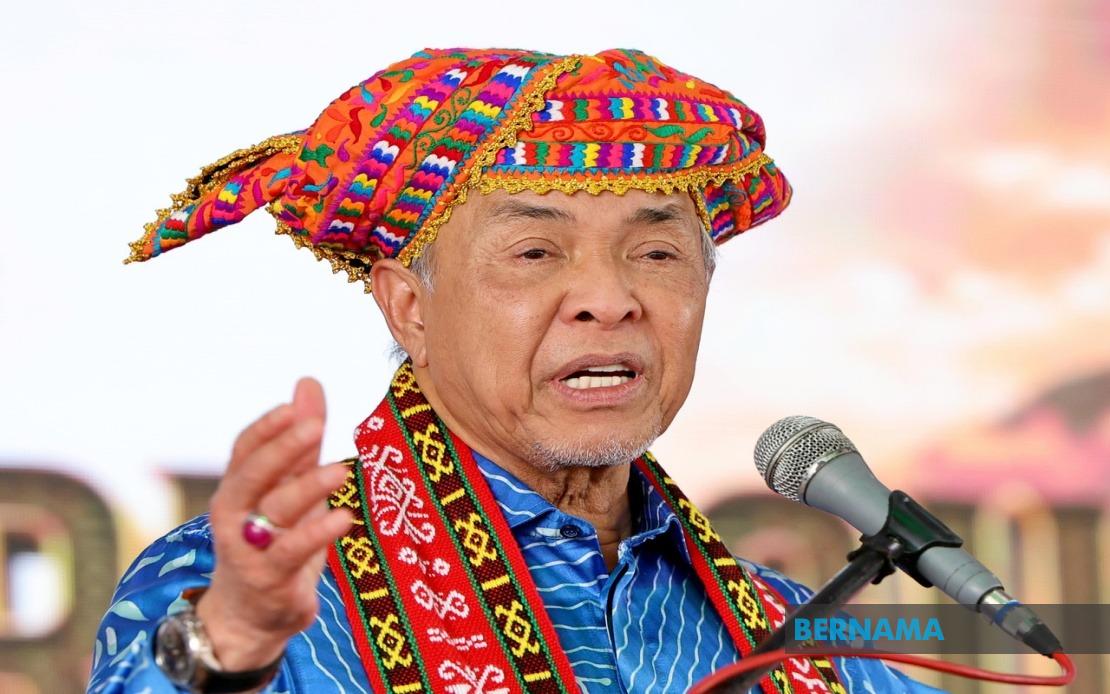
Deputy Prime Minister Datuk Seri Dr Ahmad Zahid Hamidi has committed RM4.06 billion in federal funding toward rural water supply infrastructure across Sabah, representing a substantial intervention into one of Malaysia's most pressing developmental challenges. Speaking during the opening of the Rungus Cultural Festival in Matunggong, Ahmad Zahid emphasised that the allocation reflects the federal government's determination to address the acute shortage of clean water access that has plagued rural Sabahan communities for decades. The funding will be administered directly through the state government, with implementation falling under the Rural and Regional Development Ministry (KKDW).
The scale of this investment underscores the severity of infrastructure deficits in Sabah's interior and outlying regions. Ahmad Zahid, who doubles as Minister of Rural and Regional Development, framed the initiative as essential to fulfilling the federal government's constitutional obligation to ensure that all Malaysians, regardless of geography, have access to basic services and development opportunities. Beyond water supply, he acknowledged that electricity access remains equally critical, indicating that future allocations may address the dual infrastructure challenge that has constrained economic and social development in these areas.
The allocation will be concentrated in some of Malaysia's poorest districts—Kudat, Kota Marudu, and Pitas—regions that have historically lagged in basic infrastructure coverage compared to more urbanised areas. For Malaysian policymakers and development observers, this targeting strategy reflects a shift toward geographic equity in development spending, though questions remain about whether the funding quantum is sufficient given the scale of unmet needs. The explicit focus on these three districts suggests they were identified through formal poverty and infrastructure mapping exercises, though the precise criteria for selection were not detailed.
Implementation oversight has been assigned to KKDW, which will provide technical support and monitoring to ensure projects progress according to schedule. This institutional arrangement is significant because it creates a dedicated accountability structure distinct from routine state government budget cycles. Ahmad Zahid pledged continuous engagement between federal and state authorities to track disbursement and project milestones, a reassurance that carries particular weight given historical delays in similar infrastructure rollouts across East Malaysia. The ministry's role extends beyond financial transfer to encompassing quality assurance and timeline adherence.
Beyond immediate water infrastructure, Ahmad Zahid signalled that the federal government is pursuing a broader socioeconomic agenda targeting households in the bottom 40 percent income bracket (B40) in rural Sabah. This suggests the water supply initiative is one component of an integrated poverty reduction strategy that may eventually encompass income-generation programmes, skills training, and livelihood diversification. Such an approach aligns with recent federal policy emphasising holistic development rather than siloed infrastructure projects, though implementation coordination across multiple ministries remains a persistent challenge in Malaysian governance.
The federal government's commitment has also extended to supporting local administrative ambitions. Ahmad Zahid expressed support for upgrading Matunggong Sub-District to full district status, recognising that such administrative restructuring could unlock additional development allocations from both federal and state budgets. He committed to raising the matter with Sabah Chief Minister Datuk Seri Hajiji Noor and the federal Cabinet, indicating that this proposal has already gained traction within senior government circles. The upgrade would likely enhance local governance capacity and increase the district's pull on development resources, though it also raises questions about administrative efficiency and duplicated overhead.
Immediate action has been ordered on infrastructure maintenance as well. Ahmad Zahid directed relevant agencies under KKDW to initiate repairs on Matunggong's Community Hall within three months, a tangible commitment that signals genuine engagement with local needs beyond headline announcements. The specific three-month timeframe suggests project planning is already underway, and such quick-turnaround commitments often serve as visible wins that build public confidence in government responsiveness. For residents long accustomed to delayed project completion, such directness may carry particular symbolic weight.
For Malaysian readers, this announcement reflects broader national conversations about regional inequality and the political economy of development spending in East Malaysia. Sabah and Sarawak have historically received lower per-capita development allocations relative to peninsular states, a structural imbalance that has contributed to persistent infrastructure and service gaps. This RM4.06 billion commitment, while substantial in absolute terms, must be contextualised against the cumulative infrastructure deficit spanning decades and the state's sprawling geography with dispersed rural populations.
The political dimensions merit consideration as well. Ahmad Zahid's direct involvement in the announcement, combined with his ministerial portfolio overseeing rural development, positions the federal government as responsive to East Malaysian developmental demands. This messaging becomes particularly important during parliamentary terms when representations from Sabah and Sarawak hold significant arithmetic weight in government formation. The Kudat and Kota Marudu constituencies represented by MPs at the announcement ceremony are politically significant, and visible federal investment in their districts reinforces coalition-building efforts.
Implementation timelines and disbursement schedules will now become critical watchpoints. Rural water infrastructure projects, while essential, often encounter logistical complexities—terrain difficulties, contractor capacity constraints, and maintenance sustainability challenges—that can impede progress. The KKDW's responsibility for monitoring creates a potential mechanism for course correction, yet experience across Southeast Asia suggests that federal-state coordination on infrastructure can deteriorate without sustained political will. Malaysian observers should track quarterly progress reports from the ministry to assess whether the RM4.06 billion translates into functioning water systems reaching intended beneficiaries.
The announcement also hints at broader federal-state cooperation arrangements under the current political configuration. The presence of Natural Resources and Environmental Sustainability Minister Datuk Seri Arthur Joseph Kurup alongside Ahmad Zahid suggests that water infrastructure investment may intersect with environmental management priorities, potentially incorporating water quality assurance and conservation mechanisms beyond simple supply expansion. Such integrated approaches, if well-executed, could enhance project sustainability and ensure that new infrastructure delivers genuine public health improvements rather than merely expanding access to inadequate water sources.
As Sabah continues navigating the post-Covid economic landscape, infrastructure investment becomes increasingly critical to attracting private sector participation and enabling agricultural and small-scale commercial development in rural areas. Clean water access is foundational—no community can pursue sustainable livelihood improvements without reliable water supplies for household, agricultural, and small-scale industrial uses. The RM4.06 billion commitment, if effectively implemented, could catalyse broader development momentum in these districts, though complementary investments in road access, electricity, and telecommunications infrastructure would be necessary to realise the full development potential. For now, the federal government has signalled its intention to begin addressing a long-standing infrastructure inequity, with implementation success remaining contingent on sustained execution and inter-agency coordination over the coming years.

