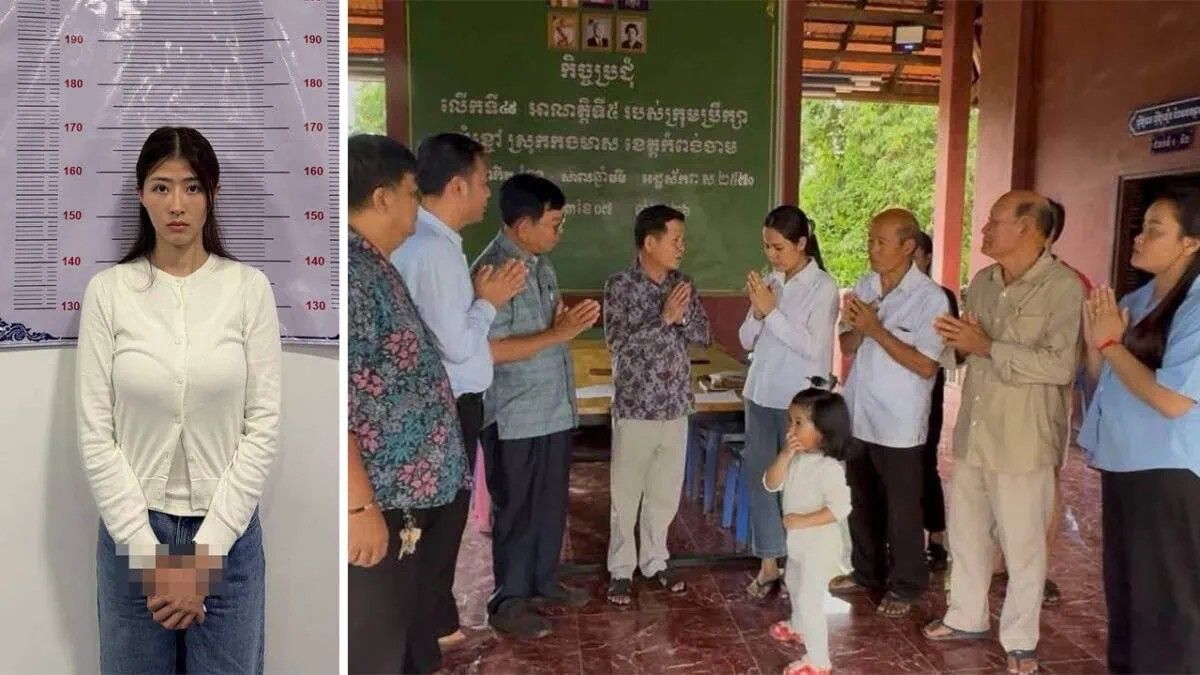
A settlement has been reached in the civil component of a fatal traffic case in Cambodia's capital, with the family of Kuoch Limhan accepting S$60,000 in compensation and agreeing to withdraw related civil claims. The out-of-court agreement, finalised on August 6 through a formal settlement document signed by both parties, represents a common practice in Cambodia where families of accident victims often resolve financial disputes through negotiation while criminal investigations proceed independently.
Kuoch Limhan, an official at the Ministry of Public Works and Transport's construction laboratory, was fatally struck by a vehicle on the evening of July 28 in Phnom Penh's Sen Sok district. According to witness accounts and scene documentation, the collision occurred when the accused driver allegedly crossed the centreline while attempting to overtake another vehicle, directly hitting Limhan's motorcycle. The impact was catastrophic; the victim, who had been returning home with milk for his young daughter, was killed instantly on the rain-soaked street.
The accused driver, Sam Meychou, fled the scene in a tuk tuk accompanied by a friend, as captured in video evidence from the accident location. Meychou later turned herself in to authorities on the afternoon of July 30, just two days after the collision. Following her arrest and preliminary questioning, the Phnom Penh Municipal Court charged her on July 31 with causing a fatal traffic accident and fleeing the scene, offences that carry serious criminal penalties under Cambodian law.
Under the civil settlement agreement, Oknha Tong Hok Seng, identified as Meychou's father, provided the S$60,000 payment directly to the victim's widow. Seung Kimhor, who acted as representative for the victim's family in filing the civil claim, was party to the settlement negotiations and signed the agreement. The settlement was formally witnessed by Kong Sekleng, the commune chief, and lawyer Phon Thearin, lending official credibility to the arrangement.
The agreement explicitly stipulates that both parties have resolved their dispute through what is termed an "amicable" resolution based on mutual understanding and goodwill. Importantly, the document contains mutual release language preventing either party from pursuing additional claims or demands related to the accident. By withdrawing the civil complaint registered as case number 4396 with the Phnom Penh Municipal Court on July 31, the victim's family has effectively closed its pursuit of further civil remedies for damages.
For Malaysian readers familiar with Southeast Asian legal systems, this arrangement reflects how civil and criminal justice proceed on separate tracks in Cambodia. The withdrawal of the civil complaint does not constitute an admission of guilt in the criminal case, nor does it obligate the court to reach any particular outcome. The two spheres operate independently, a principle enshrined in civil law jurisdictions across the region.
The criminal investigation and prosecution will continue unaffected by the civil settlement. Meychou remains charged with fatal traffic offences and unauthorised departure from an accident scene, matters that fall squarely within the state's prosecutorial mandate. The investigating judge has already ordered her placement in pre-trial detention pending trial, indicating the seriousness with which authorities are treating the criminal allegations. Whether the civil settlement influences sentencing considerations, should conviction follow, remains a matter for the court to determine.
This case illustrates the financial vulnerability of families in Cambodia when confronted with fatal accidents, particularly when the accused party possesses resources to negotiate settlements. The S$60,000 payment, while substantial in local economic terms, serves to compensate the widow and dependents for loss of the family's primary earner. Such arrangements are widespread throughout Southeast Asia and reflect the limited scope of state-funded victim compensation programmes in many countries.
The accident itself raises broader road safety concerns in the region. Overtaking manoeuvres that cross centrelines, particularly in urban areas during adverse weather conditions, remain a leading cause of fatal collisions across Southeast Asia. Cambodia's traffic infrastructure and enforcement challenges compound these risks, and incidents such as Limhan's death underscore the persistent danger facing motorcycle users, who comprise a substantial portion of urban commuters throughout the region.
The involvement of local officials—the commune chief and a lawyer—in witnessing the settlement reflects how justice mechanisms operate at community level in Cambodia. Rather than leaving victims' families to navigate the formal court system entirely, such witnesses provide informal validation of agreements, which may encourage compliance and reduce the likelihood of future disputes.
For those observing from neighbouring Malaysia and Singapore, this case demonstrates both similarities and differences in how neighbouring countries handle traffic fatalities. While Malaysia's legal framework similarly separates civil and criminal proceedings, the availability of victim compensation and the pace of criminal proceedings may differ significantly across the region's justice systems.

