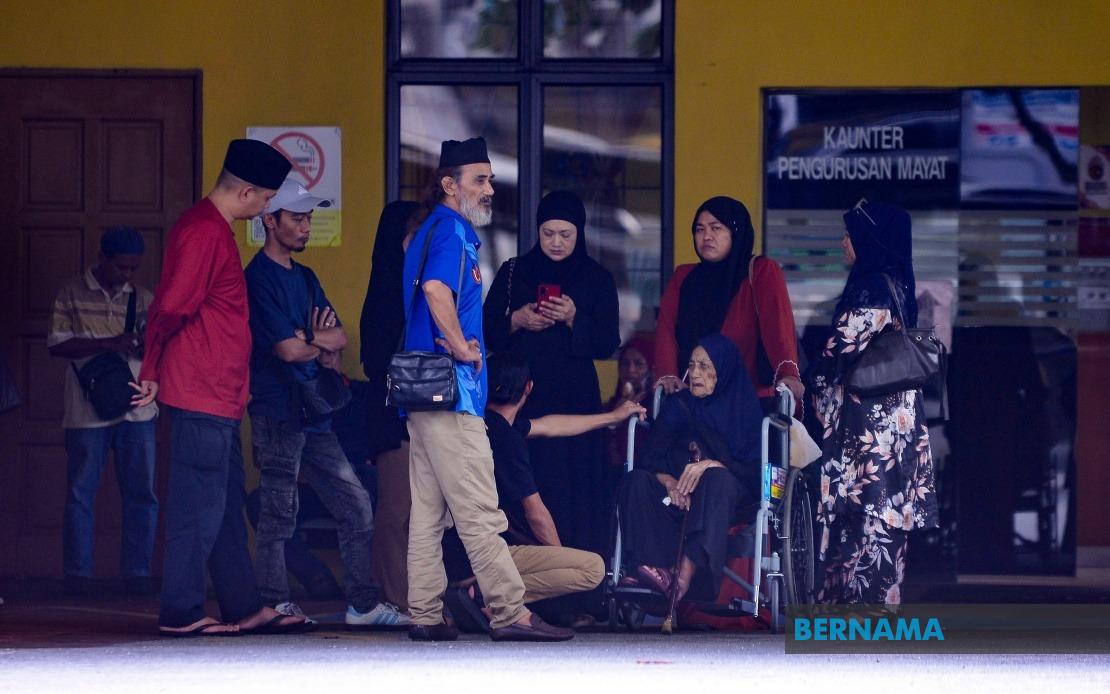
A grieving family has called for a comprehensive and transparent investigation into the circumstances surrounding a fatal collision at Maju Junction early on August 19, which claimed the lives of three members of a Malaysian household. The incident has raised fresh questions about road safety protocols involving government vehicles and the responsibilities that fall upon emergency services when operating heavy machinery on city streets.
Mohd Nadzri Razali, 69, whose family was devastated by the tragedy, expressed his determination to seek accountability through proper legal channels. Speaking from his home in Taman Aman Fasa 2, Mambang Di Awam, near Kampar, Mohd Nadzri stated that preliminary accounts suggest the Immigration Department lorry crossed the junction against a red traffic signal, a detail that will likely become central to any formal inquiry. He emphasised that his family deserves answers and justice, particularly given the sudden and shocking nature of their loss.
The victims who perished in the accident were Shaik Mohd Firdaus Shaikh Yahya, aged 53, and his two daughters, Siti Nor Sazlin, 25, and Siti Darwisyah Auni, 12. The family had been out late, crossing the intersection on foot when disaster struck just after one o'clock in the morning. Their mother, Norhayati Razali, 55, survived the collision but remains hospitalised in critical condition at the Kuala Lumpur Hospital's Intensive Care Unit. Family members are hopeful she will stabilise enough to be transferred to a facility closer to home, either Hospital Ipoh or Teluk Intan, where she can continue her recovery surrounded by relatives.
The sequence of events that unfolded at the Maju Junction intersection speaks to a complex set of circumstances that investigators must now unravel. An empty Isuzu Black Maria lorry belonging to the Malaysian Immigration Department was en route from the Kuala Lumpur Immigration Office to Chow Kit, tasked with conducting a pre-dawn operation against undocumented migrants. Although the vehicle was equipped with beacon lights and a siren, it apparently entered the intersection while its traffic light was red. Simultaneously, a Proton Saga approaching on a green light was unable to react in time to avoid a collision with the significantly heavier government vehicle.
The impact of the crash was catastrophic. The lorry, struck by the Proton Saga, lost control and skidded across the roadway in an uncontrolled trajectory. In its path stood the family of four and nearby, an Inokom Matrix multi-purpose vehicle. The pedestrians stood no chance against the massive weight and momentum of the government vehicle. First responders and investigators discovered three family members fatally injured at the scene, their lives claimed in seconds.
For Mohd Nadzri and the extended family, the tragedy compounds an already grief-stricken period. Just a few months earlier, in May, the family had suffered another significant loss. The sudden death of three relatives in a single incident has created a trauma that will reverberate through the family for years to come. Mohd Nadzri recalled that he had seen his sister's family merely two weeks before the accident, when they had travelled together to perform the Muslim custom of visiting and maintaining family graves at Teluk Bakong in Ayer Tawar.
The family's immediate practical concern now centres on funeral arrangements and ensuring proper Islamic rites are observed. They have decided to lay all three deceased to rest in a single grave at the Muslim Cemetery in Kampung Air Hitam Labu, Kampar, allowing the family to maintain a unified place of remembrance. This decision reflects both their cultural values and the need to keep the family together even in death.
Authorities have initiated a formal investigation into the incident under Section 41(1) of the Road Transport Act 1987, the legal framework governing serious road traffic violations. This provision allows investigations into grave motor vehicle accidents where criminal negligence or breach of duty may be involved. The investigation will necessarily examine whether the Immigration Department followed proper procedures for operating emergency vehicles through city intersections, whether the beacon and siren systems were functioning correctly, and what training the driver had received regarding intersection protocols.
The incident raises broader questions within Malaysia about how government agencies, particularly those operating large vehicles in emergency situations, balance operational urgency against public safety. While immigration enforcement operations serve legitimate governmental purposes, the loss of three innocent lives—including a twelve-year-old child—demands that authorities examine whether sufficient safeguards exist to prevent such tragedies. Traffic light systems at major intersections are designed with specific protocols for emergency vehicles, and any deviation from these protocols must be thoroughly investigated.
Mohd Nadzri's public plea for transparency is not merely a family's cry for justice; it reflects a broader social expectation that when government operations result in civilian casualties, the response must be thorough, honest, and culminate in meaningful accountability. The investigation's findings could influence how government agencies approach emergency operations in urban areas, potentially leading to revised procedures or additional training requirements. For now, the family awaits answers while managing the immediate crisis of their mother's recovery and the enormous grief of their loss.

