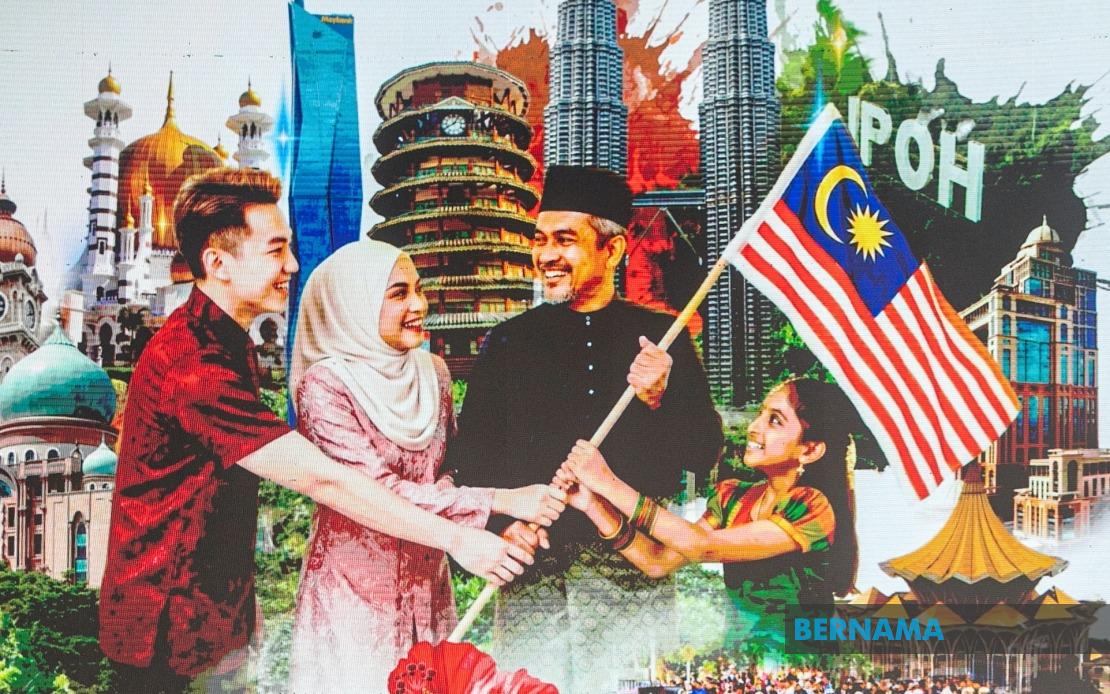
Communications Minister Datuk Seri Fahmi Fadzil has issued a formal appeal to content creators and the general public to exercise heightened vigilance when deploying artificial intelligence systems to generate imagery of the Jalur Gemilang, Malaysia's national flag. The minister's cautionary message, delivered at the launch of the 2026 National Month and Fly the Jalur Gemilang campaign in Ipoh on July 19, reflects growing concerns about the potential for AI tools to inadvertently or carelessly produce representations of the national symbol that fall short of the flag's precise specifications.
The core of Fahmi's warning centres on what appears to be a recurring technical vulnerability: the consistent and accurate rendering of the Jalur Gemilang's 14 distinctive red and white stripes. This seemingly straightforward design element has emerged as a particular point of failure when AI image generators encounter the task of producing flag imagery. The minister stressed that content creators bear responsibility for ensuring their AI-generated materials maintain fidelity to the flag's actual composition, rather than relying on automated systems to inherently understand and replicate such details without human oversight.
The advisory comes amid Malaysia's broader efforts to foster patriotic sentiment through the Fly the Jalur Gemilang campaign, which encourages citizens to display the national flag from today through at least September 16 in homes, villages, and government installations. Against this backdrop, the proliferation of AI-generated content during National Month and Malaysia Day celebrations could inadvertently spread inaccurate representations of the flag across digital platforms and physical media, potentially diluting the symbolic weight of the national emblem. Fahmi's intervention attempts to preempt such scenarios through public education and industry coordination.
Beyond the immediate technical concern, the minister announced plans for collaborative oversight involving Malaysia's media establishment. The Communications Ministry intends to engage both the Malaysian Press Institute and the Malaysian Media Council to establish baseline standards and monitoring practices for AI-generated flag content throughout the National Month period. This partnership approach suggests recognition that addressing the challenge requires coordination across multiple stakeholder groups rather than reliance on government enforcement alone.
Regarding potential enforcement mechanisms, Fahmi indicated a graduated response framework prioritising dialogue over punitive measures. When inaccuracies or errors in flag representation occur, whether through AI generation or other means, the ministry's initial approach will focus on educational correction rather than immediate legal action. Officials will attempt to contact those responsible for the erroneous content and request voluntary rectification, acknowledging that most errors likely stem from inadvertence rather than deliberate disrespect.
However, the minister's remarks revealed the existence of statutory instruments governing flag representation and use. Should voluntary correction prove unsuccessful, the government retains the option to invoke these legal frameworks, though the precise nature and severity of such provisions remained unspecified in his comments. This two-stage approach—advisory first, legal action second—suggests the ministry views public education and goodwill as more effective tools than criminal sanctions for ensuring flag integrity during celebratory periods.
The campaign launch brought together senior political leadership including Prime Minister Datuk Seri Anwar Ibrahim, National Unity Minister Datuk Aaron Ago Dagang, and Perak Menteri Besar Datuk Seri Saarani Mohamad, underscoring the government's commitment to the 2026 National Day and Malaysia Day celebrations. The event at the Sultan Azlan Shah Ministry of Health Training Institute in Tanjung Rambutan reflects the nationwide scale of preparations already underway for festivities scheduled to take place across multiple cities and states.
Plans for the 2026 celebrations are still crystallising. The National Day commemoration will be hosted in Putrajaya, Malaysia's purpose-built administrative capital, continuing the tradition of rotating the main celebration across different regions. Malaysia Day festivities, marking the formation of the Malaysian federation, will shift to Sarawak, though organisers have not yet finalised the specific venue. This geographical diversity aims to foster national unity and recognition of all constituent states' roles within the federation.
Fahmi's emphasis on educating the public about proper flag etiquette extends beyond AI considerations. The minister encouraged Malaysians to familiarise themselves with established protocols for displaying the Jalur Gemilang, suggesting that broader knowledge gaps about flag conventions may underlie some of the representation errors officials have encountered. The combination of AI-specific caution and general etiquette education indicates a comprehensive approach to preserving the flag's symbolic integrity.
For Malaysia's rapidly expanding creative industries and digital content ecosystem, Fahmi's guidance carries practical implications. Freelance designers, social media managers, marketing professionals, and amateur content creators will need to develop heightened awareness of the Jalur Gemilang's specifications before deploying AI tools for campaign materials, commercial projects, or personal celebratory content. This requirement adds a layer of responsibility to the growing adoption of generative AI across Malaysian society.
The minister's intervention also highlights a broader challenge facing governments and cultural institutions globally as artificial intelligence becomes embedded in content creation workflows. Balancing encouragement of technological adoption with protection of cultural and national symbols presents complex policy questions. Malaysia's pragmatic graduated-response model, prioritising correction over criminalisation while maintaining legal recourse as a backstop, offers one approach to this tension.
Looking ahead to the 2026 celebrations, sustained collaboration between the Communications Ministry, media organisations, and technology platforms will likely prove essential. Public awareness campaigns emphasising the 14-stripe specification and encouraging verification of AI-generated flag imagery before publication could substantially reduce errors. As Malaysia inches toward its centennial year, ensuring that the Jalur Gemilang is consistently and accurately represented across all media—particularly those created through emerging technologies—will help maintain the flag's status as an unambiguous symbol of national identity and unity.

