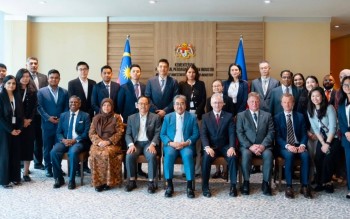
More than 70 representatives from 25 European companies descended on Kuala Lumpur this week for intensive discussions with Malaysian government officials spanning economic policy, environmental sustainability and cross-border trade. The three-day visit by the EU-ASEAN Business Council represents a significant show of confidence in Malaysia's current reform trajectory, even as both regions navigate complex geopolitical and economic currents that have reshaped investment patterns across Asia and Europe.
Chris Humphrey, executive director of the EU-ASEAN Business Council, characterised the meetings as an opportunity for European business leaders to engage directly with Malaysian policymakers and gain clarity on regulatory frameworks that will shape their operations in the country. During discussions at the Economy Ministry, the delegation received briefings on ongoing reform initiatives while publicly endorsing Malaysia's commitment to environmental sustainability and the circular economy model. These expressions of support carry weight beyond mere diplomatic courtesy; they signal to Malaysian stakeholders that European investors view the country's policy direction as credible and aligned with global standards.
The Finance Ministry engagement proved equally substantive, with discussion covering taxation frameworks, government procurement policies and the overall investment climate. Humphrey reported that officials conveyed optimism about Malaysia's economic prospects, a sentiment that appears to have resonated with the visiting executives considering the volume of companies represented. Such conversations are essential for European firms evaluating long-term commitments in the region, as they require assurance that fiscal and regulatory environments will remain stable and predictable across business cycles.
Malaysia's appeal to European investors rests on several competitive advantages that the delegation highlighted. The country's geographic position along critical global shipping routes, coupled with modern infrastructure and digital connectivity, positions it as a natural hub for companies seeking to serve markets across Southeast Asia. The availability of skilled labour and abundant natural resources further enhance Malaysia's proposition, particularly for firms in manufacturing, technology and resource-dependent sectors looking to diversify away from established production bases.
The most significant outcome from the delegation's visit may well be the reaffirmation of momentum behind Malaysia-European Union free trade agreement negotiations. Both parties are targeting completion by 2027, a timeline that reflects genuine mutual commitment rather than aspirational rhetoric. The fact that four negotiating rounds have already concluded, with a fifth scheduled for late September in Brussels and a sixth anticipated before year-end, suggests negotiators are working through substantive issues methodically. Humphrey expressed confidence that sufficient headway has been made to enable finalisation within roughly eighteen months, contingent on both sides maintaining political will.
The bilateral relationship already demonstrates substantial economic integration. The European Union ranks among Malaysia's five largest trading partners, with 2025 bilateral merchandise trade reaching €48.9 billion—a figure that underscores the depth of commercial ties already established. Malaysian exports to Europe totalled €30.3 billion against European shipments of €18.6 billion, a ratio reflecting Malaysia's strong position as a supplier of raw materials, intermediate goods and manufactured products. Beyond trade, European capital has become entrenched in the Malaysian economy, with investment stocks from EU member states reaching €33.1 billion by 2024, indicating confidence in Malaysia's medium and long-term prospects.
The delegation's agenda extended well beyond conventional trade discussions. Meetings with the Ministry of Natural Resources and Environmental Sustainability highlighted growing European interest in supporting Malaysia's transition toward cleaner energy and more sustainable resource management. These conversations are particularly relevant given that European Union member states face their own regulatory requirements around environmental due diligence and carbon accounting, creating natural incentives for them to invest in partners demonstrating credible sustainability commitments.
Customs modernisation emerged as a practical priority during the talks. The delegation discussed opportunities to streamline customs procedures and accelerate clearance processes, recognising that efficient border operations directly benefit trading partners on both sides. A particular focus fell on combating illicit trade, especially in tobacco products—an issue that has long challenged Malaysian authorities and costs the government substantial revenue. European firms with expertise in supply chain verification and anti-counterfeiting technologies see potential to contribute to Malaysia's enforcement efforts while simultaneously protecting legitimate trade.
Healthcare cooperation represents another substantive area of engagement. The delegation signalled European companies' readiness to support Malaysia's healthcare infrastructure through mechanisms including innovative financing models, pharmaceutical supply arrangements and public health initiatives. As Malaysia's population ages and healthcare spending pressures mount, partnerships with advanced European medical technology and pharmaceutical firms could yield mutual benefits through knowledge transfer and investment.
The agricultural and food security discussions point to opportunities in areas where Europe possesses established capabilities in value-added processing, quality certification and sustainable farming practices. Similarly, exchanges on digital transformation, tourism development and cultural industries reflect recognition that economic partnerships in the 21st century extend far beyond traditional commodity trade.
From a regional perspective, the delegation's visit underscores Southeast Asia's continued attractiveness to major developed economies even amid shifting geopolitical alignments. Malaysia's ability to host substantive engagement from major European business interests while maintaining strong ties across other regions demonstrates the country's enduring value as an investment and trade partner. The planned EU-Malaysia free trade agreement, if realised, would constitute a significant strategic achievement for both parties, creating preferential access that favours both European exporters and Malaysian firms seeking duty reductions in major European markets.
The momentum evident from this week's discussions suggests that Malaysia-Europe relations have entered a more structured and outcomes-focused phase. Rather than relying on general statements of intent, both sides are now channelling engagement through specific negotiating processes with defined timelines and deliverables. Success in concluding the FTA would validate this approach and potentially catalyse additional commercial activity as businesses reconfigure supply chains and investment strategies to capitalise on preferential trade terms.

