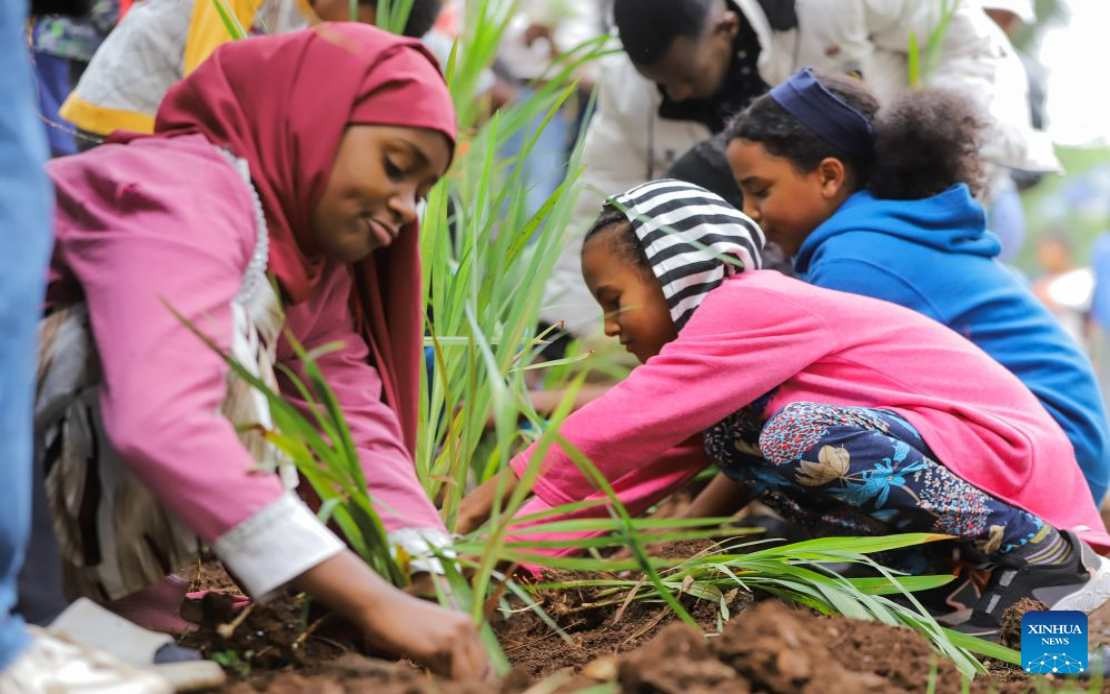
Ethiopia has achieved an unprecedented environmental milestone by mobilising millions of citizens and residents to plant 800 million tree seedlings within a single day, demonstrating the scale of commitment behind the country's flagship Green Legacy Initiative. The Monday nationwide campaign, which drew participants from all corners of society, represents a significant escalation in Ethiopia's efforts to reverse decades of deforestation and environmental degradation that has threatened the nation's ecological stability and economic development.
Launched in 2019 by Prime Minister Abiy Ahmed, the Green Legacy Initiative has evolved from an ambitious environmental vision into a tangible national movement that engages ordinary Ethiopians as active participants in climate action. This year's campaign is particularly significant as it marks eight consecutive years of sustained commitment to tree restoration, a persistence that sets Ethiopia apart in a region where environmental initiatives often struggle with continuity and public engagement.
The scale of this year's ambition extends well beyond the single-day record. Ethiopia intends to plant more than 8 billion seedlings during the current rainy season alone, a volume that underscores how the programme has accelerated in recent years. The cumulative impact of these efforts positions the country to surpass its extraordinary goal of planting 50 billion trees since the initiative began in 2019. For Malaysian readers familiar with tropical forestry challenges, such numbers illustrate the magnitude of ecosystem restoration work required to address historical deforestation across vast landscapes.
The human dimension of the campaign was evident from the diverse participants who contributed to Monday's effort. Edilawit Legesse, a thirteen-year-old from the Alembank area of Addis Ababa, exemplified the intergenerational nature of the initiative by marking her third consecutive year of participation. Her enthusiasm—planted alongside her family and community members—reflects how the Green Legacy Initiative has become woven into the social fabric, transforming environmental action from a top-down government directive into a grassroots movement where younger Ethiopians grow up viewing tree planting as a civic responsibility and shared national project.
Professionals across various sectors have also embraced the initiative with notable dedication. Healthcare workers like Hewan Legesse, a nurse who coordinated with thirty-five colleagues from her hospital to participate, demonstrate how the campaign transcends sectoral boundaries. Such broad participation from schools, hospitals, government offices, and private businesses creates a multiplier effect that makes the ambitious numerical targets achievable while building environmental consciousness across the population.
Prime Minister Abiy Ahmed characterised the annual one-day event as a defining moment of national unity, emphasising that it brings together Ethiopians from diverse backgrounds and walks of life in pursuit of a shared environmental legacy. His recent statements on social media highlighted the consistency of effort, noting that eight years of continuous action have strengthened public commitment and reinforced the collective belief that environmental restoration is achievable through coordinated national action. This framing shifts tree planting from an isolated ecological task into a nation-building exercise that reinforces social cohesion.
The environmental objectives underpinning the Green Legacy Initiative address multiple interconnected challenges facing Ethiopia. The initiative targets restoration of severely degraded landscapes that have lost productive capacity over decades, a problem familiar to many developing nations in the region struggling with soil erosion and reduced agricultural output. By expanding forest cover systematically, Ethiopia aims to rebuild natural carbon sinks that contribute to climate change mitigation while creating environmental buffers against increasing climatic volatility.
Biodiversity conservation represents another critical dimension of the programme, as restored forests provide habitats for wildlife and help maintain genetic diversity essential for ecosystem resilience. Ethiopia's unique biodiversity, including endemic species found nowhere else on Earth, faces pressure from habitat loss and fragmentation. The systematic reforestation approach offers a pathway to reconnect fragmented ecosystems and support species survival. For Southeast Asian nations grappling with similar biodiversity threats, Ethiopia's integrated approach to ecosystem restoration alongside socioeconomic development offers valuable lessons in scaling conservation efforts beyond isolated protected areas.
The economic dimensions of the initiative connect environmental restoration to Ethiopia's development aspirations. The government has positioned the Green Legacy Initiative as a cornerstone of its strategy to build a green, lower-middle-income economy characterised by sustainable resource management and climate resilience. This framing acknowledges that environmental degradation imposes direct economic costs through reduced agricultural productivity, increased vulnerability to droughts, and heightened climate risks. By investing in systematic reforestation, Ethiopia aims to create long-term economic benefits alongside environmental gains, including potential carbon credit opportunities and ecosystem services that support food security.
Climate resilience emerges as a particularly urgent motivation for the campaign's intensity and scale. Ethiopia faces increasing pressures from climate variability including unpredictable rainfall patterns and prolonged droughts that threaten agricultural livelihoods for millions dependent on rain-fed farming. Expanded forest cover helps regulate local hydrological cycles, reduce surface runoff that exacerbates flooding and soil loss, and increase water retention in soil. These benefits directly strengthen agricultural productivity and reduce climate-related vulnerability, creating tangible improvements in food security and rural incomes that resonate far beyond environmental metrics.
The achievement of planting 800 million trees in a single day presents substantial operational and logistical challenges that require careful coordination across regions, districts, and communities. Success depends on prior investments in nursery capacity to produce sufficient quality seedlings, training of planters to ensure proper establishment techniques, identification of suitable planting sites with adequate moisture for seedling survival, and follow-up care during critical early growth stages. The durability of this achievement will ultimately depend on survival rates of planted seedlings, a measure requiring multiyear monitoring and adaptive management as lessons emerge from different ecological zones and rainfall regimes.
For Malaysia and other developing nations in Southeast Asia, Ethiopia's Green Legacy Initiative offers both inspiration and cautionary insights. The ability to mobilise millions of citizens around a unified environmental objective demonstrates the potential for large-scale ecosystem restoration when led by committed political leadership and supported by broad public engagement. The programme's consistency over eight years suggests that environmental initiatives require sustained funding, political will, and institutional commitment to move beyond one-time events into transformative systemic change. As tropical forest nations across the region confront their own deforestation challenges and climate adaptation imperatives, Ethiopia's experience demonstrates that ambitious environmental goals can drive development policy while building national resilience.

