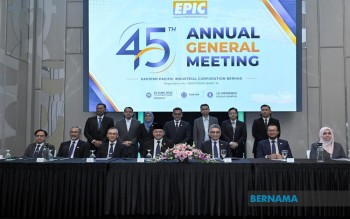
Eastern Pacific Industrial Corp Bhd (EPIC) is charting an ambitious five-year growth strategy that would see the integrated oil and gas solutions provider nearly double its revenue from current levels, reaching RM700 million annually by 2030 while simultaneously building its net asset value to RM1 billion. The roadmap, formally adopted as the EPIC Strategic Business Plan 2025-2030 (EPIC BEST 2530), reflects management confidence in the company's operational trajectory and market positioning across multiple business segments spanning upstream and downstream oil and gas services, port operations and emerging renewable energy ventures.
The financial targets represent a substantial acceleration from EPIC's existing performance baseline. Currently generating annual revenue of RM411.9 million with a net asset value hovering around RM700 million, the company would need to sustain approximately 10 to 12 percent compound annual growth to achieve its 2030 objectives. According to Group Chief Executive Officer Dr Ts Muhtar Suhaili, this growth trajectory is underpinned by proven execution capabilities and an expanding contract pipeline that already encompasses commitments valued between RM1.3 billion and RM1.5 billion within the oil and gas division alone.
EPIC's confidence in meeting these targets draws support from a strong financial showing in 2025, when the company posted net profit of RM20.6 million, representing a 24 percent increase from RM16.6 million the previous year. The revenue growth of RM411.9 million in 2025 compared to RM403.8 million in 2024 demonstrates the company's ability to convert strategic acquisitions and contract wins into tangible bottom-line improvements. This performance extends a consistent upward trajectory since 2022, when the company operated at significantly lower revenue levels, establishing a pattern of disciplined growth that management believes can be sustained throughout the remainder of the decade.
Several distinct factors contributed to EPIC's recent financial improvement, each representing a different avenue through which the company intends to drive future expansion. The acquisition of Rahar Niaga Sdn Bhd introduced additional operational capabilities and revenue streams, while newly secured contracts for Pan Malaysia Maintenance, Commissioning and Modification services, alongside Hook-Up and Commissioning work, expanded the company's addressable market within its core competencies. Simultaneously, higher volumes of offshore rig arrivals and increased cargo throughput across EPIC's port facilities demonstrate underlying growth in regional energy sector activity that should support revenue expansion through the medium term.
Within the traditional oil and gas segment, EPIC has secured contracts extending across multiple regions of Malaysia, reflecting both the company's technical reputation and strategic market positioning. Beyond its established presence in Terengganu, where the company maintains operational headquarters, EPIC has successfully penetrated the southern corridor of Peninsular Malaysia, including the major industrial hubs at Pengerang and Melaka. Most significantly, the company has recently established a foothold in Sabah through collaboration arrangements with local partners, addressing a geographic market that has historically represented a natural extension of EPIC's service portfolio given the region's substantial oil and gas infrastructure.
The Sabah expansion deserves particular attention within EPIC's growth narrative. In February 2025, EPIC established a collaboration agreement through its subsidiary EPIC OG Sdn Bhd with Begas Energy Sdn Bhd, securing a project management services role for Terminal Turnaround, Maintenance and Modification work. This arrangement simultaneously strengthens EPIC's footprint in Sabah while positioning the company to pursue similar opportunities across Sarawak, where comparable infrastructure maintenance requirements exist. For Malaysian readers tracking regional economic development, this eastward expansion represents a significant diversification of EPIC's geographic revenue base, reducing dependency on peninsular markets that face increasing competitive pressures.
Beyond conventional oil and gas services, EPIC is positioning itself as a participant in Malaysia's energy transition through selective involvement in renewable energy projects. The company has submitted bids for the hybrid hydro-solar facility development project in Kenyir alongside its parent company, Terengganu Inc., marking a strategic pivot toward cleaner energy infrastructure. Such participation aligns EPIC with broader regional and global trends emphasizing renewable capacity development, while leveraging the company's project management and operational expertise across different energy modalities. Success in securing renewable energy contracts would substantially diversify EPIC's earnings composition and reduce long-term exposure to potential cyclical weakness in oil and gas spending.
Management has explicitly signaled ambitions extending beyond Malaysia's borders, with the board mandating pursuit of growth opportunities across neighbouring Asian markets as a centerpiece of the 2030 strategy. This regional expansion approach reflects recognition that Malaysia's offshore and onshore energy infrastructure, while substantial, ultimately operates within a finite addressable market constrained by national energy reserves and development timelines. Southeast Asian neighbours including Indonesia, Thailand and Vietnam maintain significantly larger hydrocarbon reserves and corresponding infrastructure investment requirements, presenting logical expansion targets for an integrated services provider with established execution credentials.
The company's consideration of West Asian opportunities, despite acknowledged geopolitical uncertainties in the region, indicates management's willingness to pursue higher-risk, higher-reward expansion vectors. Should political stabilization occur in selective West Asian jurisdictions, the region's immense energy infrastructure requirements could provide substantial contract opportunities for firms possessing EPIC's service capabilities. However, the company's cautious posture toward geopolitical risk appropriately reflects the volatility and complexity characterizing investment decisions in that region.
Group Chief Executive Officer Muhtar's public comments following EPIC's 45th annual general meeting reflect genuine optimism regarding near-term performance prospects. His characterization of 2026 as potentially another record-breaking year for revenue gains, combined with references to newly secured Petronas contracts across multiple geographic zones, suggests the contract pipeline supports continued momentum. The strategic balance EPIC has achieved between defending its traditional oil and gas foundation while selectively expanding into renewable energy and geographic frontiers positions the company well for sustained expansion through the remainder of the decade.
For investors and stakeholders tracking Malaysian mid-cap industrial companies, EPIC's strategic positioning merits attention. The company operates within sectors benefiting from structural long-term demand—energy infrastructure maintenance, port operations and renewable energy transition—while maintaining modest market capitalization that permits substantial value creation through disciplined execution. Should EPIC successfully navigate its strategic objectives and achieve the RM700 million revenue and RM1 billion NAV targets by 2030, the company would rank among Malaysia's more successful mid-tier industrial transformation stories, demonstrating how regional companies can balance traditional hydrocarbon sector exposure with emerging clean energy opportunities.

