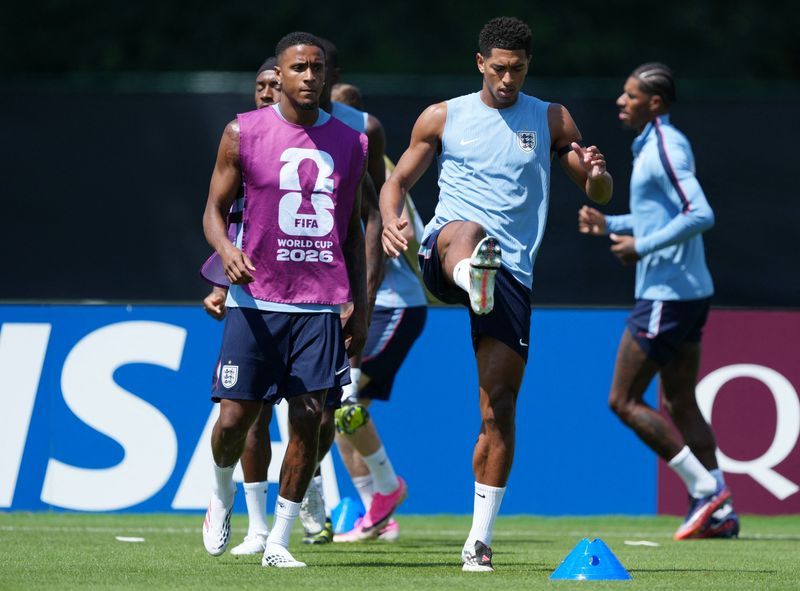
England's camp in Atlanta is projecting a message of singular purpose and togetherness as the team prepares to face Argentina in Wednesday's World Cup semi-final, determined to move beyond the noise of recent tactical disagreements that emerged after their hard-fought quarter-final victory. The English squad has adopted a collectively resolute stance toward the kind of external scrutiny that invariably accompanies the national team, with leading figures making clear that internal harmony rather than outside commentary will define their approach to the knockout fixture.
The narrative of potential discord has largely centred on differing perspectives between manager Thomas Tuchel and midfielder Jude Bellingham following England's 2-1 extra-time win over Norway. Bellingham, who scored both English goals in that encounter, appeared to question the German coach's understanding of playing under intense pressure against elite opposition, while Tuchel had expressed dissatisfaction with the overall team performance. Yet rather than allowing such disagreements to fester, the squad has framed them as evidence of the competitive standards and detail-oriented approach that characterise their preparation.
Defender Ezri Konsa articulated the team's strategy for managing persistent media speculation, acknowledging that scrutiny comes inevitably with playing for England at the highest level but emphasising the collective capacity to compartmentalise external noise. Having spent considerable time in professional football, Konsa and his teammates understand the distinction between engaging with legitimate tactical discussion and allowing superficial commentary to undermine group cohesion. The defender's comments reflect a maturity within the squad about separating constructive internal evaluation from the broader chorus of outside voices that inevitably scrutinise every decision and utterance.
Marc Guehi, another defensive cornerstone of Tuchel's setup, offered lavish praise for the German manager's contribution to the team's psychological foundation. Guehi highlighted how Tuchel has cultivated an environment characterised by mutual belief and genuine togetherness, describing an atmosphere where players feel collectively invested in the manager's strategic vision and confident in their teammates' commitment to shared objectives. The defender suggested that the quarter-final clash with Norway, despite its demanding nature and the post-match controversy, had paradoxically strengthened rather than weakened the group's bonds.
Tuchel himself, addressing journalists from his own press conference within Atlanta Stadium, elaborated on the philosophical underpinning of his approach to team-building. He articulated a conviction that football, regardless of individual talent levels, fundamentally remains a collective enterprise dependent upon unified purpose and shared commitment. The manager observed that the broader World Cup tournament had demonstrated how elite players across all competing nations have prioritised team cohesion and national pride above individual glorification, establishing a culture of togetherness that transcends the usual professional rivalries of club football.
The German manager's assessment of his squad's mental resilience emphasised what he characterises as an unwillingness to surrender, even in circumstances of considerable pressure or adversity. Tuchel framed this resistance to capitulation as the defining characteristic that generates his pride in the group, suggesting that maintaining competitive intensity and psychological resolve through the knockout stages demands a specific type of mentality that transcends technical proficiency. His comments underscore how the manager views psychological fortitude and unified commitment as the ultimate determinants of success in tournament football, where marginal advantages accumulate across multiple matches.
The path forward for England should they overcome Argentina would lead to a confrontation with Spain in a World Cup final rematch of the Euro 2024 championship match, which the Spaniards won comprehensively. Spain demonstrated their current form by dismantling France 2-0 in Tuesday's other semi-final, establishing themselves as formidable opposition should England progress. The potential for a final against a Spanish side that has recently demonstrated exceptional quality adds another layer of motivation to Wednesday's encounter with Argentina, as the England squad contemplates the possibility of confronting a team that has already defeated them in a major tournament this year.
England's delegation had travelled from their Kansas base to Atlanta as Spain and France contested their semi-final, meaning most of the squad remained focused on immediate preparation rather than scouting the competing sides. When Guehi was asked about his observations of the France-Spain match, he revealed that he had slept through the contest during the flight, a detail that encapsulates the team's singular concentration on the task at immediate hand rather than broader tournament considerations. This detail, seemingly minor, reinforces the deliberate psychological compartmentalisation that Tuchel has apparently fostered within the squad.
The England manager's emphasis on internal togetherness and collective commitment represents a deliberate strategic choice in how he manages the psychological dimensions of international football at the highest level. By consistently redirecting discussion toward team unity and shared purpose, Tuchel appears to be constructing a narrative framework within which individual disagreements become absorbed into a larger story of collective growth and strengthened resolve. This approach contrasts with some previous England management philosophies that have occasionally allowed controversies to become focal points for broader questions about team culture and leadership.
For Malaysian and Southeast Asian observers, England's situation offers an instructive case study in how leading sports organisations manage the tension between transparent internal evaluation and the maintenance of external confidence. The squad's ability to acknowledge that disagreements about tactical approach have occurred while simultaneously projecting unified commitment toward upcoming challenges demonstrates a maturity in crisis management that transcends football. As England prepares for what may prove to be the tournament's most significant knockout match, the team's deliberate cultivation of cohesion and shared purpose may ultimately prove as decisive as any tactical innovation or individual brilliance.

