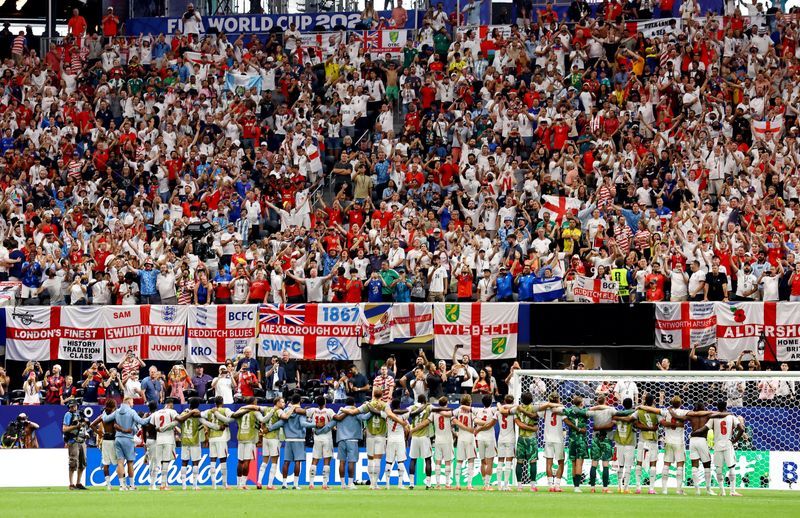
England's passage to the World Cup round of 16 proved far more treacherous than anticipated when they faced DR Congo at Atlanta Stadium on Wednesday, surviving what threatened to become a humiliating exit with a tense 2-1 comeback victory. The Three Lions had begun their tournament confidently enough with a 4-2 triumph over Croatia, but subsequent performances raised growing concerns about their defensive stability. A goalless stalemate against Ghana followed by a laboured 2-0 win over Panama suggested that Thomas Tuchel's team lacked the defensive solidity expected of tournament contenders, particularly in their backline organisation.
The full extent of those vulnerabilities became apparent within the opening quarter-hour when Brian Cipenga capitalised on England's disorganisation to fire the underdogs into an improbable lead. This represented a watershed moment in the match—the first occasion England had trailed throughout the entire tournament. The psychological weight was immediately palpable, with the stadium atmosphere shifting from confident expectancy to palpable anxiety. Television coverage captured the growing tension among England supporters, their faces reflecting creeping dread as they confronted the possibility that their team might exit at the group stage of knockout football, an outcome unthinkable before the tournament began.
DR Congo's defensive approach proved extraordinarily disciplined and effective. The Congolese side had fashioned a suffocating low block, forcing England to manufacture chances through sustained possession rather than penetrating direct play. Goalkeeper Lionel Mpasi emerged as an unexpected obstacle, producing a string of crucial saves that frustrated England's attacking players. The disparity in approach became increasingly evident—DR Congo required minimal possession to remain dangerous, whereas England created repeated opportunities but struggled to convert them into goals. When Yoane Wissa struck the post shortly before halftime following a dangerous counter-attack, and when Harry Kane's furious penalty appeal was waved away moments later, the sense that England might succumb to an upset grew tangibly stronger.
Tuchel's demeanour throughout the opening period reflected the deteriorating situation. The German manager prowled his technical area with visible frustration, at one point remonstrating loudly with defender Djed Spence following a misplaced throw-in. His tactical adjustments and substitutions in the second half demonstrated how seriously he perceived the threat. The introduction of Eberechi Eze in midfield represented an attempt to inject creativity and impetus into England's midfield play, while repositioning Declan Rice to right back sought to generate additional attacking width through unconventional means.
England's breakthrough eventually arrived in the 75th minute when Kane's glancing header brushed past Mpasi's fingertips and found the back of the net, representing his 83rd international goal. The release of tension inside the stadium felt almost cathartic, as months of accumulated anxiety found sudden expression. Kane's second goal, struck in the 86th minute, finally secured England's progression, but the manner of the victory—grinding, uncomfortable, and occasionally desperate—contradicted pre-tournament expectations of a fluid, dominant England outfit.
Tuchel's post-match reflections emphasised the psychological dimensions of knockout football. His comments about maintaining belief and patience when circumstances turn adverse acknowledged the reality that his squad had confronted genuine jeopardy. The victory represented England's first World Cup comeback since their quarter-final win over Cameroon in 1990—precisely 36 years prior. That historical parallel underscored just how rarely English teams find themselves in such desperate situations and how improbable reversals of fortune at the World Cup truly are.
Kane's own assessment proved characteristically pragmatic. The England captain recognised that knockout football imposed qualitatively different demands on teams, requiring resilience and grit rather than aesthetic performance. His observation that England must now "grind wins out" suggested a recalibration of expectations from the flowing attacking football that had characterised the group phase. The captain's acknowledgement that consecutive matches presented "two difficult games for different reasons" hinted at the contrasting challenges posed first by DR Congo's defensive discipline and subsequently by Mexico's attacking threat.
The immediate challenge confronting England now materialises in Mexico City, where they encounter the Mexicans at the Azteca Stadium—situated more than 2,200 metres above sea level. The altitude presents a physiological obstacle entirely distinct from the psychological pressures England navigated against DR Congo. At such elevation, oxygen levels diminish significantly, respiratory demands increase, and footballs travel through the thinner air with trajectories and velocities unfamiliar to teams accustomed to sea-level conditions. England's players, having expended enormous physical and emotional energy in their afternoon battle in Atlanta, must now prepare for atmospheric conditions that will further tax their cardiovascular systems and technical precision.
The convergence of these challenges—Mexico's attacking reputation combined with Azteca Stadium's geographical peculiarities—presents England with a fundamentally different examination of their World Cup credentials. Where DR Congo forced England to unlock defensive resilience and patience, Mexico threatens to expose whether the Three Lions possess sufficient robustness to withstand sustained attacking pressure. The psychological momentum generated by their comeback victory could prove decisive, yet the physical demands of Mexico City's elevation introduce variables that cannot be replicated in preparation.
For Malaysian and Southeast Asian observers, England's performance illuminates broader truths about modern tournament football. The match demonstrated that established European powers remain vulnerable to disciplined defensive opposition, particularly when lacking peak defensive organisation. The resilience England eventually demonstrated—recovering from early adversity through sustained pressure and tactical adjustment—represents a template familiar to Asian teams that regularly navigate knockout competition. Furthermore, the impact of altitude and geographical factors at Mexico City serves as a pertinent reminder for regional football development, as Southeast Asian nations increasingly host major tournaments where environmental variables significantly influence outcomes and require specialised preparation.
England's passage through this knockout stage remains uncertain. Their defensive fragility, exposed comprehensively against both Ghana and DR Congo, suggests that further tests await. Mexico represents a qualitatively different proposition—a team built around attacking capability rather than defensive fortification. Whether Tuchel's squad can transition from their defensive struggles into a more assured performance against attacking opponents will prove decisive for their tournament ambitions.

