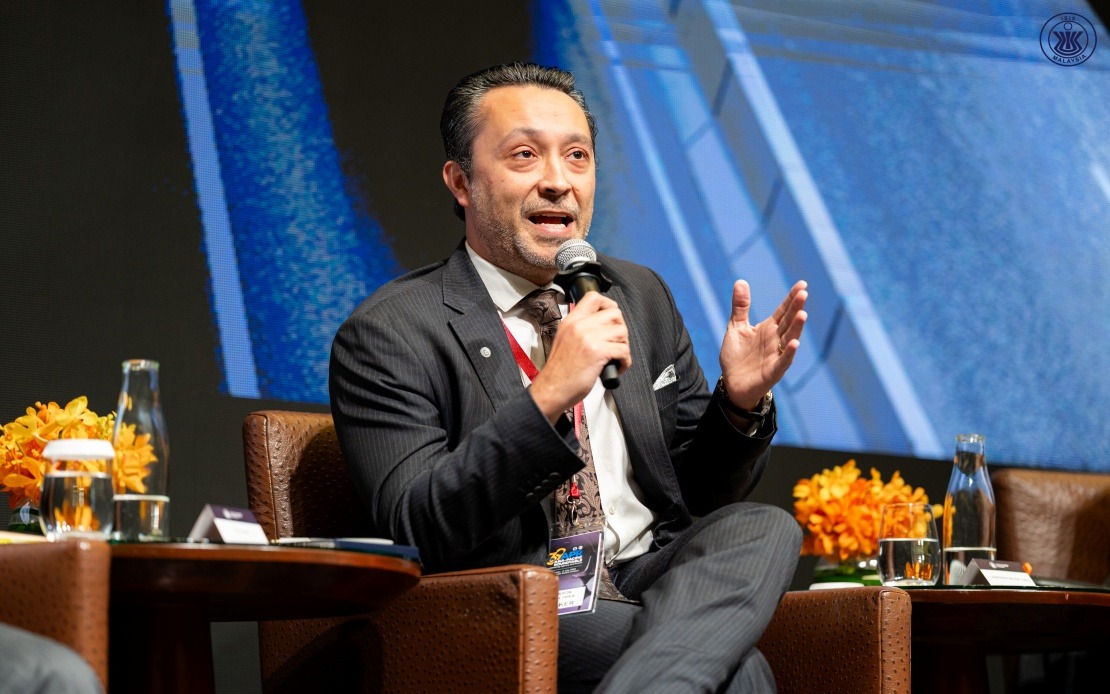
The traditional blueprint for global governance is crumbling, and nations across the Global South must seize the moment to define their own strategic priorities rather than defaulting to the playbooks of established powers. This was the central message delivered by international scholars at the 39th Asia-Pacific Roundtable in Kuala Lumpur, where panellists underscored that emerging middle powers—a category encompassing Malaysia, Brazil, India, Indonesia, Turkiye, and Mexico—occupy fundamentally different political terrain than their established counterparts and therefore require distinct approaches to navigating an increasingly fluid international landscape.
Dr Dawisson Belém-Lopes, Professor of International and Comparative Politics at Brazil's Federal University of Minas Gerais, challenged the notion that emerging and established middle powers should be treated as a monolithic bloc. Such conflation, he argued, obscures critical differences in political systems, historical trajectories, and developmental trajectories that shape how nations respond to global challenges. The emerging powers that comprise much of the Global South have historically harboured deep reservations about the liberal international order that crystallised following World War Two, he noted, pointing to longstanding calls from these nations for comprehensive systemic reform rather than incremental adjustment.
The divergence between emerging and established middle powers runs deeper than mere preference. Countries like Malaysia and Indonesia possess historical experiences markedly distinct from the developed democracies that have dominated international institutions for the past seven decades. These varied contexts generate competing priorities and values that cannot be reconciled under a single strategic framework. Belém-Lopes emphasised that emerging powers must recognise their growing material capacity and leverage newly available institutional platforms to pursue agendas that reflect their own interests rather than gravitating toward positions staked out by countries with vastly different geopolitical circumstances.
The current moment presents particular opportunity for the Global South to assert agency. As Belém-Lopes observed, these nations possess both expanded resources and access to institutional mechanisms that remained unavailable during earlier phases of their development. The proliferation of alternative forums—from BRICS to various regional organisations—provides venues through which emerging powers can coordinate positions and amplify their collective influence without reliance on Western-dominated institutions. This structural shift has fundamentally altered the calculus of global diplomacy, creating space for substantive alternatives to Western-led approaches.
Simultaneously, the underlying architecture of international order is undergoing profound transformation. Peter Varghese, Chancellor of the University of Queensland and former secretary of Australia's Department of Foreign Affairs and Trade, characterised the contemporary moment as an interregnum—a space between international orders where the post-war system centred on American leadership is gradually disintegrating. This transition stems not merely from shifts in current policy preferences but from deeper structural currents: China's meteoric economic and strategic rise, the acceleration toward genuine multipolarity, the erosion of Washington Consensus orthodoxy in economics and governance, and the resurging salience of identity and cultural politics in shaping national foreign policies.
The instability inherent in this transitional phase carries both risks and opportunities. While the breakdown of established structures creates uncertainty, it simultaneously weakens the gravitational pull that once locked countries into predetermined alignments. However, Varghese cautioned that navigating this flux demands careful calibration. The construction of new multilateral frameworks requires substantial time and cannot be hastened through force of will alone. Countries must therefore complement their assertion of agency with pragmatic investments in regional cooperation and cross-regional partnerships that can function effectively regardless of broader systemic architecture.
Asia assumes particular significance within this evolving order, according to Dr Ken Jimbo, Professor of International Relations at Keio University Japan. Despite shifts in American foreign policy direction and rhetoric, Asia will remain central to great power competition and strategic calculus. The United States will continue leveraging regional partnerships as instruments for advancing its strategic objectives, even under frameworks emphasising American national interests above multilateral commitments. This means that countries across Asia, including Malaysia, occupy privileged positions in great power calculations and can extract concessions or support by carefully managing their diplomatic relationships.
For Japan and other developed democracies dependent on current international arrangements, the stakes involve fundamental security and economic foundations. Japan's prosperity and security rest upon maintenance of a rules-based international system characterised by freedom of navigation and open commerce. Yet this requirement for institutional stability must be negotiated with other regional actors whose interests diverge substantially from Japan's. The tension between preserving beneficial order and accommodating legitimate demands for systemic reform from rising powers creates a complex landscape where all regional players must pursue sophisticated diplomacy.
Malaysia's position within these dynamics merits particular attention. As an emerging middle power with sophisticated diplomatic traditions, Malaysia possesses tools to navigate between competing great powers while advancing substantive national interests. The country's participation in multiple institutional frameworks—from ASEAN to BRICS and various bilateral arrangements—provides flexibility that many smaller nations lack. The challenge lies in converting this structural advantage into concrete gains by pursuing coherent strategies rooted in Malaysian interests rather than defaulting to external agendas.
The 39th Asia-Pacific Roundtable, organised by the Institute of Strategic and International Studies Malaysia under the theme "Accelerating Agency and Action," provided a platform for examining these dynamics at precisely the moment when their urgency has intensified. The consensus among prominent international scholars present—that emerging powers must chart independent courses rather than follow established precedents—reflects broader recognition that the post-Cold War consensus has definitively ended.
For Malaysian policymakers and business leaders, these discussions underscore a fundamental imperative: proactive engagement with the reshaping of global order rather than passive adaptation to changes driven by others. The Global South possesses numerical strength, economic dynamism, and institutional innovations that previous generations lacked. Converting these advantages into durable influence requires sustained commitment to independent thinking and strategic clarity about national priorities.
The window for asserting agency during this transitional period is neither permanent nor infinite. As new international structures gradually stabilise, the plasticity that currently characterises global relations will diminish. Countries that successfully advance their interests during this phase will occupy stronger positions in whatever order eventually solidifies. Conversely, nations that passively await developments or simply echo positions adopted by established powers risk finding themselves marginalised in subsequent configurations. For Malaysia and comparable emerging middle powers, the imperative for strategic independence has rarely been clearer.

