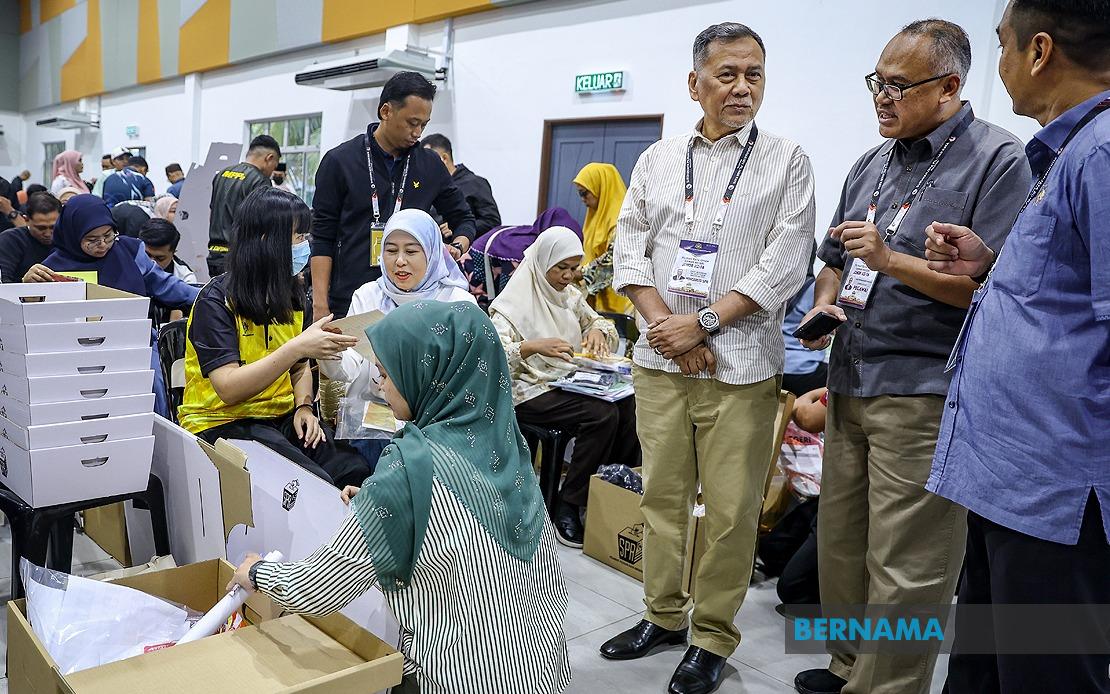
The Election Commission has mobilised personnel across Johor to complete critical last-minute preparations for the 16th State Election, which begins tomorrow with voters set to determine representation for all 56 state constituencies. With over 2.7 million registered voters expected to participate, election officials have been conducting thorough inspections of ballot boxes and electoral equipment to ensure the polling day proceeds without disruption.
Election Commission Chairman Datuk Seri Ramlan Harun emphasized the importance of meticulous pre-polling checks, describing these verification procedures as fundamental to guaranteeing a smooth electoral process. He confirmed that ballot box inspections across all 56 state seats had been completed and that returning officers at polling centres throughout the state had largely finished their preparations. By conducting these checks a day in advance, the commission aims to eliminate potential complications that could hinder voter participation or compromise the integrity of the counting process.
During inspection visits to the Sultan Ibrahim Jubilee Hall in Pontian and the Permas Multipurpose Hall in Kukup, Datuk Seri Ramlan reinforced the commission's commitment to logistical excellence and voter accessibility. Election officials have been instructed to ensure that polling centres operate at full capacity without unnecessary delays, requiring voters to adhere to their assigned time slots to prevent congestion. Additionally, the commission has advised all citizens to bring valid identification documents and follow the guidance of electoral officials stationed at each polling centre.
At Sekolah Kebangsaan Bukit Mutiara in the Puteri Wangsa state constituency, 74 election personnel supported by 12 police officers have been converting 12 classrooms into distinct polling streams to handle the expected volume of voters efficiently. Polling centre supervisor Mohd Rasib Ngadiman reported smooth progress in arranging facilities, including the installation of directional signboards and the provision of wheelchairs for elderly citizens and persons with disabilities. This allocation of 74 personnel to a single centre reflects the commission's determination to provide adequate staffing for seamless operations.
In Kluang's Mahkota state constituency, similar preparations are underway at Sekolah Kebangsaan Kampong Melayu, where 30 election personnel have established five polling streams capable of processing approximately 3,000 voters. The meticulous arrangement of facilities demonstrates the commission's attention to accommodating varying voter needs and ensuring that the democratic process remains accessible across different demographic groups. This standardized approach to polling centre setup has been replicated across multiple locations, indicating a coordinated strategy for managing electoral logistics.
Batu Pahat has also received focused attention, with preparations at Sekolah Menengah Kebangsaan Dato' Seth in Yong Peng prioritizing comfortable voting facilities for vulnerable populations including senior citizens and young voters. By implementing disability-friendly infrastructure and age-sensitive accommodations, the commission recognises that effective electoral participation depends on removing physical barriers that might discourage certain voters from casting ballots.
The most challenging logistics have emerged in Mersing's Tenggaroh state constituency, where four island communities—Pulau Aur, Pulau Pemanggil, Pulau Sibu, and Pulau Tinggi—require ballot boxes to be transported via the Mersing Jetty. This operation involves approximately 50 personnel working in coordination with the Marine Police Force and local district police to ensure secure transportation of electoral materials across water routes. The complexity of conducting elections in geographically dispersed locations highlights the commission's capacity to manage diverse operational challenges across the state.
The electoral contest itself reflects Malaysia's competitive political landscape, with 172 candidates from multiple parties and independent contenders vying for the 56 state seats. Pakatan Harapan and Barisan Nasional have fielded comprehensive slates across all constituencies, while Perikatan Nasional is contesting 33 seats and Parti Bersama Malaysia 15. Smaller parties including MUDA, the Malaysian Orang Asli Party, and the Socialist Party of Malaysia, along with six independent candidates, round out the diverse field competing for voter support.
The scale of voter registration—2.7 million eligible citizens—underscores Johor's significance within Malaysia's electoral system, as the state represents a substantial portion of the nation's electorate. The election commission's preparations across multiple polling centres simultaneously demonstrates the institutional capacity required to administer democratic processes in a state of this magnitude. Success tomorrow will depend not only on the planning conducted today but also on the coordination and professionalism of thousands of election officials deployed across the state.
Voters are being reminded that bringing valid identification cards remains essential for casting ballots, and that respecting designated time slots will help maintain orderly queues and reduce waiting periods. The commission's emphasis on voter education and procedural clarity reflects lessons learned from previous elections and a commitment to continuous improvement in electoral administration. As Johor's voters prepare to exercise their democratic franchise, the infrastructure and personnel mobilised over recent weeks will be tested in determining whether the commission's preparations translate into an efficient and credible polling day.

