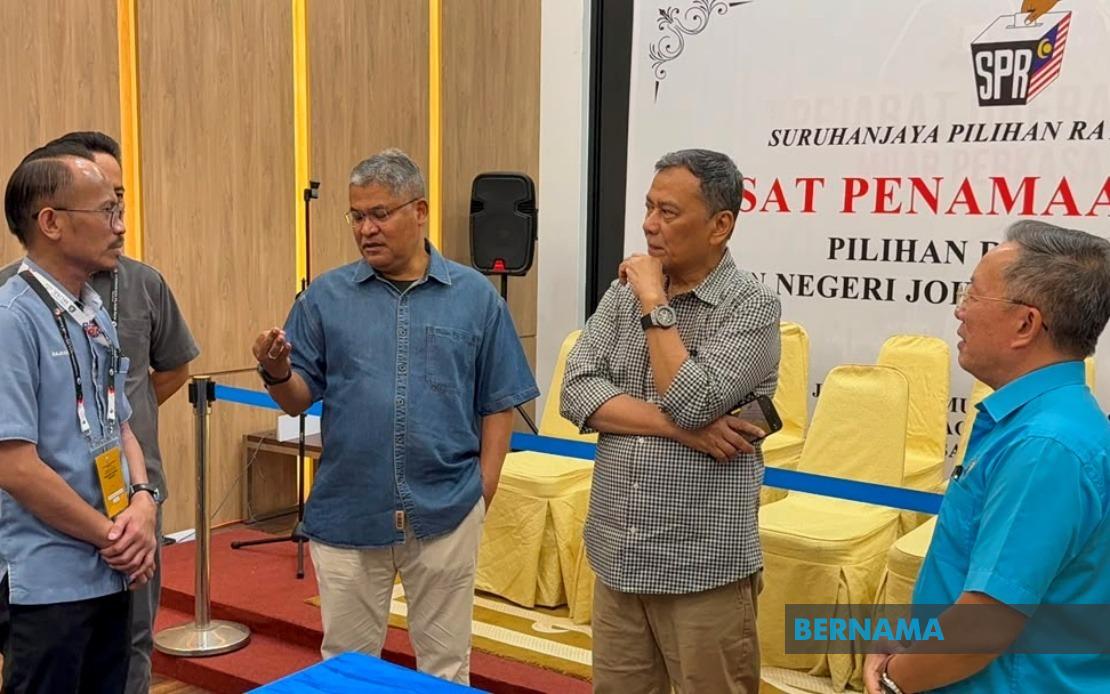
The Election Commission has declared itself fully prepared for tomorrow's nomination day in the Johor state election, completing a final round of logistics and operational checks across the state. Officials at multiple Candidate Nomination Centres reported that technical preparations have been finalised, with staff now in position to receive candidates and their nominations from 9am to 10am.
The scale of the undertaking is substantial. The election involves 2,727,926 registered voters across Johor, comprising 2,703,175 ordinary voters alongside 12,041 military personnel and their spouses, and 12,710 police personnel and their spouses. This voter base will be channelled through 56 nomination centres positioned throughout the state, each requiring coordination between returning officers, police, local authorities, and party representatives.
At the Perling state constituency centre located at Dewan Jubli Intan Hall in Johor Bahru, returning officer Nazatul Shima Mohamad expressed confidence that infrastructure and procedural simulations had been completed. She emphasised that all agencies had demonstrated equal commitment to ensuring a smooth process, and urged prospective candidates to arrive early with proper documentation and the required deposit funds. Her statement reflected a broader message from the Election Commission seeking to establish clear expectations and minimise delays on the day itself.
Security and crowd management emerge as significant operational considerations. The Kota Iskandar centre, housed at the Main Hall of the Iskandar Puteri City Council in Medini, will operate under specific protocols developed in coordination with police. These include temporary road closures around the nomination venue, a 50-metre perimeter restriction limiting how close candidate supporters may approach the centre, dedicated tent areas for party supporters outside the main hall, and physical barriers separating competing parties' groups. These measures acknowledge the potential for heated political engagement during the nomination process while attempting to balance transparency with orderly administration.
The returning officer for Kota Iskandar, Shahrulizam Abdul Rashid, appealed to the public to exercise restraint and avoid confrontations. His statement recognised that while candidate supporters will inevitably gather to show solidarity, the nomination process depends on mutual cooperation and the avoidance of provocations. This appeal signals awareness of past tensions during Malaysian election nomination periods and represents an attempt at preventive crowd management rather than reactive intervention.
The timeline for the 16th Johor state election reflects standard Malaysian electoral procedures with compressed scheduling. The state assembly was dissolved on June 1, establishing the foundation for tomorrow's nomination day. Early voting has been set for July 7, allowing registered voters in designated categories—including military and police personnel—to cast ballots before the main polling day. The general election itself will take place on July 11, meaning the entire process from dissolution to polling day spans roughly five weeks.
This compressed timeframe places considerable pressure on all electoral stakeholders. Candidates must navigate the nomination process tomorrow with complete documentation and financial deposits in place, knowing that any procedural errors or missing requirements could disqualify them from contesting. Party machinery must mobilise supporters and campaign resources within a narrow window, while the Election Commission must maintain electoral integrity and transparency across a geographically dispersed state with multiple population centres.
The voter registration figures underscore Johor's political significance within Malaysia. With nearly 2.73 million registered voters, Johor represents one of the nation's largest single-state electorates and a crucial battleground in Malaysian politics. The state's composition—encompassing urban centres like Johor Bahru and Iskandar Puteri alongside smaller towns and rural constituencies—means that election outcomes can shift based on turnout patterns and regional voting trends. Candidates will be competing for seats in an environment where demographic and economic diversity translates into varied political priorities.
The Election Commission's emphasis on readiness and preparation reflects lessons learned from previous electoral exercises in Malaysia. By publicly confirming that centres are equipped, staff are trained, and security arrangements are finalised, the commission seeks to establish public confidence in the electoral process. Transparency about logistics—such as operating hours, required documentation, and procedural steps—reduces the potential for confusion or complaints about accessibility and fairness.
For political parties and candidates, tomorrow's nomination day represents a critical juncture. Only candidates who successfully navigate the nomination process with complete compliance will be eligible to contest on July 11. The 56 nomination centres will process applications sequentially, with returning officers validating each nomination against Electoral Commission requirements. Any deficiency in documentation or deposit payments could result in rejection, eliminating candidates before campaigning even begins.
The implications for Malaysian politics extend beyond Johor itself. State elections serve as barometers for national political sentiment and test ground for campaign strategies. Results from the Johor election will influence perceptions about voter preferences heading into potential federal elections, and may reshape coalition dynamics within the state and potentially across the broader Malaysian political landscape. The smooth administration of tomorrow's nomination process will therefore impact not only Johor's governance but also Malaysia's wider political trajectory.
As nomination day dawns tomorrow, the success of the process will depend on coordination between multiple agencies, compliance from candidates and parties, and restraint from supporters gathering at nomination centres. The Election Commission's final preparations, while procedurally complete, will ultimately be tested by the conduct and cooperation of all participants in this democratic exercise.

