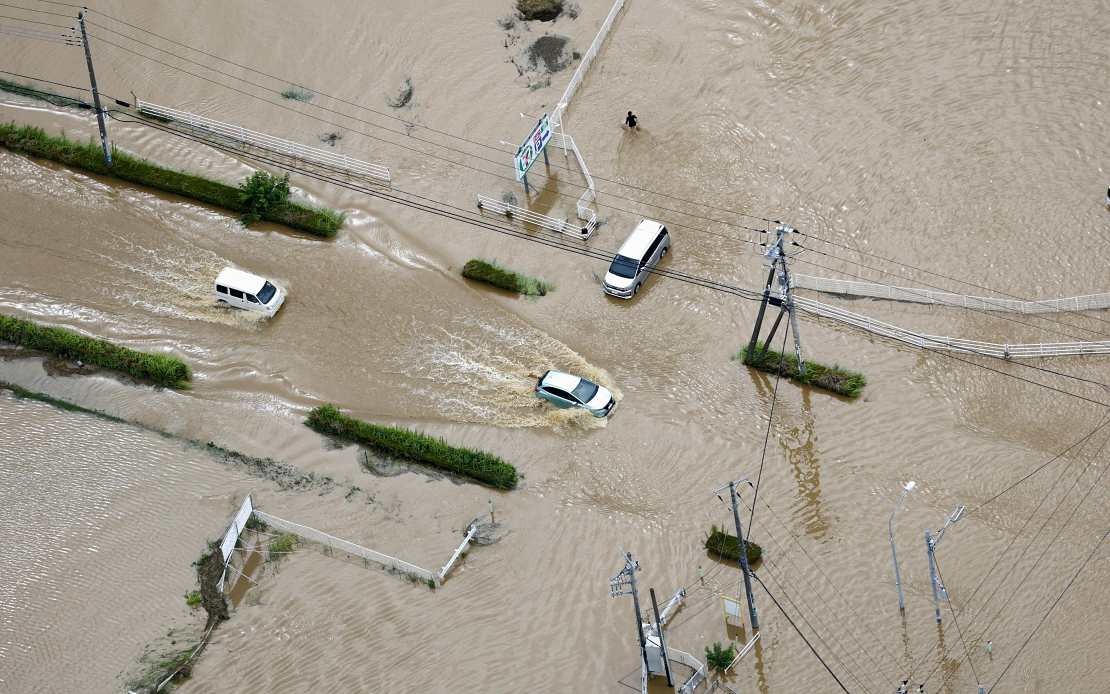
A catastrophic weather system has swept across Japan's Chiba Prefecture, leaving a trail of destruction that has claimed eight lives and disrupted transportation for thousands. The record-breaking deluge, which pummelled the eastern region through the early hours of Friday, represents one of the most severe weather events to strike the prefecture in recent times, with authorities struggling to manage the humanitarian fallout across multiple municipalities.
The confirmed fatalities span five cities within Chiba Prefecture, including the prefectural capital Chiba City itself, alongside Kashiwa, Ichikawa, Sakura and Yachiyo. Beyond the tragic loss of life, four additional residents sustained minor injuries during the storm's onslaught. The sheer scale of the emergency prompted widespread evacuation efforts, with prefectural authorities ordering more than 102,600 residents to abandon their homes and seek higher ground as of Friday morning, underscoring the immense risk posed by the continuing weather situation.
The Japan Meteorological Agency revealed the staggering dimensions of the rainfall event that triggered this crisis. Chiba City absorbed an extraordinary 348 millimetres of precipitation within a single 12-hour window ending at 1.40 am local time on Friday—an unprecedented volume that shatters the city's historical records. To contextualise this meteorological anomaly, the total represents approximately three times the typical monthly rainfall that Chiba City normally experiences throughout August, compressed into mere hours. Such concentrated precipitation overwhelms drainage systems and natural water absorption capacity, creating conditions ripe for flash flooding and cascading secondary disasters.
The severity of the situation prompted the Japan Meteorological Agency to issue its highest-level alert—a Level 5 emergency warning—specifically targeting heavy rain and landslide hazards across portions of Chiba Prefecture. This maximum-tier alert signals imminent and extreme danger requiring immediate protective action. Though weather officials gradually downgraded these warnings to Level 4 or lower by Friday morning as precipitation eased, meteorologists cautioned that the atmospheric conditions remained unstable and that additional heavy rainfall bursts could develop with minimal warning.
For travellers and commuters throughout the region, the storm produced cascading disruptions that left thousands stranded and transportation networks paralysed. Narita Airport, one of the nation's primary international aviation hubs located within Chiba Prefecture, found itself ensnared in operational chaos as the downpour devastated regional rail and bus infrastructure. Approximately 7,000 passengers remained marooned at the airport overnight, unable to proceed with their journeys as ground transportation became inaccessible and flights faced delays or cancellations. The airport operator warned that recovery of normal operations would require considerable time as the underlying transportation damage was assessed and addressed.
From a Southeast Asian perspective, this catastrophe carries immediate relevance for Malaysian and regional travellers who regularly transit through Narita Airport—one of Asia's busiest aviation gateways. The disruption highlights the vulnerability of infrastructure concentrated in single geographic regions to extreme weather events, a pattern increasingly familiar across Southeast Asia as monsoon intensification and climate variability create more volatile precipitation patterns. Malaysian business travellers, tourists and expatriates dependent on regular Japan connections face potential itinerary complications whenever such weather events strike Japan's population centres.
The broader implications extend to disaster management frameworks across the region. Japan's sophisticated meteorological forecasting systems and early warning protocols—among the world's most advanced—nevertheless struggled to fully mitigate human casualties and economic damage. This sobering reality suggests that even well-resourced nations with cutting-edge infrastructure require continuous improvement in emergency response coordination, evacuation logistics and building resilience. For Southeast Asian countries developing their own extreme weather response capabilities, Japan's experience offers both cautionary lessons and instructional models worth studying carefully.
Climate scientists increasingly link these extreme precipitation events to shifting atmospheric patterns and warming ocean temperatures in the Pacific region, trends that affect weather systems across East and Southeast Asia. The concentration of intense rainfall in geographically limited areas creates compounding risks: saturated soil becomes unstable on hillsides, overwhelmed drainage channels spawn flash floods in urban zones, and disrupted infrastructure cascades across multiple sectors simultaneously. Understanding these interconnected risks helps frame how weather events in Japan may foreshadow patterns affecting the broader region.
The human dimensions of this disaster—the loss of eight lives, the displacement of over 100,000 people from their homes, the stranding of thousands of air passengers—underscore the profound vulnerability that modern societies face when confronted with meteorological extremes. While Japan possesses institutional capacity and technological capability that exceeds most nations worldwide, these assets did not prevent significant loss of life. This paradox illustrates that weather preparedness requires not merely technology or wealth, but cultural adaptation, community engagement and continuous institutional learning about emerging climate realities.

