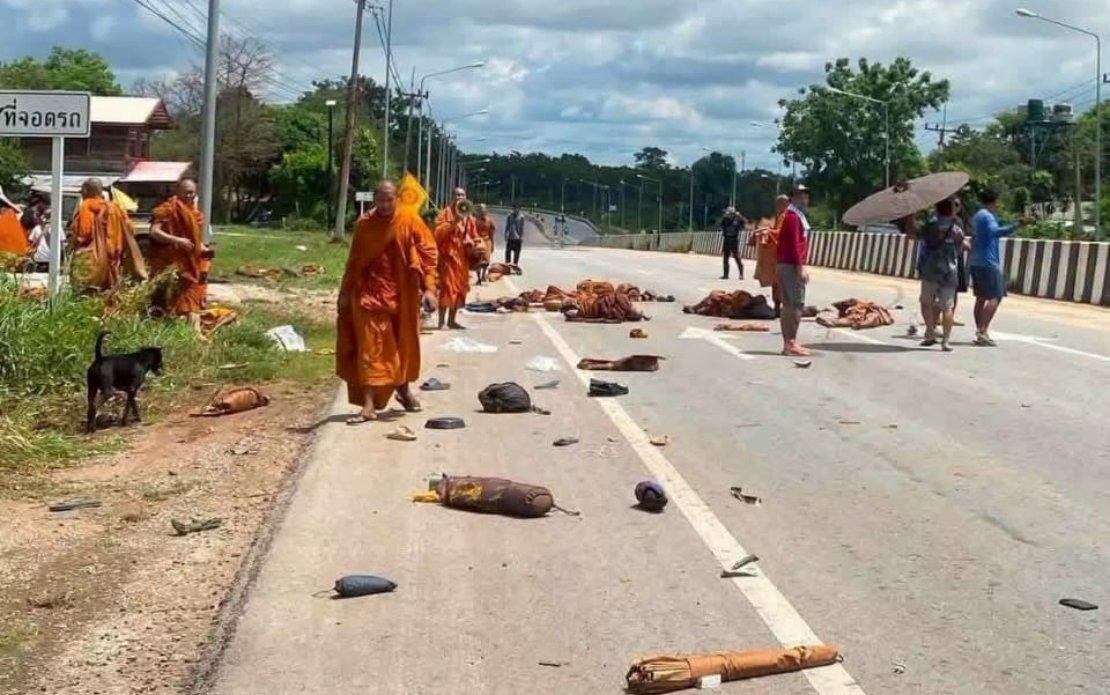
A tragic road accident in northeastern Thailand has claimed the lives of eight Buddhist monks and left 14 others injured after a pickup truck crashed into a walking pilgrimage group. The incident unfolded on Thursday in Mukdahan province when the monks, engaged in a religious walking journey toward Nam Khun district in neighbouring Ubon Ratchathani province, were struck by the vehicle while travelling along Ban Na Si Nuan Road in Mueang district. Emergency responders discovered that five monks died immediately at the scene, while three additional victims succumbed to injuries sustained during the collision after reaching hospital facilities.
The severity of injuries varied significantly among the 22 monks and one civilian who required hospitalisation following the accident. Dr Narong Chankaew, Mukdahan Provincial Public Health Chief, documented that four patients suffered critical injuries requiring intensive medical intervention, whilst ten others experienced moderate injuries. In total, 23 patients entered the hospital system for treatment and ongoing care, stretching local medical resources as healthcare providers worked to stabilise the most vulnerable victims. The incident quickly prompted Mukdahan Hospital to issue an urgent public appeal for blood donations to support the mounting medical demands.
According to preliminary investigation findings released by Mukdahan Governor Warayan Boonnarat, the monks had commenced their pilgrimage at approximately 11 am, walking in a direction opposite to vehicular traffic flow on Ban Na Si Nuan Road—a pedestrian safety measure designed to allow them to see approaching vehicles. The front five monks in the procession successfully evaded the pickup truck's path when it suddenly lost control. However, the remaining monks, positioned roughly two metres away from the road's edge, could not escape the vehicle's trajectory as it veered off the roadway and struck them with devastating force.
The driver of the pickup truck, identified as a juvenile under 15 years old, was apprehended at the scene and taken into custody by Mukdahan Provincial Police. Police Major General Phairoj Thaiputra, Mukdahan Provincial Police Commander, indicated that authorities have intensified their investigative efforts by gathering physical evidence and conducting interviews with the young driver's parents. This legal approach aims to establish the precise circumstances that led to the loss of vehicle control, a critical factor in determining appropriate charges and accountability measures.
Investigators are currently exploring whether the parents of the underage driver should face negligence charges for permitting their child to operate the vehicle. This potential prosecutorial pathway reflects broader concerns in Thailand regarding supervision of young drivers and parental responsibility for vehicle access. The case raises questions about enforcement of juvenile driving laws and the circumstances that allowed a child under 15 to be behind the wheel during daylight hours, suggesting possible gaps in monitoring or enforcement of existing traffic regulations.
The incident represents a stark collision between religious devotion and modern transportation hazards in Thailand. Buddhist pilgrimage traditions remain deeply rooted in Thai culture, with monks regularly undertaking long-distance walking journeys as spiritual practice. However, such activities increasingly expose participants to risks posed by motorised traffic, particularly given Thailand's well-documented road safety challenges. The timing of the collision at approximately midday suggests the monks were visible and the roads were active with vehicular movement.
For Malaysian readers, this tragedy underscores transportation safety concerns that extend across Southeast Asia. Thailand consistently records among the highest road fatality rates globally, a problem that extends beyond simple vehicle collisions to encompass broader issues of driver accountability, vehicle maintenance standards, and enforcement of traffic laws. The involvement of an underage driver raises additional questions about supervision mechanisms and whether comparable gaps exist in Malaysia's monitoring of young people accessing vehicles.
The pilgrimage route itself traverses the rural landscape of Thailand's northeast region, an area where vehicle traffic may be less regulated and enforcement mechanisms potentially weaker than in urban centres. This geographic factor may have contributed to circumstances allowing a juvenile to operate a vehicle unsupervised. The monks' deliberate choice to walk against traffic flow demonstrates safety consciousness, yet proved insufficient against the sudden loss of vehicle control, highlighting limitations of individual precautions when facing systemic risks.
The incident will likely prompt Thai authorities to examine juvenile driving regulations more closely and consider whether parental liability provisions require strengthening. Religious organisations may also reassess safety protocols for pilgrimage activities, potentially incorporating advanced notice to local authorities or coordination with traffic management officials. The case demonstrates how traditional spiritual practices intersect with contemporary challenges in transport infrastructure and regulation enforcement.
This tragedy serves as a regional reminder of the ongoing tension between preserving cultural and religious practices whilst managing inherent transportation risks. Southeast Asian governments, including Malaysia, continue grappling with balancing religious freedom and traditional observances against modern safety imperatives. The investigation outcomes in this Thai case will likely inform policy discussions across the region regarding juvenile driving supervision, parental accountability, and protective measures for large pedestrian groups operating on public roads.

