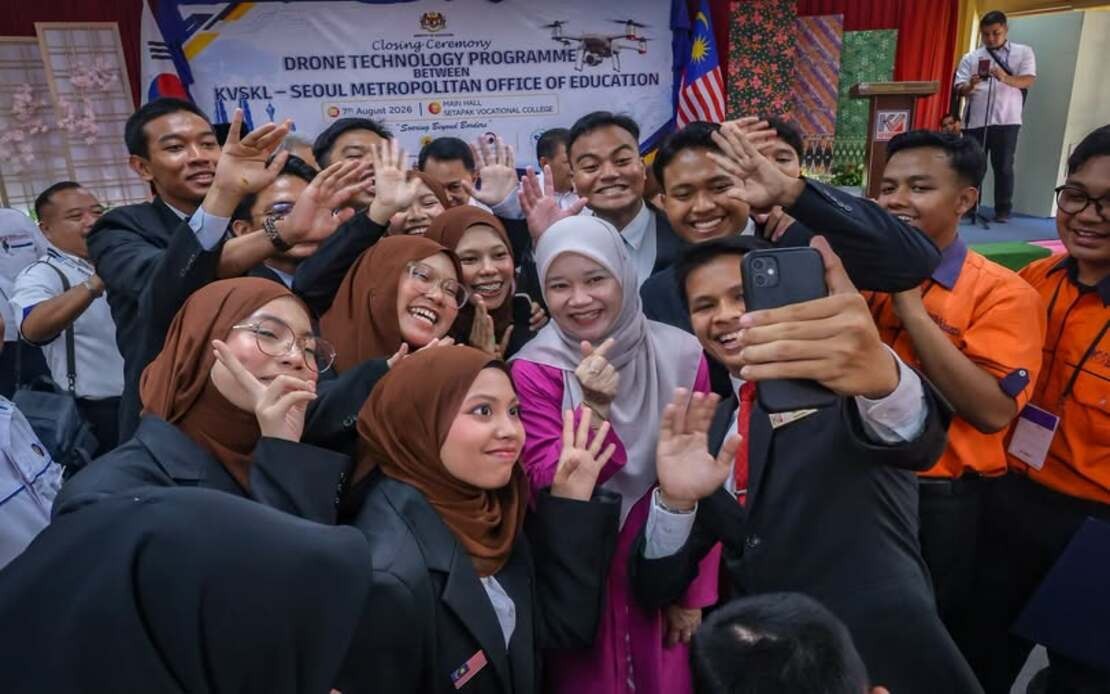
Education Minister Fadhlina Sidek has thrown down a challenge to students at Setapak Vocational College: harness drone technology to address a real-world problem on their own campus by developing innovative security solutions. Speaking during a collaboration initiative with the Seoul Metropolitan Office of Education, Fadhlina gave the cohort of students a one-month window to research, analyse, and conceptualise how unmanned aerial systems could meaningfully enhance their school's security infrastructure before presenting their findings directly to her.
The challenge represents a significant shift in how Malaysia's vocational education system approaches technology training. Rather than treating drones and robotics as abstract technical skills confined to classroom demonstrations, Fadhlina is pushing students to bridge the gap between theoretical knowledge and practical problem-solving. This pedagogical approach aligns with global trends emphasising outcome-based learning, where students must justify technological applications with tangible benefits rather than simply mastering operational competencies. For vocational institutions particularly, this methodology strengthens the relevance of their graduates in an increasingly automation-dependent labour market.
The initiative emerged from a formal partnership between Malaysia's education authorities and South Korean counterparts, with South Korean Ambassador to Malaysia Yeo Seung-bae attending the programme launch. Such bilateral collaboration underscores Southeast Asia's growing engagement with Northeast Asian technological expertise, particularly as nations compete to develop competitive advantages in emerging sectors. South Korea's decades of experience embedding robotics and automation into education systems makes it a logical knowledge partner for Malaysian institutions seeking to accelerate their own technological integration.
During the collaboration programme, Fadhlina observed students operating drones, manipulating robotic systems, and engaging hands-on with sophisticated equipment. She remarked that while some demonstrations succeeded flawlessly and others encountered technical failures, the students' perseverance through setbacks constituted authentic learning. This perspective carries implicit criticism of educational models that prioritise error-free performance over experimentation and resilience—qualities increasingly valued by employers seeking adaptable graduates capable of navigating technological uncertainty.
The minister emphasised that robotics, drone technology, and artificial intelligence have transitioned from futuristic speculation into present-day economic reality. Malaysia's manufacturing sector, logistics networks, and infrastructure industries increasingly incorporate these technologies into operations. Vocational colleges must therefore equip students not merely as operators but as innovators capable of identifying practical applications suited to local contexts. For Malaysia particularly, where the economy relies heavily on established sectors, positioning vocational graduates as technology problem-solvers could unlock new competitive advantages and entrepreneurial pathways.
Fadhlina's broader strategic vision involves repositioning vocational education as a driver of technological adoption rather than a supplier of trained operatives. By tasking students with security-focused drone applications, she simultaneously addresses a pressing need—campus safety remains a legitimate institutional concern across Malaysian schools—while creating genuine motivation for technological learning. Students are more likely to engage deeply with complex systems when solving concrete problems than when following abstract curricula.
The Setapak challenge also implicitly acknowledges Malaysia's security landscape. Educational institutions increasingly invest in surveillance and safety infrastructure, creating operational demand for cost-effective monitoring solutions. Drones offer advantages over traditional fixed-camera systems: flexibility in deployment, reduced permanent installation costs, and rapid response capability. Should student proposals prove viable, pilot implementations could benefit not only Setapak but potentially become templates for broader adoption across Malaysia's vocational college network.
This initiative reflects a deliberate effort to close skills gaps identified in Malaysian labour market analyses. Employers consistently report shortages of technologically sophisticated graduates capable of independently assessing technology applications and justifying implementations through data and analysis. Vocational colleges have historically emphasised practical competency; by adding entrepreneurial and analytical dimensions, they can produce graduates more aligned with employer expectations and better positioned for career advancement beyond entry-level technical roles.
The international partnership dimension also signals Malaysia's commitment to maintaining educational relevance within a rapidly globalising skills economy. South Korean expertise in integrating emerging technologies into mainstream education carries direct transferable value. As Malaysia pursues digital economy objectives outlined in its long-term development frameworks, ensuring that educational pipelines—particularly vocational streams serving non-university-bound students—adequately prepare cohorts for technology-intensive employment becomes strategically critical.
For Setapak students specifically, this challenge represents an opportunity to enhance their vocational portfolios with innovative project credentials valuable during employment searches. Proposals demonstrating independent problem-solving, technical knowledge, and practical feasibility carry weight with employers far beyond conventional academic transcripts. Students who successfully develop workable drone-security concepts gain marketable experience in a growing sector—uncrewed systems represent one of Malaysia's identified high-growth technology domains attracting significant investment and talent recruitment.
The one-month timeframe suggests expectations of genuine deliverables rather than superficial assignments. Students must conduct site surveys, analyse security vulnerabilities, research drone capabilities, assess regulatory constraints, estimate costs, and develop implementation roadmaps. This compressed timeline mirrors real-world project constraints, teaching valuable discipline around scope management and prioritisation—competencies that distinguish capable technicians from merely trained operators.
Fadhlina's framing of technological literacy as encompassing not just operational skills but creative problem-solving represents a subtle philosophical reorientation within Malaysia's education policy. As automation and artificial intelligence reshape employment landscapes, rote technical proficiency diminishes in value while adaptive thinking and creative application gain importance. Vocational colleges positioned as innovation incubators rather than training factories could unlock new relevance and prestige, potentially shifting societal perceptions of non-university education pathways as genuine alternatives rather than consolation options.
Looking ahead, the success of this Setapak initiative could catalyse similar challenges across Malaysia's vocational institution network, establishing a pattern where students address real institutional or community problems using emerging technologies. Such an approach simultaneously strengthens educational outcomes, generates practical solutions for participating institutions, and cultivates graduate cohorts demonstrating initiative and creative thinking—precisely the characteristics Malaysian employers increasingly prioritise as technological change accelerates.

