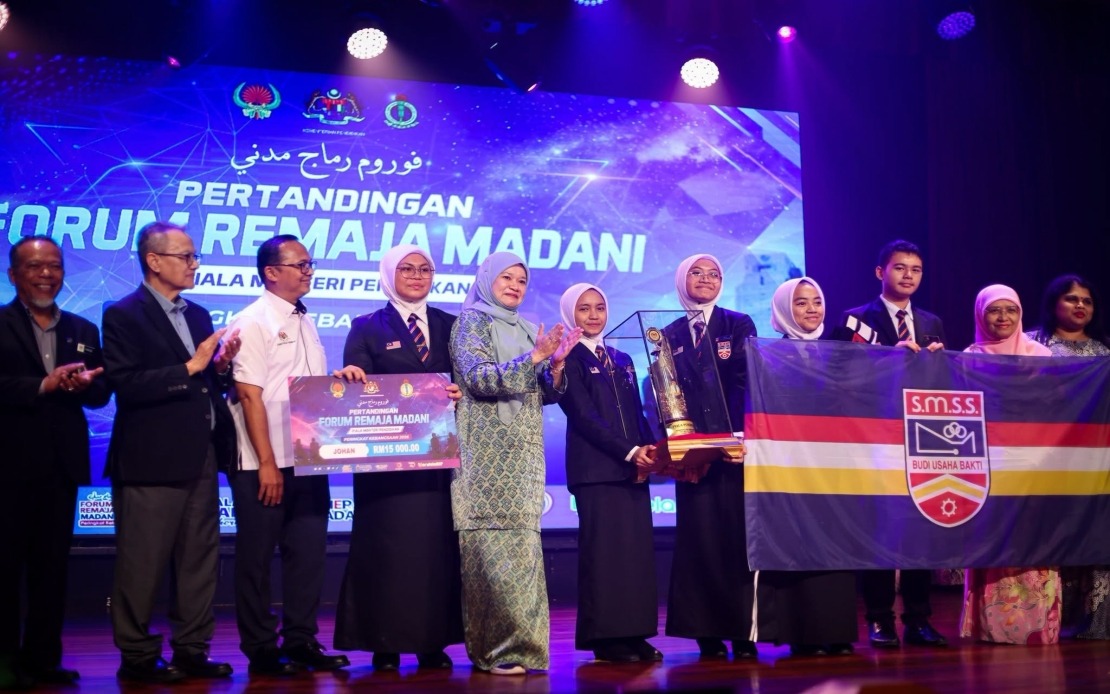
Education Minister Fadhlina Sidek has articulated a vision for Malaysian character education centred on developing young people's capacity to articulate their perspectives with confidence while maintaining respect for divergent opinions. Speaking at the National MADANI Youth Forum, Fadhlina underscored that the pedagogical approach should nurture not merely compliant citizens but engaged thinkers capable of substantive public discourse.
The minister's remarks reflect a deliberate pivot toward fostering intellectual independence among the younger generation. Rather than adopting a directive stance that prescribes what students should believe, her proposed framework emphasises equipping them with the analytical tools and communicative skills necessary to construct evidence-based arguments and defend their positions rigorously. This approach represents a shift from rote learning toward developing cognitive competencies that prepare citizens for participation in an increasingly complex, contested public sphere.
Fadhlina's emphasis on respectful disagreement carries particular resonance in the Malaysian context, where social cohesion and intercommunal harmony remain defining national preoccupations. The tension between encouraging candid expression and maintaining social equilibrium has long challenged Malaysian policymakers. Her formulation—that mature nations are built not on universal agreement but on populations that understand how to navigate disagreement constructively—offers a conceptual resolution to this longstanding dilemma. It suggests that fostering genuine pluralistic discourse strengthens rather than threatens national stability.
The minister explicitly linked character education to Malay language promotion, contending that strengthening the national language requires creating institutional spaces where young people utilise Malay as a vehicle for expressing contemporary ideas. This positioning reframes language policy beyond nostalgic or nationalist concerns, situating it instead within a functional framework where linguistic competence enables substantive participation in civic life. When the younger generation perceives Malay as a dynamic instrument capable of articulating sophisticated thought, rather than an antiquated relic, adoption and retention naturally accelerate.
Fadhlina's observations at the forum highlight a recognition that character development transcends moral instruction or ethical platitudes. Instead, it encompasses the practical capacity to listen actively, acknowledge legitimate counterarguments, and modify positions when presented with compelling evidence. These meta-cognitive and interpersonal competencies constitute the foundation for a functioning democratic culture, where disagreement becomes a mechanism for refining collective understanding rather than a threat to social order.
The challenge embedded in the minister's position concerns implementation. Educational systems worldwide have historically struggled to translate democratic aspirations into classroom practice. Teachers often face institutional pressures to standardise responses and prioritise examination outcomes over exploratory learning. In the Malaysian context, where examination-driven education remains entrenched, cultivating the critical autonomy that Fadhlina envisions requires substantial pedagogical recalibration, curriculum redesign, and teacher retraining. Her statements suggest awareness of these objectives, but translating vision into systemic change demands sustained institutional commitment and resource allocation.
The National MADANI Youth Forum itself signals governmental attention to youth engagement and development. The Forum's architecture, in which young people present and defend positions before official audiences, creates tangible opportunities for practising the articulation and respectful contestation that Fadhlina advocates. However, scaling such initiatives across Malaysia's diverse educational ecosystem—encompassing urban and rural schools, vernacular institutions, and socioeconomically disparate communities—presents logistical and conceptual obstacles that require deliberate policy intervention.
Fadhlina's remarks also implicitly acknowledge that consensus-seeking governance, whilst superficially harmonious, may mask underlying tensions and forecclose the possibility of genuine deliberation. Her contention that a mature nation accommodates structured disagreement suggests a sophisticated understanding of democratic pluralism. This perspective stands in contrast to governance approaches that privilege social calm over authentic engagement, or that construe critical questioning as destabilising dissent rather than productive inquiry.
The linkage between language proficiency and democratic participation deserves particular consideration for Malaysia. As English increasingly dominates global discourse, ensuring that Malay retains utility for expressing abstract, technical, and political ideas sustains cultural distinctiveness and ensures that future citizens can engage meaningfully in national conversations conducted in their linguistic heritage. Fadhlina's framework positions language policy not as cultural preservation but as a prerequisite for informed citizenship.
Looking forward, the implementation of Fadhlina's vision will require coordinated action across multiple institutional domains. Curriculum frameworks must allocate space for deliberative exercises, debate, and collaborative problem-solving. Assessment mechanisms should evaluate not merely factual recall but argumentative coherence and intellectual flexibility. Teacher professional development must equip educators to facilitate rather than dominate classroom discourse. Institutional cultures within schools need to reinforce the legitimacy of questioning and respectful dissent.
The minister's statements ultimately articulate a normative vision of Malaysian citizenship grounded in intellectual engagement and interpersonal respect. Whether this vision gains traction within educational institutions and translates into observable changes in how young Malaysians approach public discourse and civic participation will significantly shape the nation's democratic trajectory in coming decades. The challenge now lies not in articulating aspirations but in building the institutional capacity to realise them consistently across Malaysia's heterogeneous educational landscape.

