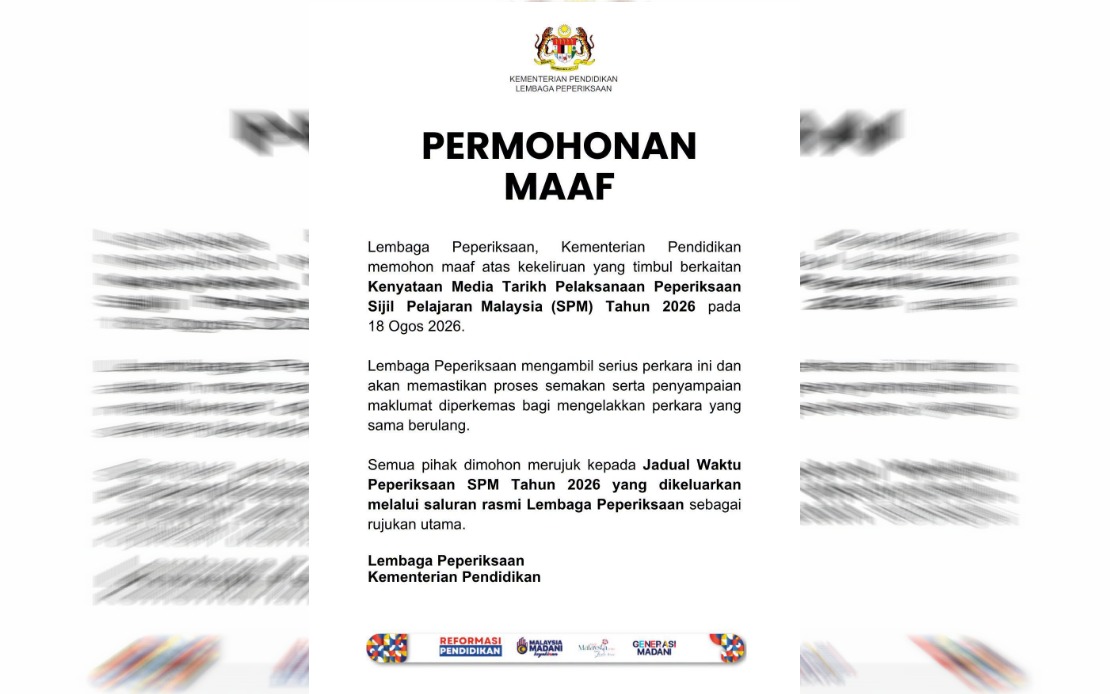
The Examination Board under Malaysia's Ministry of Education has issued an apology for the confusion generated by an incorrect press release distributed yesterday regarding the implementation dates of the 2026 Sijil Pelajaran Malaysia (SPM) examination. The board released a clarification statement today, acknowledging that the administrative error has created unnecessary uncertainty among stakeholders including students, parents, educators, and school administrators who rely on accurate official communications for planning purposes.
In addressing the mistake, the Examination Board emphasised that the matter has been treated with appropriate gravity within the ministry. Officials indicated that a comprehensive review of both the information verification processes and the channels through which examination-related announcements are distributed will be undertaken to minimise the likelihood of similar incidents occurring in the future. This commitment suggests recognition that the credibility of official educational communications is paramount, particularly when they affect nearly half a million students across the country.
The board has directed all stakeholders to consult the official 2026 SPM Examination Timetable released through the Examination Board's verified communication channels as the authoritative reference document. This guidance is crucial for schools and students seeking definitive information about examination schedules, centres, and administrative procedures. The emphasis on official channels underscores a broader institutional effort to combat misinformation and ensure that educational calendars and schedules rely on primary sources rather than secondary interpretations or circulated versions that may contain errors.
The scale of the 2026 SPM examination is substantial, with preliminary registration figures indicating that 420,879 candidates have enrolled to sit for the qualification across 3,334 examination centres nationwide. These numbers reflect the SPM's continued significance as the primary national secondary school qualification in Malaysia, serving as a critical milestone for students completing their secondary education and transitioning toward tertiary studies or vocational training pathways.
The examination itself is scheduled to commence on November 23 and conclude on December 17, providing a structured four-week testing window during which candidates will complete papers across various subjects. This timeframe is carefully designed to balance the comprehensive assessment requirements of a national examination with practical considerations regarding school calendars, resource allocation, and the management of multiple examination sessions across geographically dispersed centres.
For Malaysian students and their families, the significance of accurate SPM scheduling cannot be overstated. The examination period falls during the latter part of the calendar year, necessitating careful coordination with school holiday arrangements, tuition schedules, and family planning. Students typically intensify their revision efforts in the months preceding the examination, and clear communication about exact dates allows schools to optimise their teaching schedules and revision timetables accordingly.
The administrative episode also highlights the operational complexity involved in managing a national examination of this magnitude. With over 420,000 candidates spread across thousands of schools nationwide, the logistics of scheduling, invigilating, and administering the SPM requires meticulous coordination between the ministry, examination boards, schools, and state education departments. A single error in communications can cascade through this entire system, potentially causing confusion at multiple institutional levels.
For schools and educators, clarity regarding examination dates is operationally essential. Teachers must structure their curriculum delivery to ensure all content is covered before the examination period begins, and administrators must arrange examination halls, recruit and train invigilators, and coordinate with the examination board regarding logistics and compliance procedures. Any uncertainty about dates can disrupt these preparations and create inefficiencies across the educational system.
The commitment to streamlining information delivery processes represents a positive step toward institutional improvement. Educational systems across Southeast Asia increasingly recognise that transparent, timely, and accurate communication serves not merely administrative functions but also reinforces public confidence in educational institutions and government bodies responsible for certification and assessment. When official communications contain errors, the broader credibility of institutional announcements may be compromised, affecting future compliance and stakeholder engagement.
The incident also serves as a reminder of the importance of verification protocols within government communications. In an era of rapid information dissemination through multiple channels and platforms, ensuring that official press releases undergo rigorous fact-checking before release becomes increasingly critical. A single error in a document addressing national examinations can spread rapidly through schools, media channels, and social platforms, making correction efforts more challenging and time-consuming.
Moving forward, students and parents preparing for the 2026 SPM should prioritise obtaining examination information directly from the Examination Board's official website and verified announcements rather than relying on informal channels or secondary sources. Schools have similarly been advised to base their administrative planning on the official examination timetable, ensuring consistency across educational institutions nationwide. This approach protects candidates and educators alike from being disadvantaged by misinformation.

