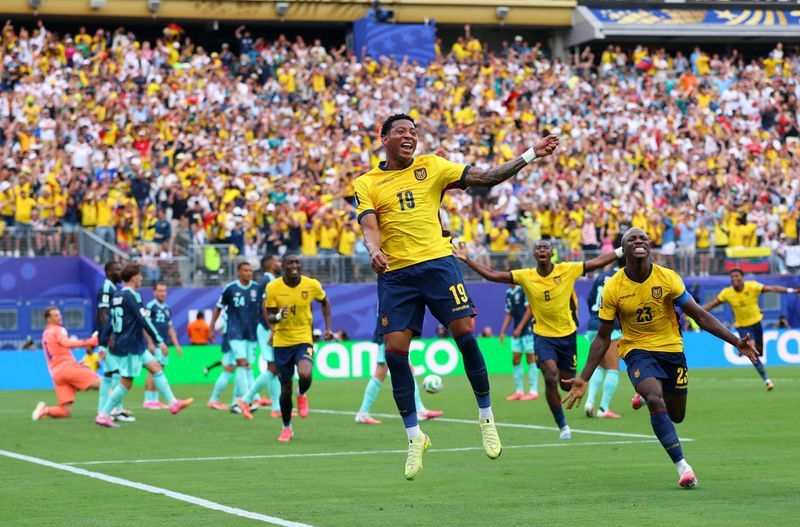
Ecuador pulled off a dramatic upset to eliminate their fears and advance to the World Cup knockout round, defeating Germany 2-1 in their decisive Group E clash on Thursday at the sold-out stadium in East Rutherford, New Jersey. The result was nothing short of miraculous for the South American side, who had arrived at the fixture facing potential elimination after disappointing results in their opening matches. With qualification hanging by a thread, Ecuador conjured a remarkable turnaround to secure one of the eight available berths reserved for the best-performing third-place teams across all groups.
The opening moments could scarcely have been grimmer for Ecuador's prospects. Germany, already assured of progressing as group winners, struck with devastating efficiency when Leroy Sane collected the ball inside the penalty area in the second minute, finishing left-footed after Florian Wirtz picked him out following a quick throw-in. The goal represented Sane's maiden World Cup strike across 15 previous appearances at major international tournaments, a statistic that underscored how rapidly the match had turned against Ecuador. However, Ecuador lodged a protest that Aleksandar Pavlovic had raised his foot dangerously high and struck Pedro Vite in the head during the buildup, though referee Tori Penso allowed the goal to stand.
The Ecuador response came swiftly and with purpose. Despite arriving at this tournament plagued by an inability to convert chances—having recorded 39 unsuccessful attempts without a goal—they found the breakthrough at their 40th shot. Nilson Angulo curled a precise finish beyond goalkeeper Manuel Neuer from the edge of the box just seven minutes after conceding, sparking jubilant scenes among the sea of yellow-clad supporters filling the arena. The goal represented a watershed moment for Ecuador's attacking play and rekindled hope that their campaign could yet be salvaged.
The second half opened with further controversy when Penso awarded Germany a penalty after Felix Nmecha played in Kai Havertz, who appeared to tumble under a challenge from Joel Ordonez. The decision sent Ecuador's hopes into temporary freefall, but a VAR intervention proved decisive. The technology revealed that Germany had committed a foul during the buildup phase, prompting the referee to overturn his original decision and restore equilibrium to the contest. This crucial intervention proved pivotal, as Germany would not be afforded another penalty attempt.
Gonzalo Plata delivered the decisive blow with thirteen minutes remaining, reacting with alertness after Kevin Rodriguez flicked on a corner at the near post. Plata stabbed the ball past the sprawling Neuer to send the stadium into pandemonium. Ecuador had snatched an unlikely victory from the jaws of defeat, transforming their World Cup narrative entirely through determined football and clinical finishing when opportunities presented themselves.
Germany's elimination as group winners—despite the defeat—illustrated the tournament structure's nuances. The European side finished atop Group E with six points, having won two matches, while the Ivory Coast advanced as runners-up on goal difference following their 2-0 dismantling of Curacao. Germany's unbeaten record of twelve consecutive victories came to an abrupt end, though they secured top spot nonetheless. Their defensive shortcomings remained exposed throughout the group phase, having conceded in all three matches, raising questions about vulnerabilities that could prove costly in knockout football.
Ecuador's journey through the group stage had been precarious from the outset. Following an initial defeat to the Ivory Coast and a subsequent stalemate with Curacao, they arrived at this final fixture knowing that only victory would preserve their tournament life. The pressure bearing down on the South American outfit was immense, yet they responded with composure and character when it mattered most. Their ability to overcome a lightning-quick deficit and maintain composure despite defensive frailties demonstrated resilience that suggests they may yet prove troublesome opponents in the knockout phase.
For Malaysian and Southeast Asian observers, Ecuador's triumph carries relevance beyond the immediate result. The match exemplified how tournament football can deliver unexpected outcomes when teams commit fully to attacking intent despite adverse circumstances. Ecuador's breakthrough in scoring, after such prolonged barrenness in front of goal, reflected their desperation and willingness to take calculated risks. Their progression offers a cautionary tale for established heavyweights that group-stage success demands consistency and attention to detail throughout, as defensive lapses can be ruthlessly punished by opponents with tactical flexibility and clinical finishing.
The victory also underscored VAR's role in contemporary football governance, as the technology's intervention to overturn the penalty decision proved instrumental in Ecuador's advancement. While refereeing decisions remain contentious, the intervention prevented what could have been a tournament-altering moment. Germany's inability to capitalize on that opportunity, combined with their defensive vulnerabilities throughout the group phase, suggested that advancement to the knockout stage alone would not guarantee deep tournament progress. The continental divide in football quality continues to narrow, as demonstrated by Ecuador's ability to extract a result against one of Europe's traditional powerhouses.

