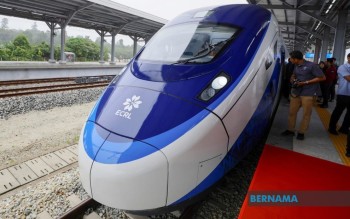
The East Coast Rail Link represents far more than a transportation upgrade for Malaysia's eastern corridor. According to Deputy Minister of Economy Datuk Mohd Shahar Abdullah, the megaproject is fundamentally reshaping the region's economic foundation by creating an integrated ecosystem that will enable small and medium enterprises to compete on a national scale. Speaking recently in Kuantan, he emphasised that the infrastructure development extends beyond mere connectivity, reaching into the supply chain architecture that underpins modern commerce.
Central to the ECRL's potential is its transit-oriented and cargo-focused development model. Rather than simply connecting cities with rail tracks, the project creates purpose-built zones for warehousing, industrial parks, and logistics hubs along its route through Pahang, Terengganu, Kelantan, and Selangor. This deliberate spatial planning transforms the rail line into what economists call a "development spine"—a backbone infrastructure that attracts complementary investment and business clustering. Mohd Shahar, who represents Paya Besar in Parliament, outlined how these peripheral developments will generate commercial opportunities that ripple through multiple economic sectors simultaneously.
The cost-of-logistics dimension represents perhaps the most immediate advantage for regional entrepreneurs. By dramatically reducing transportation expenses and delivery timeframes compared to road-based alternatives, the ECRL enables smaller producers to access markets previously uneconomical to serve. For a manufacturer in Terengganu or Kelantan, the ability to ship products to Selangor or beyond at substantially lower unit costs fundamentally alters competitive positioning. This transportation efficiency gain translates into tangible business advantages: companies can either reduce prices while maintaining margins, or maintain prices while improving profitability—both scenarios strengthen market competitiveness.
Scaling production becomes genuinely viable through expanded market reach. Mohd Shahar articulated this production-volume dynamic compellingly: the difference between manufacturing 10,000 units and 20,000 units creates economies of scale that make prices more competitive across the board. Regional enterprises currently constrained by geographical limitations now face genuinely national markets. A batik producer or handicraft manufacturer in the East Coast is no longer restricted to local or proximate consumers; they can now economically access metropolitan demand centres. This geographic freedom operates as a multiplier effect throughout supply chains, encouraging investment in larger production facilities and more efficient manufacturing processes.
The supply-chain ecosystem extends beyond final-product delivery. The ECRL project itself generates employment and business opportunities across construction, operations, and ongoing maintenance phases. These sectors employ not only large contractors but also numerous smaller service providers, transporters, and material suppliers. Additionally, the industrial parks and warehousing facilities emerging along the ECRL corridor create permanent commercial infrastructure that supports diverse business types—from e-commerce fulfillment centres to agricultural processing plants to manufacturing hubs.
Tourism represents another significant secondary benefit that multiplies through the regional economy. Improved rail connectivity makes East Coast destinations more accessible to domestic and international visitors. This accessibility increase benefits not only major hospitality operators but particularly micro-entrepreneurs: food stall owners, handicraft artisans, small guesthouse operators, and local product manufacturers capitalise on elevated visitor volumes. The tourism multiplier effect supports these businesses directly while also stimulating demand for supporting services and supplies.
Yet realising this potential requires entrepreneurial adaptation beyond simply waiting for the infrastructure to arrive. Mohd Shahar cautioned business operators that infrastructure alone is insufficient; successful companies must evolve their operational models to leverage emerging technologies and digital platforms. This modernisation imperative encompasses e-commerce integration, supply-chain visibility systems, digital marketing, and customer-relationship management tools. The ECRL removes geographical barriers, but only digitally-equipped businesses will fully capitalise on national market exposure. Traditional business models relying solely on local relationships and established patterns become increasingly vulnerable as competitors gain access to the same expanded markets.
The project's advancement trajectory demonstrates tangible progress toward these opportunities. The Pahang segment has achieved 97.33 per cent completion, while the overall megaproject reached 93.66 per cent progress as of April, with December completion scheduled. This timeline means the practical benefits—functioning rail services, operational logistics facilities, active industrial zones—transition from planning documents to operational reality within months. Businesses positioned to leverage these capabilities immediately upon opening will capture first-mover advantages in emerging regional supply chains and distribution networks.
For Malaysian policymakers and regional observers, the ECRL exemplifies infrastructure-led economic development strategy. Rather than relying solely on foreign direct investment or centralised wealth concentration in Klang Valley, the project deliberately extends productive capacity and market access to peripheral regions. This geographic redistribution strengthens national resilience by diversifying economic activity, reducing infrastructure strain in already-congested areas, and activating underutilised human and natural resources across the East Coast. Southeast Asian neighbours also observe these patterns; successful infrastructure deployment correlates with investment confidence and talent retention in peripheral regions.

