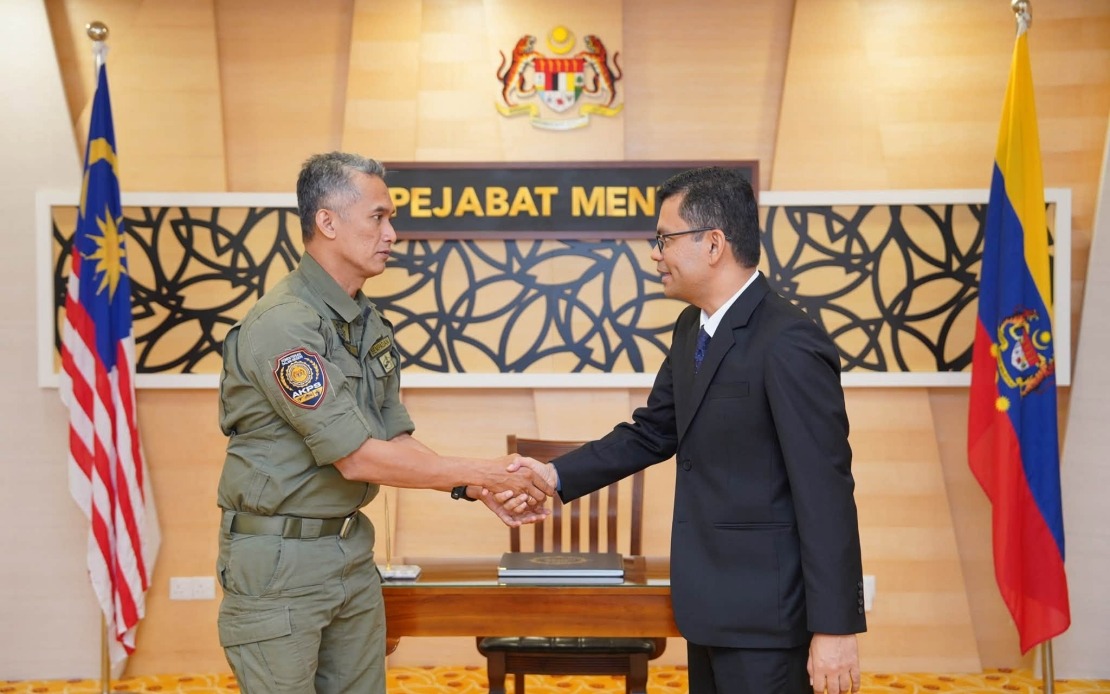
The Economy Ministry and Malaysia's Border Control and Protection Agency (AKPS) have begun mapping out a comprehensive strategy to fortify the nation's border infrastructure and capabilities, with discussions centred on securing adequate development budgets and deploying cutting-edge technology systems. During a meeting in Putrajaya between Economy Minister Akmal Nasrullah Mohd Nasir and AKPS director-general Datuk Seri Mohd Shuhaily Mohd Zain, officials outlined how structured investment and strategic planning could enhance both border security and the efficiency of Malaysia's critical trade gateways.
The initiative addresses a fundamental restructuring that took effect on January 1, 2025, when AKPS commenced operations as a unified border management authority. This consolidation represents a significant shift in how Malaysia handles cross-border control, merging enforcement functions that previously operated independently across six government agencies: the Immigration Department, the Royal Malaysian Customs Department, the Malaysian Quarantine and Inspection Services Department, the Health Ministry, the Department of Wildlife and National Parks, and the Road Transport Department. By consolidating these disparate operations under single command, Malaysia aims to eliminate overlapping jurisdictions and communication delays that historically complicated border processing.
The strategic conversation between the two bodies reflects a recognition that Malaysia's economic competitiveness depends substantially on how smoothly goods and people move across entry points. When border procedures become congested or inefficient, supply chains stall and trade corridors lose attractiveness to international partners. For a nation as dependent on trade as Malaysia—with total trade exceeding RM3 trillion annually—even marginal improvements in border throughput translate into substantial economic gains. The Economy Ministry's involvement signals that border management is now treated as an economic infrastructure priority rather than purely a security matter.
Technology deployment forms a cornerstone of AKPS's modernisation agenda. The agency is prioritising development of smart border systems centred on integrated biometric identification, automated cargo scanning platforms, and real-time data analytics powered by artificial intelligence. These systems would allow border officers to process travellers and shipments faster while simultaneously enhancing detection capabilities for contraband, forged documents, and security threats. For Malaysian traders, such systems promise reduced waiting times at checkpoints; for regional partners, they offer confidence in Malaysia's border integrity and professional standards.
The infrastructure dimension of the strengthening plan encompasses physical upgrades at entry points nationwide. Border gates and customs facilities, some of which date back decades, require modernisation to handle contemporary trade volumes and technological systems. Enhanced facilities at land borders with Thailand, improved ports of entry, and upgraded airport infrastructure all demand significant capital investment. The discussions between the Economy Ministry and AKPS centre on determining the appropriate budget allocations to finance these upgrades systematically across Malaysia's network of entry points.
Human resource capacity emerges as a critical but often overlooked component of effective border management. AKPS must recruit, train, and retain skilled personnel capable of operating sophisticated technology platforms while maintaining the interpersonal and investigative skills necessary for frontline border work. Mohd Shuhaily's emphasis on enhancing human resource capacity reflects understanding that even advanced systems depend on competent operators. Building institutional knowledge and establishing professional standards across the merged agency requires sustained attention to workforce development and career progression.
For Southeast Asian economies and trading partners, Malaysia's border strengthening carries implications beyond domestic borders. As a regional hub for trade and logistics, Malaysian ports and land crossings serve as gateways for goods moving throughout the region. When Malaysia improves border efficiency, the benefits cascade across neighbouring countries through faster regional trade flows. Conversely, when Malaysian checkpoints experience congestion, the delays ripple across supply chains serving Thailand, Singapore, Indonesia, and beyond. This regional interdependence means AKPS's success or failure affects economic performance across multiple nations.
The consolidation of border functions under AKPS also addresses historical fragmentation that sometimes compromised effectiveness. When immigration officers, customs agents, health inspectors, and quarantine officials operated under separate command structures and reporting hierarchies, coordination challenges inevitably arose. A traveller might clear immigration only to be held up by customs, then again by quarantine officials—each delay reflecting institutional separation rather than genuine security requirements. AKPS's unified command structure enables integrated decision-making and reduces unnecessary friction in the clearance process.
The timing of this initiative carries significance given Malaysia's broader economic trajectory. As the nation pursues greater trade diversification and seeks to strengthen its position as a reliable supply chain partner amid global geopolitical tensions, demonstrating border competence becomes strategically valuable. Countries and companies selecting production and logistics bases consider border reliability among their infrastructure evaluation criteria. A Malaysian border system operating with modern efficiency becomes a competitive advantage in attracting foreign investment and securing trade partnerships.
Beyond pure efficiency metrics, the integration and technological advancement signal Malaysia's commitment to professional governance at its international boundary. The shift from fragmented, agency-specific approaches to coordinated, technology-enabled border management reflects evolving international standards for how modern nations manage their frontiers. International trade partners increasingly expect compatible systems, shared data protocols, and professional standards that facilitate legitimate commerce while effectively countering smuggling, human trafficking, and security threats.
The Economy Ministry's formal engagement with AKPS's development planning also indicates recognition that border management directly influences national economic resilience. In an era of supply chain fragility exposed by recent global disruptions, the ability to maintain open, efficient borders during crises becomes strategically important. AKPS's development plan appears designed to create border infrastructure and systems capable of handling both routine operations and emergency scenarios—whether pandemic-related health screening, natural disaster logistics, or other contingencies.
Moving forward, the effectiveness of this border strengthening initiative will be measured not merely by budget allocations secured but by measurable improvements in clearance times, cargo throughput, traveller satisfaction, and security outcomes. The discussions between the Economy Ministry and AKPS represent initial planning; execution will require sustained commitment across multiple government levels and years of systematic implementation. For Malaysian traders and international partners, the ultimate test will arrive at the border gates themselves.

